
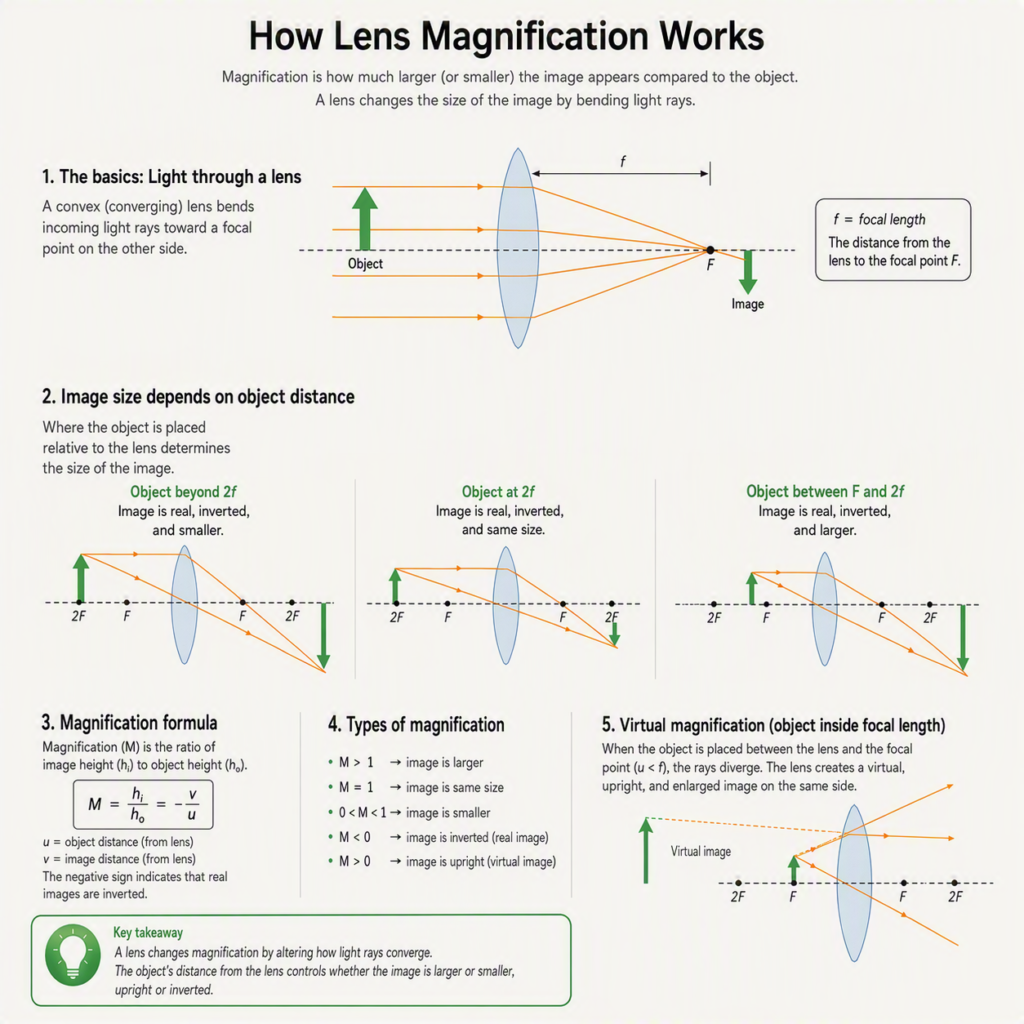
Here is a clear breakdown of how lens magnification works, from the basic physics to the practical photography terms.
1. The Fundamental Physics: It’s All About AnglesAt its core, a lens doesn’t actually “magnify” an object like a microscope does. Instead, it changes the angle of view.Imagine looking at a mountain.
With your naked eye, you see a wide scene. If you put a lens in front of your eye, the lens bends (refracts) the light rays coming from the mountain so that they take up a larger portion of your retina. The lens isn’t making the mountain bigger; it’s narrowing the angle of view so the mountain fills more of your vision.
2. The Three Key FactorsMagnification in a lens is determined by three things:· Focal Length (f): This is the distance (in mm) from the lens to the sensor when focused on infinity.
A longer focal length (e.g., 200mm) gives a narrower angle of view and higher magnification. A shorter focal length (e.g., 24mm) gives a wider view and lower magnification.· Distance to Subject (d): The closer you are, the larger the subject appears. Magnification is a ratio of the image size on the sensor to the actual subject size.· Sensor Size: This doesn’t change the lens’s magnification, but it changes the field of view. A smaller sensor (like APS-C) captures only the center of the image circle, making it appear more magnified (this is called crop factor).
3. The Magnification Formula (For Close-Up Work)For macro photography, magnification is expressed as a ratio (e.g., 1:1, 1:2, 2:1).Magnification (M) = Image Size on Sensor / Actual Subject Size· 1:1 (Life Size): A 10mm insect projects a 10mm image on the sensor.· 1:2 (Half Life Size): A 10mm insect projects a 5mm image.· 2:1: A 5mm insect projects a 10mm image (2x magnification).You can calculate this with:M = f / (d – f)(Where f is focal length and d is distance from lens to subject)
4. How Zoom Lenses WorkA zoom lens changes its effective focal length by moving lens elements inside the barrel.· Wide (e.g., 24mm): Light rays are bent gently. The image circle is large, so you see a wide scene.· Telephoto (e.g., 200mm): Light rays are bent more sharply. The image circle is smaller, so you see a narrow, magnified slice of the scene.Important: Zooming does not change perspective. If you stand in the same spot and zoom in, the background appears to compress (larger relative to the foreground), but that’s just because you’re cropping into a smaller area.
5. Magnification vs. ResolutionA common misconception: More magnification ≠ More detail.· If you magnify an image digitally (cropping), you lose resolution.· If you magnify optically (with a longer lens), you preserve resolution because you’re using more of the sensor’s pixels to capture that specific area.· However, every lens has a resolution limit (diffraction). Beyond a certain point (e.g., f/22), magnifying further just makes the image blurrier, not more detailed.6.
Practical Examples· Bird Photography: A 600mm lens on a full-frame camera gives high magnification, filling the frame with a small bird.· Macro Photography: A 100mm macro lens at 1:1 magnification lets you fill the frame with a coin.· Smartphone:
Tiny lenses with short focal lengths. They use digital zoom (cropping) for “magnification,” which degrades quality. Optical zoom on phones uses multiple physical lenses.SummaryLens magnification is the result of focal length narrowing the angle of view, projecting a larger image of the subject onto the sensor.
For close-ups, it’s a ratio of sensor image size to real-life size. Zoom lenses change focal length mechanically, while sensor size affects the field of view, not the true magnification.