
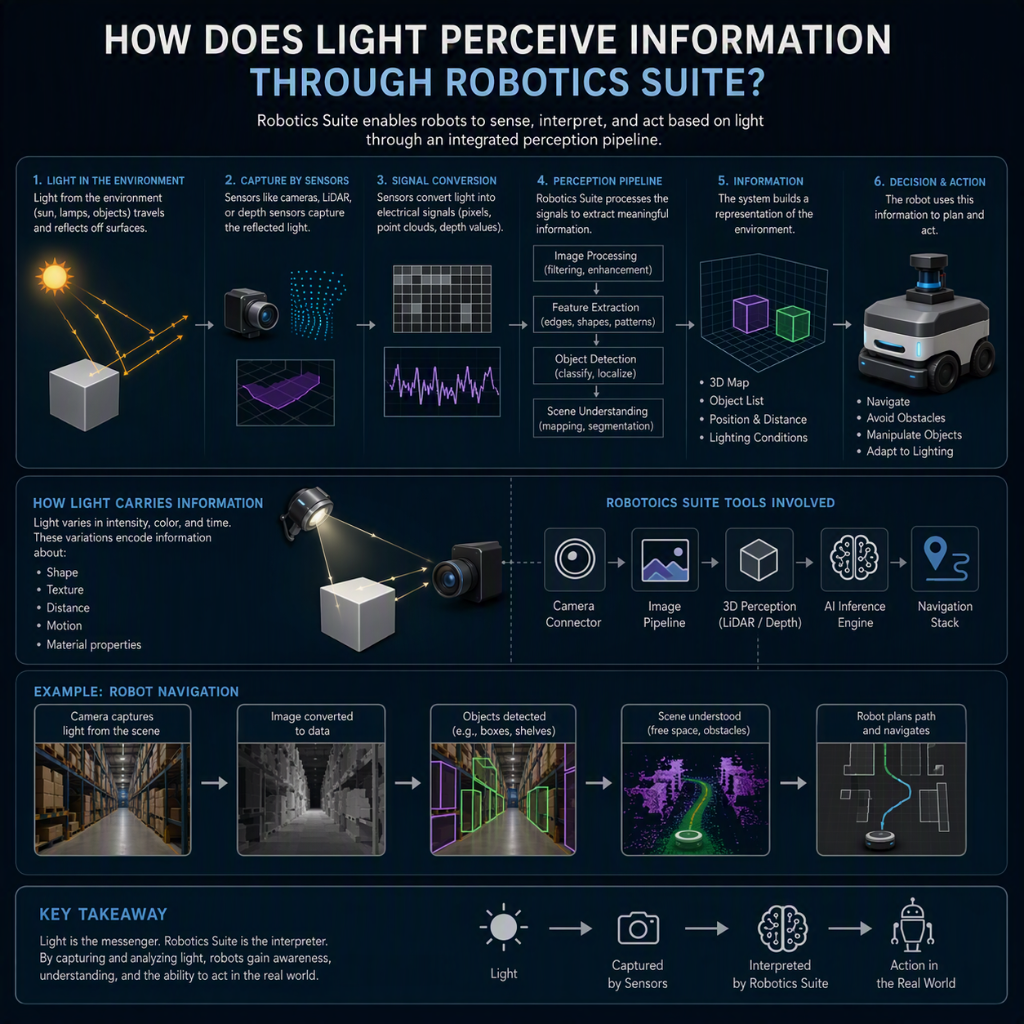
In a robotics suite, light doesn’t “perceive” information on its own—it carries raw physical data that the robotic system interprets. The process works like this:💡
1. Light as an Information CarrierLight is electromagnetic radiation. When it hits an object, it changes in predictable ways:· Reflects off surfaces· Absorbs into materials· Scatters depending on texture· Refracts through transparent objects· Emits from active sources (LEDs, lasers)Each change carries information about the object’s:· Shape· Distance· Color· Material· Surface roughness· Motion📷
2. Sensing: Converting Light to DataThe robotics suite uses sensors to capture light and convert it into electrical signals:· Cameras (2D): Capture intensity and color. Each pixel becomes a number representing brightness and RGB values.· Depth Cameras (3D): Use time-of-flight (measuring how long light takes to return) or structured light (projecting patterns) to calculate distance per pixel.· LiDAR: Fires laser pulses and measures return time to build precise 3D point clouds.· Spectrometers: Measure wavelength distribution to identify materials.· Photodiodes: Detect simple presence/absence of light for triggering.🧠
3. Processing: Making Sense of Light DataRaw sensor data is meaningless without interpretation. The robotics suite processes it through:· Image Processing: Filtering, edge detection, contrast enhancement.· Computer Vision Algorithms: Object detection (YOLO, R-CNN), segmentation, feature matching.· Deep Learning: Neural networks trained to recognize patterns—faces, defects, tools, obstacles.· Sensor Fusion: Combining camera + LiDAR + IMU data to build a unified model of the environment.🔄
4. Perception: Building a World ModelThis is where “perception” actually happens. The system creates an internal representation:· Where objects are (position, orientation)· What they are (classification)· How they’re moving (tracking)· What they’re made of (material inference)· How they relate to each other (spatial reasoning)🦾
5. Action: Closing the LoopPerception drives decision-making:· Pick and place: Robot identifies object, calculates grasp point, moves arm.· Quality inspection: System detects defect from visual pattern.· Navigation: Robot maps obstacles from depth data and plans path.· Assembly: Vision guides sub-millimeter alignment.🧩 The Full Pipeline“`Light → Object Interaction → Sensor Capture → Signal Conversion → Data Processing → AI Interpretation → World Model → Decision → Robot Action → Feedback Loop“`🔬 Key InsightLight itself is passive information. The robotics suite actively interrogates light by:· Controlling illumination (structured light, lasers)· Choosing sensor types· Applying algorithms· Learning from outcomesSo the real answer: Light carries information, sensors capture it, algorithms interpret it, and the robot acts on it. The “perception” is a computational construct, not a property of light itself.
YOU CAN SEARCH MORE ABOUT on google LIKE HOW…!
Would you like to go deeper into a specific sensing method, like structured light or LiDAR?