
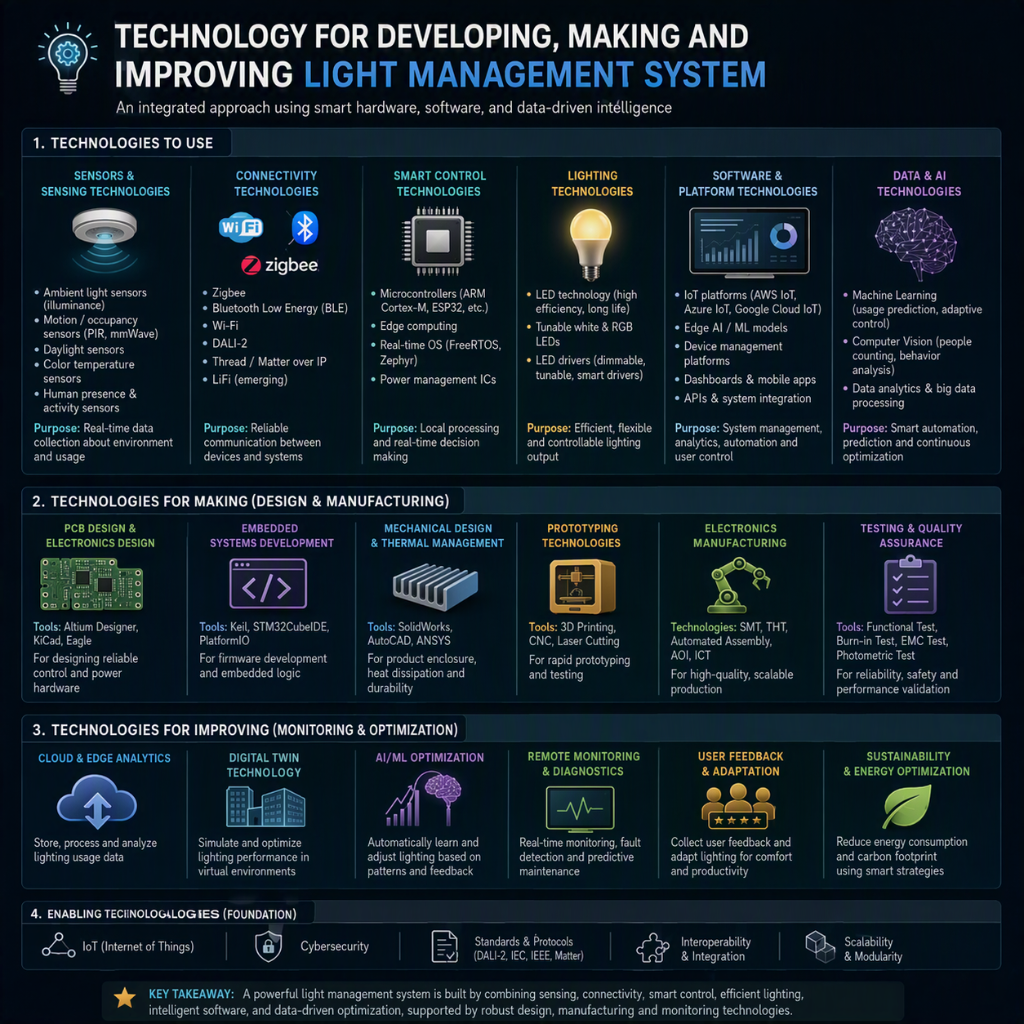
Based on the search results, here are the key technologies used to build an intelligent light-improving system.💡
Machine Learning & Adaptive Control The core of modern intelligent lighting is its ability to learn and adapt. A Machine Learning (ML) driven system can dynamically adjust artificial light levels and color temperature based on ambient daylight or user preferences. For instance, a system using linear regression can train on collected data to produce the desired Correlated Color Temperature (CCT).
More advanced approaches use Reinforcement Learning (RL) to generate optimal spectrum policies, considering factors like color rendering index (CRI) and circadian rhythm promotion.🔄 Closed-Loop Control & FeedbackTo maintain precise lighting, a closed-loop control system is essential.
It continuously senses the environment and provides feedback to stabilize illumination despite fluctuations in natural daylight. A typical implementation uses a PID controller, where algorithms like Genetic Algorithms (GA) can automatically tune the PID parameters to adapt to nonlinear and dynamic conditions. The system can also include a feedback signal representative of the light’s properties to maintain the illumination spectrum matched to a target.📡 Multi-Sensor Data FusionAn intelligent system relies on multiple sensors to understand its environment. Data from an ambient light intensity sensor, temperature and humidity sensor, human body sensor (infrared), and air quality sensor can be fused using a weighted average algorithm. This creates a comprehensive environmental state evaluation. A Support Vector Regression (SVR) model can then predict user illumination needs based on historical behavior and real-time data.🎨
Dynamic Spectrum & Color Tuning To achieve the right light quality, the system must control its spectral output. This is done by mixing the emissions of warm white and cool white LEDs, with the intensity of each controlled individually using Pulse-Width Modulation (PWM) signals. By adjusting the LED driving current, the system can shift the color temperature—for example, to a warm tone in cooler environments or a cool tone in warmer ones—to match the environment and user needs.🔬
Advanced Optical & Hardware TechnologiesFor high-precision applications, specialized hardware is required. In automotive lighting, Digital Micromirror Device (DMD) technology uses a chip with over 1 million individually controllable micromirrors to precisely shape the light beam, enabling features like glare-free high beam and road projections. Similarly, Laser-Assist LED systems combine lasers with LEDs to increase output brightness and enable adaptive driving beam (ADB) functionality.
For machine vision, a hybrid-dimming control method can simultaneously control current intensity and on-time to avoid light saturation and capture clearer images.In short, an effective intelligent lighting system is a fusion of adaptive algorithms (ML, RL), precise control loops (PID, GA), multi-sensor fusion, and advanced optical hardware to deliver optimal, context-aware illumination.
You can search more about like…!
Would you like to dive deeper into the machine vision aspect or the automotive lighting technology?