
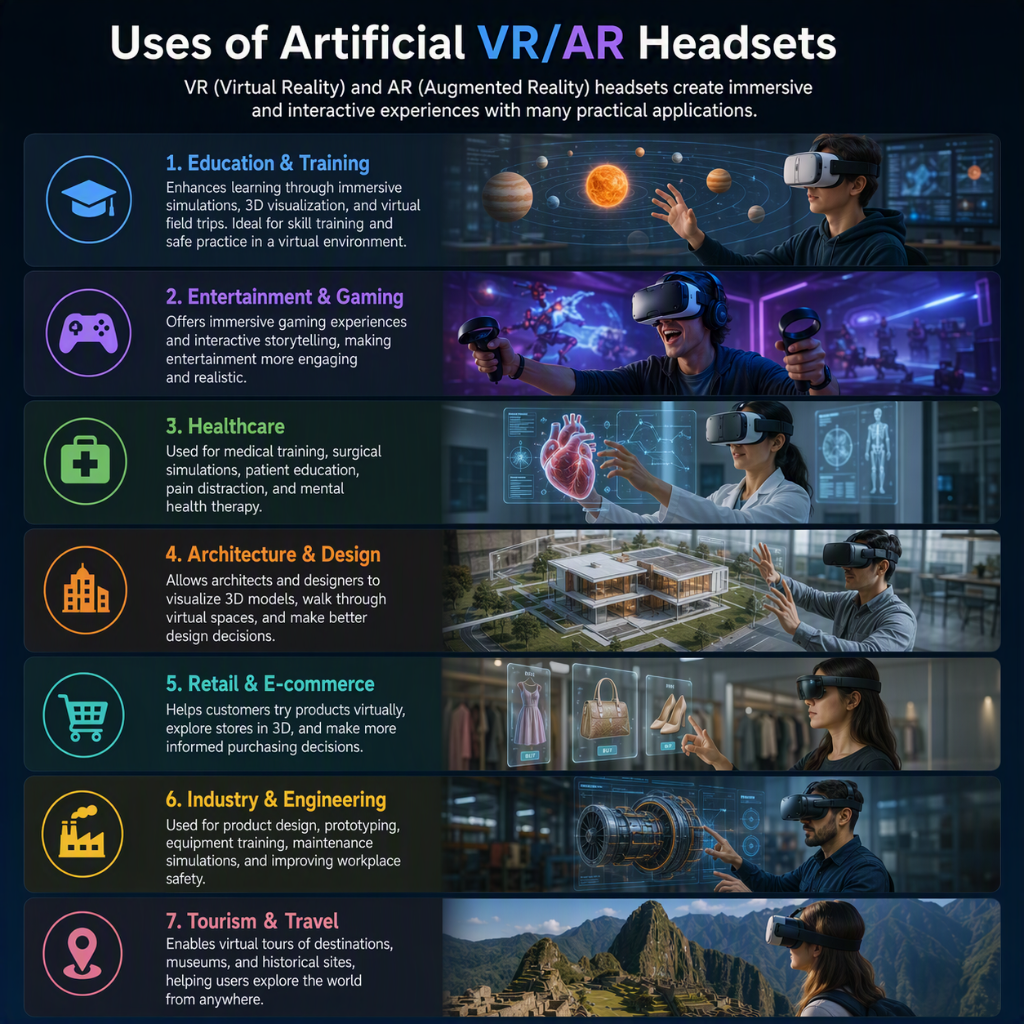
Artificial VR/AR headsets are primarily used to overlay digital intelligence onto the real world, transforming how people work, learn, and interact. Their core value is delivering context-aware information and guidance without requiring you to look away at a screen.🏭 Professional & Industrial TrainingThis is one of the most mature applications. Headsets create safe, repeatable environments for high-stakes skills.· Surgical & Medical Training: Doctors train on AI-generated virtual patients that react in real-time.
If a mistake is made, the system simulates consequences like bleeding or vital changes, offering a “quiet guidance layer” to correct technique without risking real lives.· Industrial & High-Risk Safety: Workers practice rare, dangerous scenarios (like nuclear reactor coolant failures or chemical plant emergencies) repeatedly. The AI varies each simulation so people learn to react, not just memorize steps.· Enterprise Productivity: Technicians can pull up interactive, on-screen instruction guides that appear alongside real-world equipment, helping them navigate unfamiliar wiring or machinery without pausing to consult a manual.🩺
Clinical & Surgical NavigationAR headsets are moving into operating rooms as a software-only navigation tool.· Mixed Reality Neurosurgery: The ARGUS AI platform overlays reconstructed 3D CT/MRI scans and highlighted tumour/risk structures directly into the surgeon’s field of view. This replaces bulky hardware, reducing cognitive load and potentially cutting the cost of advanced navigation by over 80%.🧠 Smart Assistants & Context-Aware InteractionAI turns headsets from passive displays into active, hands-free helpers.· Natural Language Queries: Systems like “Words into World” let users ask compound spatial questions (e.g., “Which screwdriver is within reach on the desk?”) and receive answers grounded in 3D space, not just 2D image recognition.·
Adaptive Immersion: Samsung’s patents describe systems that automatically adjust how much virtual content you see based on your attention. If you’re focused on a task, the headset increases immersion; if you need to be aware of your surroundings, it dials back to light floating notifications.🎓 Education & Skill DevelopmentAI-powered characters and environments make learning interactive and personalized.· AI Peer Mentors: Platforms like AlgeVerse use AI-powered virtual peers in VR to give learners guidance and feedback. Users might not be able to tell which avatars are real students and which are AI.· Language & Cultural Exchange: Students from different countries can meet in a shared VR space and communicate in real-time, with AI translation breaking down language barriers.⚡ The Underlying Enabling TechnologyThese uses are made possible by several key AI-driven advances:· Foveated Rendering: Eye-tracking determines where you’re looking, rendering that area in high resolution and reducing detail in peripheral vision. This significantly reduces the computing power needed, making high-quality VR feasible on lighter headsets.· Real-Time On-Device AI: AI models are being optimized to run directly on the headset, enabling low-latency features like real-time object detection and language understanding without relying on a cloud connection.If you’re curious about a specific field like medical training or industrial maintenance, I can go deeper into how those workflows actually operate.