
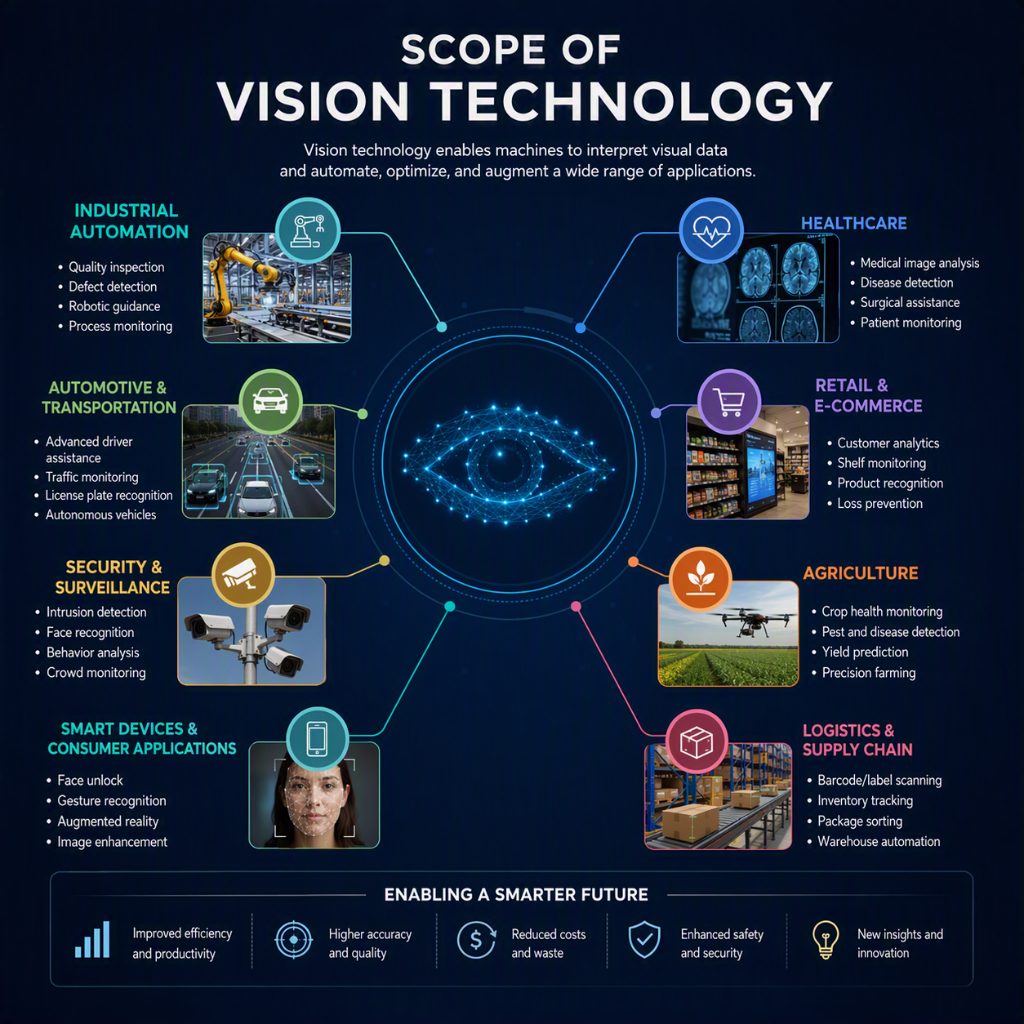
The scope of vision technology is remarkably broad, spanning from correcting basic refractive errors to restoring sight and even revealing signs of systemic diseases. It bridges clinical ophthalmology, advanced engineering, and artificial intelligence.🔬
Clinical Vision Care & Correction This is the most established scope, focused on diagnosing and correcting vision problems. It includes designing spectacle lenses, contact lenses, and intraocular lenses (IOLs), as well as fitting low vision aids like magnifiers and telescopes for patients with partial sight . Modern ophthalmic optics has moved toward free-form technology, allowing lenses to be digitally designed for a user’s unique requirements .🧠 AI-Powered Diagnostics & ScreeningArtificial intelligence is expanding how eye diseases are detected and monitored. Vision-language foundation models like RETFound and VisionFM can diagnose conditions such as diabetic retinopathy and glaucoma with high accuracy (AUC exceeding 0.90) across diverse datasets . AI also makes advanced imaging practical: a method called RRTGAN reduces the data needed for adaptive optics imaging by three-fourths, enabling cellular-level retinal scans in busy clinics . The eye is also being explored as a “canary in the coal mine” for systemic conditions like Alzheimer’s and heart disease through AI-powered retinal analysis .⚙️ Vision Restoration & ProstheticsFor irreversible vision loss, the scope extends to neural prosthetics that bypass damaged eye structures. The SIGHTED project is developing a 1,000-electrode implant that stimulates the lateral geniculate nucleus (LGN) in the brain, aiming for high-resolution vision restoration with human trials planned . At EPFL, researchers use AI models to predict optimal stimulation patterns for cortical prosthetics, aiming to evoke images of faces and objects rather than simple light spots . Commercial efforts like Neuralink’s Blindsight also target direct brain stimulation .🏭 Industrial & Computer VisionVision technology has a massive footprint in manufacturing and automation. Vision AI systems inspect products on assembly lines in real time, detecting surface defects, misalignments, or missing components with far greater accuracy than human eyes—essential in semiconductor production with its 2,000+ process steps . Beyond manufacturing, computer vision enables autonomous vehicles to recognize road signs and pedestrians, and powers retail shelf monitoring for real-time inventory updates .💡 Emerging FrontiersThe field is also expanding into augmented vision—AR systems that don’t just correct vision but enhance it beyond traditional glasses, offering task-specific visual enhancements and modifying the incoming light field .
Visual prosthetics are moving toward object-level perception, and research is exploring whether the same AI modeling can restore hearing through cochlear implants .Would you like to explore a specific area in more depth, such as AI foundation models for diagnostics or the engineering behind vision prosthetics?