
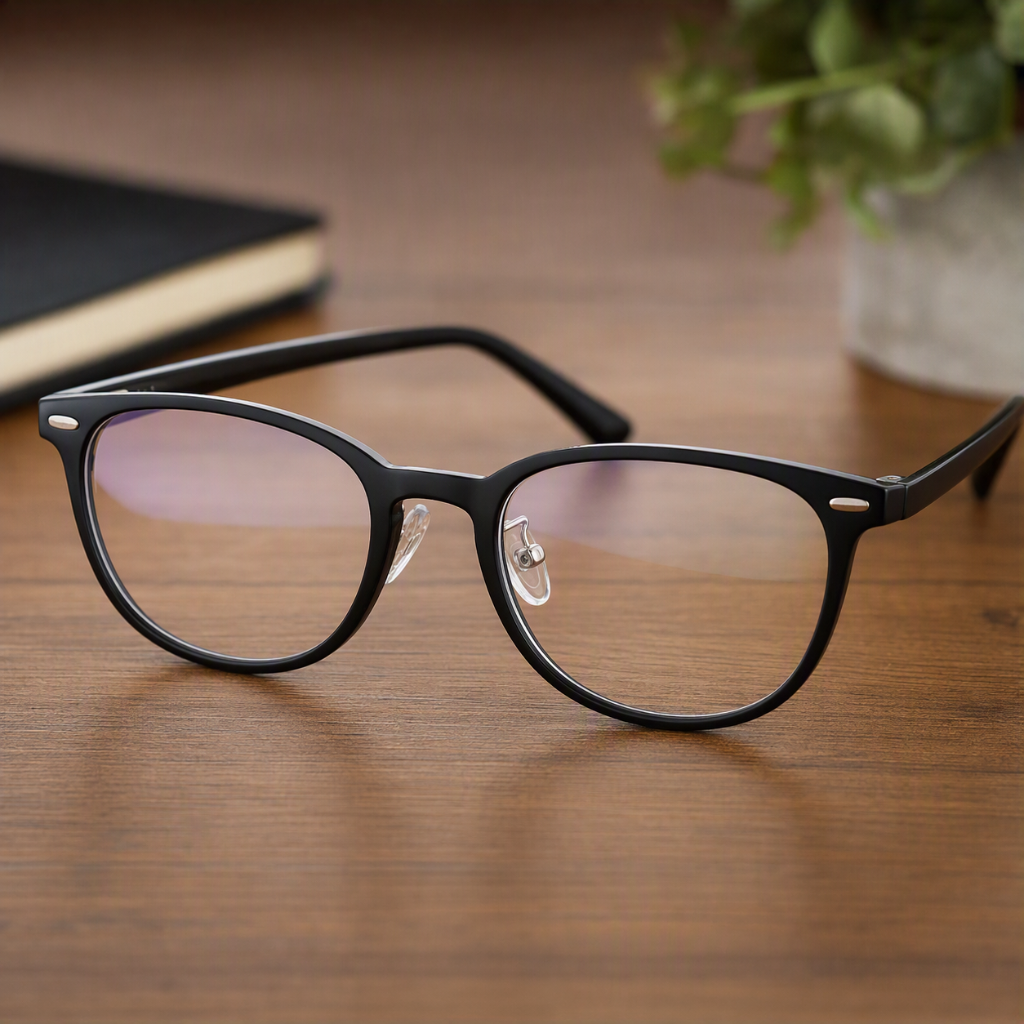
Why people wear spectacles in their routinely lifestyle?

People wear spectacles in their daily lives for a mix of medical necessity, comfort, protection, and style. Here’s why they’ve become a routine part of millions of lives:👁️

1. Correcting Refractive Errors (The #1 Reason)The most common reason is to fix how the eye focuses light.· Myopia (Nearsightedness): Can’t see far—driving, watching TV, recognizing faces.· Hyperopia (Farsightedness): Can’t see near—reading, phone use, close work.· Astigmatism: Blurred or distorted vision at all distances.· Presbyopia: Age-related loss of near focus—reading glasses become essential after 40.Without glasses, these conditions cause blur, eye strain, headaches, and reduced quality of life.💻

2. Digital Screen ProtectionModern lifestyles mean hours on screens.· Blue light filtering: Reduces eye strain and improves sleep quality.· Anti-reflective coating: Cuts glare from screens and overhead lights.· Computer glasses: Optimized for intermediate distance (arm’s length) to reduce fatigue.☀️

3. Environmental ProtectionGlasses act as a barrier against daily hazards.· UV protection: Prevents cataracts, macular degeneration, and eyelid cancer.· Wind and dust: Keeps debris out of eyes.· Impact protection: Safety glasses for sports, DIY, or industrial work.· Blue light outdoors: Reduces glare from sunlight.🧠

4. Medical & Post-Surgical Needs· Post-cataract surgery: Protective glasses during healing.· Diabetic retinopathy: Corrective lenses for vision changes.· Glaucoma: Glasses don’t treat it, but correct associated vision issues.· Amblyopia (lazy eye): Children wear glasses to strengthen the weaker eye.👓

5. Comfort & Quality of Life· Less squinting: Reduces facial tension and wrinkles.· Fewer headaches: Eliminates strain from constant focus effort.· Better depth perception: Improves driving, sports, and coordination.· Reading comfort: Allows longer reading without fatigue.

🎨 6. Style & Self-Expression· Fashion statement: Frames match outfits and personality.· Professional image: Glasses can convey intelligence or authority.· Identity: Some people feel “not themselves” without glasses.· Trend cycles: Vintage, oversized, minimalist—frames follow fashion.

🏃 7. Sports & Performance· Enhanced vision: Sharper focus for golf, shooting, cycling.· Eye protection: Polycarbonate lenses for impact sports.· Anti-fog coatings: For swimming, skiing, running.· Prescription sunglasses: UV protection + vision correction.🧓

8. Age-Related Needs· Presbyopia: Reading glasses become routine after 40.· Cataracts: Stronger prescription before surgery.· Macular degeneration: Low vision aids integrated into glasses.· Dry eye: Wraparound frames reduce tear evaporation.

📊 Summary: Why People Wear Spectacles DailyReason ExampleVision correction Myopia, hyperopia, astigmatismDigital protection Blue light, anti-glareEnvironmental safety UV, wind, dust, impactMedical needs Post-surgery, amblyopiaComfort Less strain, fewer headachesStyle Fashion, identity, professional imageSports Performance, protectionAge-related Presbyopia, cataracts💡 Key InsightSpectacles are no longer just medical devices. They are:· Protective gear (UV, impact)· Productivity tools (screen optimization)· Fashion accessories (style, identity)· Lifestyle enablers (driving, reading, sports)For most people, wearing spectacles is a routine habit because they improve how they see, feel, and function every day.Would you like to know how to choose the right spectacles for a specific lifestyle, like office work or sports?

How drilling parameters are calculated for different lens curvatures?

Calculating drilling parameters for different lens curvatures is a precise process that ensures a rimless frame sits correctly on the wearer’s face. The core challenge is that the demo lens used for fitting often has a different curve than your actual prescription lens.📐 The Core Problem: Curve MismatchWhen a rimless frame is fitted, it’s usually done with a demo lens. However, your actual prescription lens may have a different surface curve (how domed the front is). If you drill a hole perpendicular to the demo lens and use the same angle on the actual lens, the frame’s endpiece and temples may not align properly, affecting fit and the temple opening angle .🧮

How the System Calculates the Correct AngleModern lens processing machines solve this with a geometric calculation. The operator selects a drilling mode, typically one of these three :

1. First Drilling: The hole angle is normal (perpendicular) to the demo lens surface.

2. Second Drilling: The hole angle is normal to the actual lens surface.

3. Third Drilling: The hole angle is arbitrarily set by the operator.The most complex calculation happens in the First Drilling mode. The system uses the following data to find the correct hole position and angle on your actual lens :· Demo Lens Data: The system needs the surface curve (or radius of curvature) and the exact hole position coordinates from the demo lens .· Actual Lens Data: It also needs the surface curve of your actual prescription lens .📉 The Calculation in ActionUsing these inputs, the software performs a geometric correction. It calculates a correction amount (ΔW) to shift the hole position on the actual lens. This shift compensates for the difference in curvature between the demo and actual lenses .The goal is to find the correct hole angle and hole position on the actual lens so that when the frame is assembled, the endpiece fits the lens edge perfectly and the temple angle remains correct for the wearer’s face .📏 Practical Considerations· Perpendicularity: The system can adjust the lens tilt so the drill enters perpendicular to the refractive surface, which is often desired for a stable fit .· Data Transfer: In practice, manufacturers like Silhouette provide drilling coordinate files (often downloadable) that give exact measurements for automated machines or printable templates for manual drilling, which account for these curve variations .In short, the calculation is a geometric correction. It uses the curve values of both the demo and actual lenses to determine a corrected hole position and angle, ensuring the rimless frame fits properly regardless of the prescription’s curvature.

How rimless frames are engineered?

Rimless frames are engineered through precision mounting systems that attach the bridge and temples directly to the lenses—no surrounding frame material. The engineering challenge is balancing invisibility with structural security.🔩

Core Mounting MethodsScrew-Mounted (Traditional Drill Mount)The most common approach. Two or more through-bores are drilled into the lens edge area. The bridge and end pieces have barbed metal pins or threaded posts that pass through these holes, secured with screws and nuts or compression bushings .

A patent describes using a plastic filament (nylon) through auxiliary holes to invisibly anchor the bridge and temple elements, keeping hardware hidden .Compression/Clamp MountingA newer approach that avoids drilling entirely. The bridge and end pieces have protrusions that clamp onto the lens surface. The fixing body is lowered over the lens and fastened with a nut, creating a pressure seal . This prevents lens cracking from shock and extends lens life by eliminating holes as stress points.

Groove-Mounted (Rimway/Cortland Style)A groove is cut around the lens edge. A support line (often fishing line or nylon) sits in the groove and threads through holes in the bridge and end pieces . This provides stability while keeping the attachment nearly invisible.📐 Engineering the Drill HolesDrilling rimless lenses requires precision to avoid star cracks or flaking:· Hole angle: The system must account for the surface curve of the demo lens versus the actual prescribed lens. A software method selects drilling angles—normal to the demo lens, normal to the actual lens, or arbitrarily set—and calculates hole position data to compensate for curvature differences .·

Material selection: Trivex is preferred for drilled rimless because it is least affected by drilling, reducing star cracks. Its tensile strength allows thinner edges without chipping . Polycarbonate is also recommended for safety .· Edge thickness: A minimum of 2.0 to 2.2 mm edge thickness is maintained for groove-mount rimless. High-index lenses with thinner edges (1.8 mm) flake during fabrication or later .🔧 Structural Stability SystemsTo prevent lenses from rotating or shifting, engineers add:· Anti-rotation features: Non-cylindrical pins (oval, square) prevent relative rotation between lens and mount .· Three-point fit: Nose pads and temples create tripod stability, keeping lenses aligned .· Spring hinges: Integrated spring mechanisms allow temples to flex without breaking the mount .⚠️

Trade-OffsRimless frames are lightest and most invisible but least durable. The mounting points are stress concentrators—loose screws cause lens shift, affecting vision and risking cracks . They require more frequent professional checks of mounting hardware .Would you like to explore specific mounting hardware designs, or how drilling parameters are calculated for different lens curvatures?

how does spectacles made?

Making spectacles is a blend of precision optics, digital design, and manual craftsmanship. The process moves from a raw material to a finished pair in roughly 10–15 steps. Here is how it works:📋

1. The Prescription & Order· An optometrist writes your prescription (sphere, cylinder, axis, PD, add).· You choose a frame and lens type (single vision, progressive, photochromic, coatings).· The order goes to a lens lab or factory.🔬

2. Lens Design (Digital)· The prescription is entered into computer-aided design (CAD) software.· For free-form lenses, AI calculates the exact surface geometry needed for your eye.· The software outputs a file that tells the machine how to cut the lens.🧱

3. Lens Blank Selection· A semi-finished blank (one side pre-curved, one side flat) is selected.· Material: CR-39, polycarbonate, Trivex, or high-index plastic.· The blank is chosen based on your prescription strength and lens index.⚙️

4. Surfacing (Cutting the Prescription)· The blank is mounted on a blocker (holds it in place).· A generator (diamond-cutting lathe) carves the back surface to match your prescription.· Free-form generators cut complex, custom curves for progressive lenses.· The lens is now optically correct but still rough.🔄

5. Fine Grinding & Polishing· The lens goes through fine grinding to smooth the surface.· Then polishing with a slurry to make it optically clear.· Any remaining surface imperfections are removed.🧪

6. Hard Coating· A scratch-resistant coating is applied (often via spin coating or dip coating).· The lens is cured under UV light or heat.🎨

7. Tinting & Coatings (Optional)· Tinting: Lens is dipped in dye for sunglasses or fashion tints.· Anti-reflective (AR): Multiple thin layers are deposited in a vacuum chamber.· Mirror coating: Metallic layers applied for reflective look.· Hydrophobic/oleophobic: Repels water and oil.· Blue light filter: Blocks specific wavelengths.✂️

8. Edging (Cutting to Frame Shape)· The lens is cut to the exact shape of your frame.· A pattern or digital tracer provides the frame shape.· The edger grinds the lens edge to fit the frame groove.🔧

9. Frame Assembly· The lenses are inserted into the frame.· For rimless frames, holes are drilled and screws/mounts installed.· For metal frames, the lenses are snapped into the rim.📐

10. Final Alignment & Adjustment· The optician checks optical center alignment with your pupils.· Nose pads, temples, and tilt are adjusted for fit.· The frame is cleaned and inspected for defects.🧠

11. Quality Control· Lenses are checked for power accuracy, coating defects, and scratches.· A lensometer verifies the prescription.· Frame alignment is checked with a gauge.📦

12. Dispensing· The finished spectacles are given to you with fitting instructions.· Follow-up adjustments are made if needed.🏭 Factory vs. In-Store LabFeature Factory Lab In-Store LabVolume High LowCustomization Free-form, complex StandardTurnaround 3–7 days Same dayCost Lower per unit Higher per unitCoatings Full range Limited💡 Key InsightSpectacles are made through a digital-to-physical pipeline:Prescription → CAD design → Surfacing → Polishing → Coating → Edging → Assembly → AlignmentThe most critical steps are surfacing (cutting the correct curve) and alignment (centering the lens on your pupil). Everything else—coatings, tinting, edging—adds comfort, durability, and style.Would you like to know how progressive lenses are specifically manufactured, or how frame materials are chosen?

How does ai workflow works in making smooth transition of lens in spectacles factory?

In a spectacles factory, AI works less like a single robot and more like a “central nervous system” that ensures smooth transitions by predicting, simulating, and optimizing every step of the lens creation process. It makes the shift from a raw blank to a finished progressive lens seamless and efficient.🧠

Designing the Smooth Transition (The Lens Design)The “smooth transition” you feel when wearing progressives starts with how the lens is designed. AI-driven design software creates a single, cohesive optical surface rather than a collection of individual points.· Mean Power Profiling: AI algorithms analyze the “mean power” required across the entire lens surface, ensuring a smooth, gradual shift from distance to reading zones. This minimizes the “swim effect” and peripheral distortion common in older designs.· Biometric Approximation: Companies like Rodenstock use AI trained on vast biometric datasets to predict individual eye parameters (like eye length) from standard prescriptions, allowing them to tailor the lens more precisely for a smoother visual experience.

⚙️ Making the Transition on the Production LineOnce designed, AI manages the physical manufacturing to ensure consistency and speed.· Real-Time Process Control: Systems like SCHNEIDER’s Modulo platform use AI to monitor production data across surfacing, cleaning, and coating. The AI dynamically adjusts machine parameters in real-time to prevent bottlenecks and ensure each lens comes out exactly as designed.· Predictive Manufacturing: AI is used to predict the best manufacturing parameters (like tool paths) based on the lens prescription before production even begins. This minimizes errors and ensures the physical lens perfectly matches the digital design.🔄

The Feedback Loop The transition doesn’t end at the factory gate. Companies like Optiswiss use AI that learns from eye movement patterns and customer feedback. The algorithm continuously improves its predictions of real-life user behavior, making each new generation of lenses even smoother to adapt to. In short, AI ensures smooth transitions by designing a more natural optical surface, predicting the best way to manufacture it, and controlling the machines to execute that plan flawlessly.

How does light work in making game technology?

Light in game technology works on two levels: simulating how light behaves in the real world (rendering) and using light as a physical tool (input, display, networking). Here’s how each works:🎮

1. Light Simulation in Game RenderingThis is how games calculate what you see on screen. The goal is to mimic how photons bounce, reflect, and refract in real life.Real-Time Ray Tracing· Instead of approximating light, the GPU traces individual rays from the camera into the scene.· Each ray hits an object, then bounces to calculate reflections, refractions, and shadows.· NVIDIA RTX and AMD RDNA use dedicated RT cores to do this in real time.· Result: Accurate reflections in water, realistic glass, soft shadows.Rasterization (Traditional Method)· Most games still use rasterization: objects are converted to pixels, and lighting is approximated using shaders.·

Global Illumination (GI) techniques like baked lightmaps or screen-space reflections fake bounced light.· Hybrid approach: Many modern games combine rasterization for speed + ray tracing for key effects.Key Lighting ModelsModel What It SimulatesPhong/Blinn-Phong Basic specular highlightsPBR (Physically Based Rendering) Energy-conserving materials, metalness, roughnessPath Tracing Full light transport (used in offline rendering, slowly entering real-time)Light Sources in Games· Directional (sun)· Point (bulb)· Spot (flashlight)· Area (window, neon sign)· Emissive (glowing objects)Advanced Effects· Volumetric lighting: Light shafts through fog (god rays)· Subsurface scattering: Light passing through skin, leaves, wax· Caustics: Light focused through glass or water· HDR & Tone Mapping: Simulates eye adaptation from dark to bright💡 2. Light as a Physical Tool in Gaming HardwareOptical Input Devices· Optical mice: LED or laser light tracks surface movement. A sensor takes thousands of images per second and calculates displacement.· Light guns: Early versions detected CRT scan lines; modern ones use infrared cameras and sensor bars.· Motion tracking: PlayStation Move, VR headsets use IR LEDs tracked by cameras.· Eye tracking: Infrared light reflects off the cornea to determine gaze direction (used in PSVR2, Varjo).Optical Displays· LCD: Backlight passes through liquid crystal pixels.· OLED: Each pixel emits its own light—no backlight needed.· MicroLED: Tiny LEDs per pixel, high brightness, no burn-in.· Laser projectors: RGB lasers scan to create images.·

Holographic displays: Light interference patterns create 3D images without glasses.Optical Networking· Fiber optic cables: Use light pulses to transmit game data across servers with near-zero latency and huge bandwidth.· Data centers: Cloud gaming (GeForce Now, Xbox Cloud) relies on optical interconnects between servers.Optical Storage (Legacy)· CD/DVD/Blu-ray: Laser reads pits on a disc. Blu-ray uses blue lasers (405 nm) for higher density.· Modern gaming: Mostly digital, but discs still use optical reading.🔬

3. Light in VR/AR Gaming· Inside-out tracking: Headset cameras use IR light to map the room and track controllers.· Depth sensing: Time-of-flight sensors (like Kinect) bounce IR light off objects to build 3D maps.· Passthrough AR: Cameras capture the real world, and the GPU composites virtual objects with correct lighting.· Retinal projection: Some prototypes project light directly onto the retina using MEMS mirrors.🧠

4. The Full Pipeline“`Light Source (Sun/Lamp/Emissive) ↓Ray/Raster Calculation (GPU) ↓Material Interaction (PBR) ↓Bounce/Reflection/Shadow ↓Tone Mapping → Display (LCD/OLED) ↓Player’s Eye → Brain Perception“`💡 Key InsightIn gaming, light serves two roles:1. Simulated light — calculated by the GPU to create realistic visuals (ray tracing, PBR, GI)2. Physical light — used in hardware for input (optical mice, VR tracking), display (OLED, laser projectors), and networking (fiber optics)The trend is convergence: real-time ray tracing is making simulated light nearly indistinguishable from reality, while optical hardware is making input and display faster and more immersive.Would you like to go deeper into ray tracing vs. path tracing, or how VR headsets use infrared light for tracking?

How do glasses stay properly aligned with both eyes when you wear them, and how does an optician adjust them to keep them centered?

Here is a clear, detailed answer to your improved question:How Glasses Stay Aligned with Both Eyes During WearGlasses stay aligned through a combination of precise measurements, frame design, and three-point stability. Here’s how it works:📏

1. The Measurements That MatterBefore lenses are even cut, the optician takes key measurements:Measurement What It DoesPupillary Distance (PD) Ensures each lens’s optical center sits directly over each pupilOptical Center Height Positions the lens vertically so your line of sight hits the correct zoneVertex Distance Controls the gap between lens and cornea (critical for strong prescriptions)Pantoscopic Tilt Sets the slight downward angle so light enters the eye naturallyIf these are wrong, even a perfectly fitted frame won’t align properly.👓

2. Frame Fit: The Stability SystemA frame stays centered through three-point contact:

1. Nose bridge/pads — supports the frame and controls horizontal position

2. Left temple — rests behind the left ear3. Right temple — rests behind the right earThis creates a tripod effect. If any point is off, the frame tilts or slides.🔧

3. How an Optician Adjusts ThemOpticians use specialized pliers and tools to make micro-adjustments:Horizontal Alignment (left-right)· Bends the nose pad arms so both pads contact the nose evenly·

If the frame sits too far left, the right pad is adjusted forward· Ensures both pupils are centered in their respective lensesVertical Alignment (up-down)· Adjusts nose pad height so both lenses sit at the same level· Bends temple arms to raise or lower the frame front· Checks that the frame front is perfectly level using a frame alignment gaugeTemple Adjustment (front-back stability)· Bends the temple tips to match the angle behind your ears· Ensures the frame doesn’t slide forward when you look down· Adjusts temple spread so the arms hug your head without pinchingPantoscopic Tilt· Rotates the frame front slightly downward· Critical for progressive lenses—ensures the reading zone sits correctly· Typically set between 8–12 degreesFace Form· Bends the frame front to follow the curve of your face· Prevents the lenses from sitting too flat or too angled🔄

4. What Keeps It Aligned Over Time· Spring hinges — allow slight flex without losing shape· Adjustable nose pads — can be re-bent as needed· Memory metals (like titanium) — return to shape after minor bending· Regular check-ups — opticians re-adjust every 6–12 months⚠️

5. Signs of Misalignment· One lens sits higher than the other· Frame slides down your nose constantly· One side presses behind your ear more than the other· You tilt your head to see clearly· Headaches, eye strain, or double vision🧠

6. The Brain’s RoleEven with perfect adjustment, your brain fuses the two images into one. If alignment is slightly off, the brain compensates—but this causes fatigue. That’s why even small misalignments matter.💡 SummaryStep What HappensMeasure PD, height, tilt, vertex distanceFit Three-point contact (nose + both ears)Adjust Nose pads, temples, tilt, face formMaintain Spring hinges, regular re-adjustmentBrain Fuses images, compensates for small errorsBottom line: Glasses stay aligned through accurate measurements + stable frame fit + professional adjustment. The optician’s job is to make both lenses sit optically centered on each pupil while keeping the frame comfortable and stable—so you forget you’re wearing them.Would you like to know how progressive lenses specifically maintain alignment across distance, intermediate, and near zones?

what technology helping in improving industrial robotics eye vision industrial manufacturing of products?

Several key technologies are converging to give industrial robots reliable “eyes” for manufacturing tasks—ranging from object recognition to high-precision assembly.👁️

Vision Sensing Hardware The physical “eyes” of the robot rely on specialized sensors.· Global Shutter Sensors: Unlike rolling shutter cameras, these capture the entire frame simultaneously, eliminating motion blur when robots move quickly. This is crucial for accurate positioning on fast-moving production lines.· 2.5D and 3D Depth Perception: Systems like OnRobot’s “Eyes” provide 2.5D vision (length, width, and a degree of height), ideal for recognizing different parts for CNC machine loading or palletizing. True 3D sensors (like Teledyne’s Optimom 5D) generate detailed depth maps, allowing robots to handle complex shapes or transparent materials.·

360-Degree Sensors: The Fraunhofer “SensePRO” sensor uses a rotating laser “measuring curtain” to provide a 360-degree view. This prevents blind spots on complex workpieces, ensuring the robot always knows its position for gluing or welding.🧠

AI and Software for RecognitionHardware provides data; software gives it meaning.·

Deep Learning for Object Detection: Algorithms like YOLO are used to identify and locate objects in real time. For instance, one system achieved a 95.54% detection accuracy on a moving conveyor belt.· Synthetic Data and Generative AI: Training AI requires massive datasets. GANs (Generative Adversarial Networks) create realistic counterfeit images, helping the robot learn to recognize objects even when real-world training data is limited. Digital twins also generate labeled data for robust adaptation.·

CAD-Model Matching: For precise bin picking, software projects a 3D CAD model into 2D views, forms a point cloud, and uses algorithms like Iterative Closest Point (ICP) to match it with the real object seen by the camera.🎯 Precision and Control Technologies

Getting the robot to act on what it sees requires tight integration.·

Visual Servoing: This technique uses image feedback to control the robot’s motion. The GS-UNet framework uses a deep learning model to detect keypoints and guide the robot, achieving sub-millimeter assembly accuracy (0.27–0.49 mm position error).· Eye-in-Hand Configuration: Mounting the camera on the robot’s wrist (end-effector) provides a flexible, close-up view. This setup, combined with deep learning, enables accurate pick-and-place even with a low-cost 2D camera.·

Dynamic Grasping: To catch moving targets on a conveyor, systems use Kalman filters for trajectory prediction and deep reinforcement learning (SAC) to overcome delays, achieving a 92.5% dynamic grasping success rate.🏭 Integration PlatformsSoftware platforms tie everything together for ease of use.·

ABB OmniCore EyeMotion: This platform allows users to create vision applications by dragging and dropping function blocks. It can reduce commissioning time by up to 90% and shorten cycle times by up to 50%.· Robot Operating System (ROS): A common open-source framework used in research and industry to integrate robot arms, cameras, and deep learning models into a cohesive system.Are you interested in a specific application, such as bin picking or assembly?

What is the use of protective lens?

A protective lens is used to shield the actual lens of a device from damage while maintaining image quality. Its main purposes are:

1.

Physical protection – Guards against scratches, dust, dirt, fingerprints, moisture, and impacts. If it gets damaged, it’s cheaper to replace than the main lens.

2. Preserving resale value – Keeps the original lens in pristine condition, which matters for resale.

3. Optical filtering (in some cases) – Certain protective lenses also add UV filtering, anti-reflective coatings, or glare reduction.

4. Easy cleaning – Can be removed and cleaned without risk of damaging the primary lens coatings.Common uses:· Cameras – Protects expensive camera lenses (often called a “UV filter” or “clear filter”)· Smartphones – Tempered glass or plastic covers over the camera bump· Eyewear/safety glasses – Shields eyes from debris, chemicals, or UV light· Industrial/scientific equipment – Protects sensors, lasers, or optical instrumentsTrade-off: A protective lens can slightly reduce image quality (flare, reduced sharpness) and adds cost, so the choice depends on how valuable the underlying lens is and the shooting conditions.