What is the use of lens in making and analazying small nano & microbes objects?

Lenses are essential tools for both making and analyzing nano-objects, but they work in fundamentally different ways depending on the task: optical lenses use light to manipulate or observe, while electron lenses use electromagnetic fields to achieve atomic-scale resolution.

🔬 Making Nano-Objects: Optical Lithography

For manufacturing, lenses focus light to “write” patterns on a tiny scale.

· Immersion Lithography: A high-index liquid (like water) is placed between the lens and the silicon wafer, increasing the Numerical Aperture (NA) and allowing smaller features to be printed.
· Solid Immersion Lens (SIL): A high-index solid lens is placed in near-contact with the sample. It focuses light into a spot smaller by a factor of the material’s index (n or n²), enabling sub-wavelength patterning.

👁️ Analyzing Nano-Objects: Breaking the Diffraction Limit

For observation, lenses either enhance optical resolution or switch to electrons entirely.

· Super-Resolution Optical Techniques: Microsphere lenses placed near the sample convert near-field (evanescent) waves into propagating ones, allowing standard microscopes to resolve features as small as 65–87 nm. Metasurfaces (flat lenses) can also track nanoparticles with 10 nm accuracy.
· Electron Lenses (TEM/SEM): Because electrons have much shorter wavelengths, electromagnetic “lenses” can resolve down to sub-0.1 nm (atomic scale). This is far beyond the ~200 nm limit of visible light.

🎯 Manipulating Nano-Objects: Optical Tweezers

Lenses are also used to trap and move individual nanoparticles.

· Optical Tweezers: A tightly focused laser beam creates a gradient force that holds a particle at the focus. By steering the beam, particles can be moved, stretched (like DNA), or sorted.

If you’d like to dive deeper into a specific technique, such as how immersion lithography prints chips or how electron lenses correct aberrations, feel free to ask.
what is the use of vision technology in making future combat machinery technological system?

Vision technology is fundamentally reshaping future combat by giving weapons and soldiers the ability to see, identify, and decide faster than ever before. Its use spans the entire “kill chain”—from surveillance to strike—and is being deployed at scale in active conflicts.🎯 Precision Guidance and Target RecognitionVision tech allows missiles and drones to lock onto targets autonomously, even when GPS and communications are jammed.· Missile Terminal Guidance: Deep learning models like YOLOv8 are integrated with tracking algorithms (DeepSORT) to identify and track targets in real-time. Systems use infrared (IR) imaging to recognize targets in complex backgrounds and distinguish them from decoys like flares .· Decoy Discrimination: For example, Ukraine uses AI and computer vision on over 70 different drone systems. When communications are lost due to electronic warfare, the drone’s AI locks onto a target and continues autonomously to strike it .🤖 Autonomous Drone SwarmsVision technology enables one operator to control many drones, which coordinate with each other like a single organism.· “One-to-Many” Control: China’s Atlas system allows a single operator to control up to 96 drones. The swarm intelligence algorithm gives each drone a “smart brain” to share info, avoid mid-air collisions, and adjust formation in real-time .

The U.S. has also tested a single operator controlling three attack drones simultaneously .· Collaborative Combat: Systems like the UK’s ANVIL use computer vision to let drones find and identify targets. The system can be retrained to recognize new targets within 24 hours, making the swarm adaptable to new threats .🪖 Augmented Reality for SoldiersVision tech is moving from weapons to the soldiers themselves, creating a shared visual network.· Smart Glasses: Companies like Anduril and Meta are prototyping AR headsets for soldiers. These glasses overlay maps, drone feeds, and AI-driven target recognition directly onto the soldier’s field of view.

A soldier could potentially order a drone strike using just eye-tracking and voice commands .· Shared Vision: The goal is a “cyborg-inspired” system where drones and soldiers “see together,” sharing information seamlessly to make decisions as one unit .🗺️ Battlefield Awareness and Decision DominanceAI processes the massive flood of visual data from satellites, drones, and sensors to give commanders a clear picture.· Data Processing at Scale: The U.S. Army’s Maven Smart System acts as a “digital spotter.” It analyzes thousands of hours of video to automatically identify and flag objects of interest, like enemy vehicles, cutting through the “fog of war” .· Rapid Decision-Making: By automating the detection of targets, AI accelerates the military decision-making cycle, allowing commanders to act faster than the adversary .⚙️

How the Technology Works· Neuromorphic Sensors: New sensors capture pixel-level changes rather than full video frames. This allows for high-speed, low-latency tracking of fast-moving objects like hypersonic missiles .· Multi-Spectral Fusion: Systems combine visual, Infrared, and other wavebands to see through fog, smoke, and darkness, and to distinguish real targets from decoys .If you’re interested in a specific aspect, I can go deeper into how drone swarm algorithms work or the technology behind soldier-worn AR headsets.

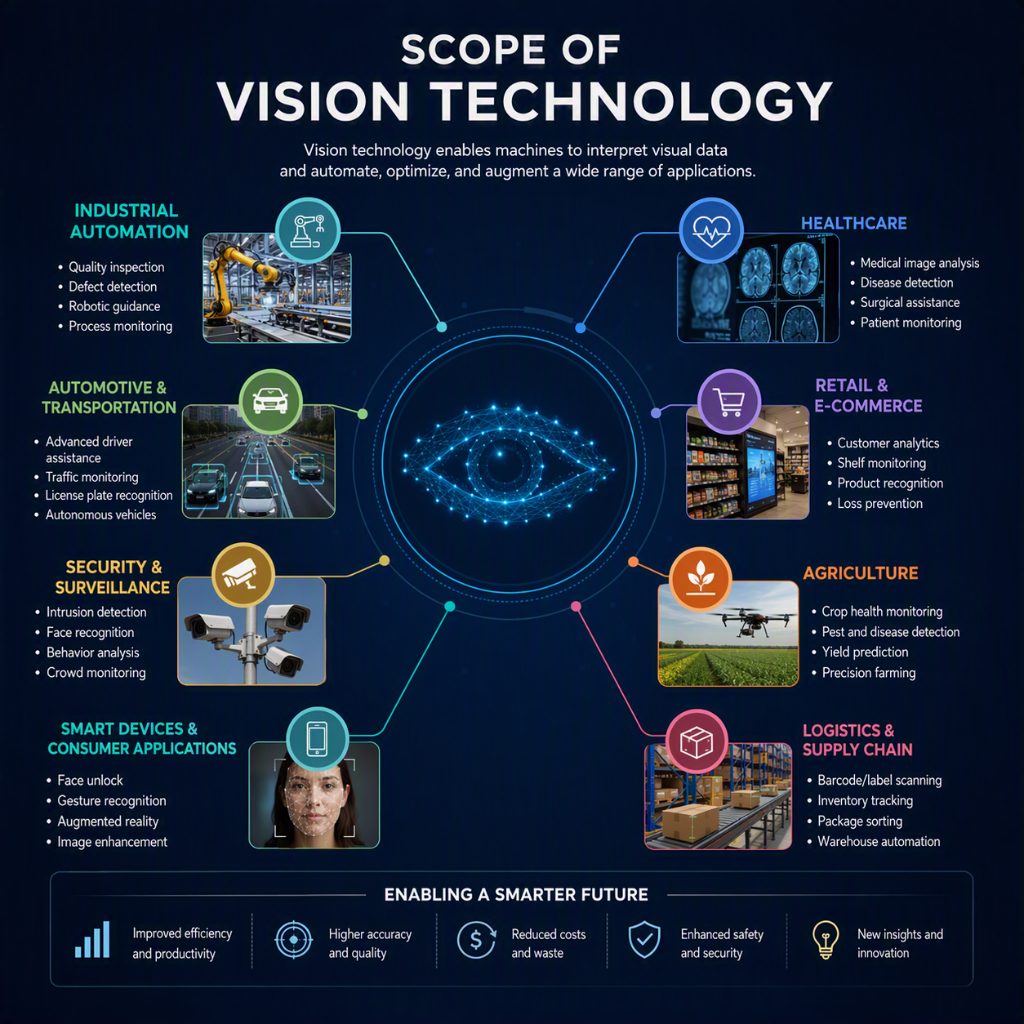
what is the scope of vision technology?

The scope of vision technology is remarkably broad, spanning from correcting basic refractive errors to restoring sight and even revealing signs of systemic diseases. It bridges clinical ophthalmology, advanced engineering, and artificial intelligence.🔬

Clinical Vision Care & Correction This is the most established scope, focused on diagnosing and correcting vision problems. It includes designing spectacle lenses, contact lenses, and intraocular lenses (IOLs), as well as fitting low vision aids like magnifiers and telescopes for patients with partial sight . Modern ophthalmic optics has moved toward free-form technology, allowing lenses to be digitally designed for a user’s unique requirements .🧠 AI-Powered Diagnostics & ScreeningArtificial intelligence is expanding how eye diseases are detected and monitored. Vision-language foundation models like RETFound and VisionFM can diagnose conditions such as diabetic retinopathy and glaucoma with high accuracy (AUC exceeding 0.90) across diverse datasets . AI also makes advanced imaging practical: a method called RRTGAN reduces the data needed for adaptive optics imaging by three-fourths, enabling cellular-level retinal scans in busy clinics . The eye is also being explored as a “canary in the coal mine” for systemic conditions like Alzheimer’s and heart disease through AI-powered retinal analysis .⚙️ Vision Restoration & ProstheticsFor irreversible vision loss, the scope extends to neural prosthetics that bypass damaged eye structures. The SIGHTED project is developing a 1,000-electrode implant that stimulates the lateral geniculate nucleus (LGN) in the brain, aiming for high-resolution vision restoration with human trials planned . At EPFL, researchers use AI models to predict optimal stimulation patterns for cortical prosthetics, aiming to evoke images of faces and objects rather than simple light spots . Commercial efforts like Neuralink’s Blindsight also target direct brain stimulation .🏭 Industrial & Computer VisionVision technology has a massive footprint in manufacturing and automation. Vision AI systems inspect products on assembly lines in real time, detecting surface defects, misalignments, or missing components with far greater accuracy than human eyes—essential in semiconductor production with its 2,000+ process steps . Beyond manufacturing, computer vision enables autonomous vehicles to recognize road signs and pedestrians, and powers retail shelf monitoring for real-time inventory updates .💡 Emerging FrontiersThe field is also expanding into augmented vision—AR systems that don’t just correct vision but enhance it beyond traditional glasses, offering task-specific visual enhancements and modifying the incoming light field .

Visual prosthetics are moving toward object-level perception, and research is exploring whether the same AI modeling can restore hearing through cochlear implants .Would you like to explore a specific area in more depth, such as AI foundation models for diagnostics or the engineering behind vision prosthetics?

How does ai workflow works in making smooth transition of lens in spectacles factory?

In a spectacles factory, AI works less like a single robot and more like a “central nervous system” that ensures smooth transitions by predicting, simulating, and optimizing every step of the lens creation process. It makes the shift from a raw blank to a finished progressive lens seamless and efficient.🧠

Designing the Smooth Transition (The Lens Design)The “smooth transition” you feel when wearing progressives starts with how the lens is designed. AI-driven design software creates a single, cohesive optical surface rather than a collection of individual points.· Mean Power Profiling: AI algorithms analyze the “mean power” required across the entire lens surface, ensuring a smooth, gradual shift from distance to reading zones. This minimizes the “swim effect” and peripheral distortion common in older designs.· Biometric Approximation: Companies like Rodenstock use AI trained on vast biometric datasets to predict individual eye parameters (like eye length) from standard prescriptions, allowing them to tailor the lens more precisely for a smoother visual experience.

⚙️ Making the Transition on the Production LineOnce designed, AI manages the physical manufacturing to ensure consistency and speed.· Real-Time Process Control: Systems like SCHNEIDER’s Modulo platform use AI to monitor production data across surfacing, cleaning, and coating. The AI dynamically adjusts machine parameters in real-time to prevent bottlenecks and ensure each lens comes out exactly as designed.· Predictive Manufacturing: AI is used to predict the best manufacturing parameters (like tool paths) based on the lens prescription before production even begins. This minimizes errors and ensures the physical lens perfectly matches the digital design.🔄

The Feedback Loop The transition doesn’t end at the factory gate. Companies like Optiswiss use AI that learns from eye movement patterns and customer feedback. The algorithm continuously improves its predictions of real-life user behavior, making each new generation of lenses even smoother to adapt to. In short, AI ensures smooth transitions by designing a more natural optical surface, predicting the best way to manufacture it, and controlling the machines to execute that plan flawlessly.

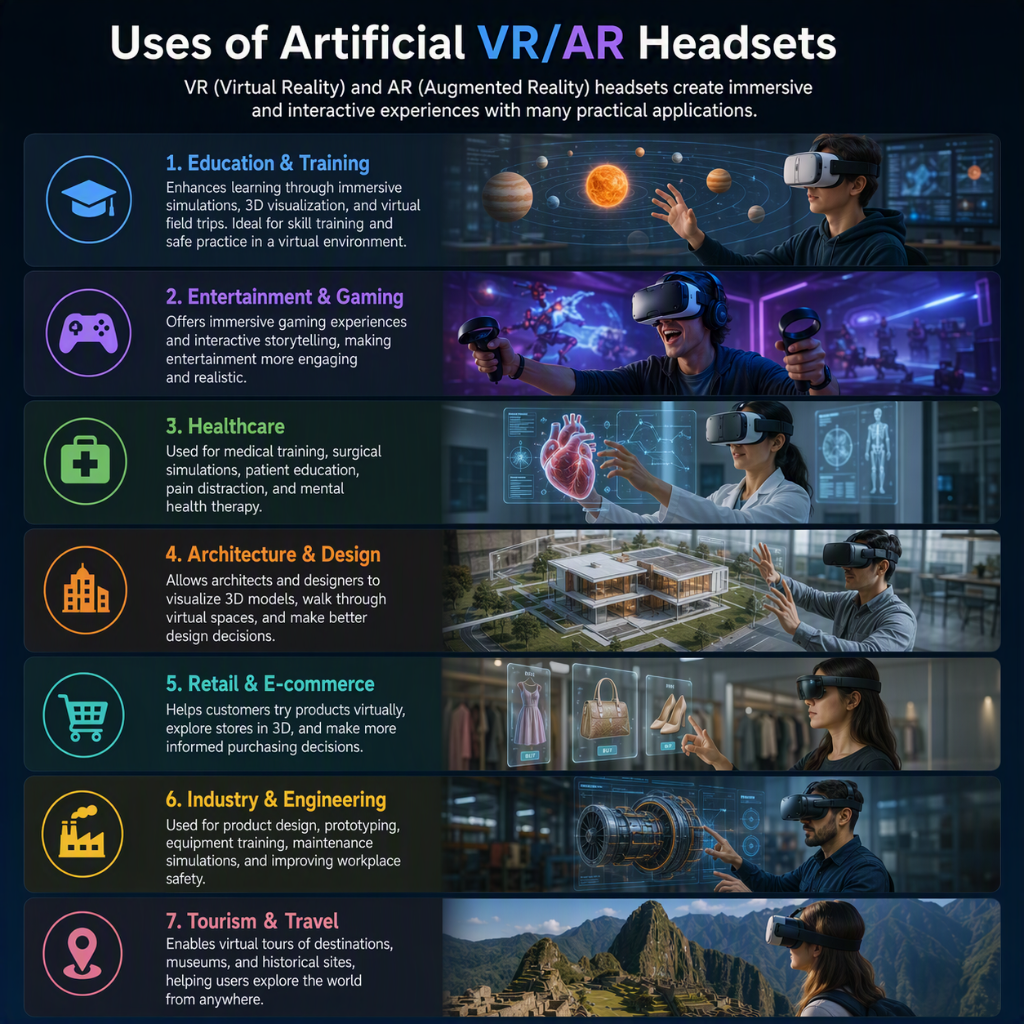
What is the use of artificial vr ar headsets?

Artificial VR/AR headsets are primarily used to overlay digital intelligence onto the real world, transforming how people work, learn, and interact. Their core value is delivering context-aware information and guidance without requiring you to look away at a screen.🏭 Professional & Industrial TrainingThis is one of the most mature applications. Headsets create safe, repeatable environments for high-stakes skills.· Surgical & Medical Training: Doctors train on AI-generated virtual patients that react in real-time.

If a mistake is made, the system simulates consequences like bleeding or vital changes, offering a “quiet guidance layer” to correct technique without risking real lives.· Industrial & High-Risk Safety: Workers practice rare, dangerous scenarios (like nuclear reactor coolant failures or chemical plant emergencies) repeatedly. The AI varies each simulation so people learn to react, not just memorize steps.· Enterprise Productivity: Technicians can pull up interactive, on-screen instruction guides that appear alongside real-world equipment, helping them navigate unfamiliar wiring or machinery without pausing to consult a manual.🩺

Clinical & Surgical NavigationAR headsets are moving into operating rooms as a software-only navigation tool.· Mixed Reality Neurosurgery: The ARGUS AI platform overlays reconstructed 3D CT/MRI scans and highlighted tumour/risk structures directly into the surgeon’s field of view. This replaces bulky hardware, reducing cognitive load and potentially cutting the cost of advanced navigation by over 80%.🧠 Smart Assistants & Context-Aware InteractionAI turns headsets from passive displays into active, hands-free helpers.· Natural Language Queries: Systems like “Words into World” let users ask compound spatial questions (e.g., “Which screwdriver is within reach on the desk?”) and receive answers grounded in 3D space, not just 2D image recognition.·

Adaptive Immersion: Samsung’s patents describe systems that automatically adjust how much virtual content you see based on your attention. If you’re focused on a task, the headset increases immersion; if you need to be aware of your surroundings, it dials back to light floating notifications.🎓 Education & Skill DevelopmentAI-powered characters and environments make learning interactive and personalized.· AI Peer Mentors: Platforms like AlgeVerse use AI-powered virtual peers in VR to give learners guidance and feedback. Users might not be able to tell which avatars are real students and which are AI.· Language & Cultural Exchange: Students from different countries can meet in a shared VR space and communicate in real-time, with AI translation breaking down language barriers.⚡ The Underlying Enabling TechnologyThese uses are made possible by several key AI-driven advances:· Foveated Rendering: Eye-tracking determines where you’re looking, rendering that area in high resolution and reducing detail in peripheral vision. This significantly reduces the computing power needed, making high-quality VR feasible on lighter headsets.· Real-Time On-Device AI: AI models are being optimized to run directly on the headset, enabling low-latency features like real-time object detection and language understanding without relying on a cloud connection.If you’re curious about a specific field like medical training or industrial maintenance, I can go deeper into how those workflows actually operate.

How does light work in making game technology?

Light in game technology works on two levels: simulating how light behaves in the real world (rendering) and using light as a physical tool (input, display, networking). Here’s how each works:🎮

1. Light Simulation in Game RenderingThis is how games calculate what you see on screen. The goal is to mimic how photons bounce, reflect, and refract in real life.Real-Time Ray Tracing· Instead of approximating light, the GPU traces individual rays from the camera into the scene.· Each ray hits an object, then bounces to calculate reflections, refractions, and shadows.· NVIDIA RTX and AMD RDNA use dedicated RT cores to do this in real time.· Result: Accurate reflections in water, realistic glass, soft shadows.Rasterization (Traditional Method)· Most games still use rasterization: objects are converted to pixels, and lighting is approximated using shaders.·

Global Illumination (GI) techniques like baked lightmaps or screen-space reflections fake bounced light.· Hybrid approach: Many modern games combine rasterization for speed + ray tracing for key effects.Key Lighting ModelsModel What It SimulatesPhong/Blinn-Phong Basic specular highlightsPBR (Physically Based Rendering) Energy-conserving materials, metalness, roughnessPath Tracing Full light transport (used in offline rendering, slowly entering real-time)Light Sources in Games· Directional (sun)· Point (bulb)· Spot (flashlight)· Area (window, neon sign)· Emissive (glowing objects)Advanced Effects· Volumetric lighting: Light shafts through fog (god rays)· Subsurface scattering: Light passing through skin, leaves, wax· Caustics: Light focused through glass or water· HDR & Tone Mapping: Simulates eye adaptation from dark to bright💡 2. Light as a Physical Tool in Gaming HardwareOptical Input Devices· Optical mice: LED or laser light tracks surface movement. A sensor takes thousands of images per second and calculates displacement.· Light guns: Early versions detected CRT scan lines; modern ones use infrared cameras and sensor bars.· Motion tracking: PlayStation Move, VR headsets use IR LEDs tracked by cameras.· Eye tracking: Infrared light reflects off the cornea to determine gaze direction (used in PSVR2, Varjo).Optical Displays· LCD: Backlight passes through liquid crystal pixels.· OLED: Each pixel emits its own light—no backlight needed.· MicroLED: Tiny LEDs per pixel, high brightness, no burn-in.· Laser projectors: RGB lasers scan to create images.·

Holographic displays: Light interference patterns create 3D images without glasses.Optical Networking· Fiber optic cables: Use light pulses to transmit game data across servers with near-zero latency and huge bandwidth.· Data centers: Cloud gaming (GeForce Now, Xbox Cloud) relies on optical interconnects between servers.Optical Storage (Legacy)· CD/DVD/Blu-ray: Laser reads pits on a disc. Blu-ray uses blue lasers (405 nm) for higher density.· Modern gaming: Mostly digital, but discs still use optical reading.🔬

3. Light in VR/AR Gaming· Inside-out tracking: Headset cameras use IR light to map the room and track controllers.· Depth sensing: Time-of-flight sensors (like Kinect) bounce IR light off objects to build 3D maps.· Passthrough AR: Cameras capture the real world, and the GPU composites virtual objects with correct lighting.· Retinal projection: Some prototypes project light directly onto the retina using MEMS mirrors.🧠

4. The Full Pipeline“`Light Source (Sun/Lamp/Emissive) ↓Ray/Raster Calculation (GPU) ↓Material Interaction (PBR) ↓Bounce/Reflection/Shadow ↓Tone Mapping → Display (LCD/OLED) ↓Player’s Eye → Brain Perception“`💡 Key InsightIn gaming, light serves two roles:1. Simulated light — calculated by the GPU to create realistic visuals (ray tracing, PBR, GI)2. Physical light — used in hardware for input (optical mice, VR tracking), display (OLED, laser projectors), and networking (fiber optics)The trend is convergence: real-time ray tracing is making simulated light nearly indistinguishable from reality, while optical hardware is making input and display faster and more immersive.Would you like to go deeper into ray tracing vs. path tracing, or how VR headsets use infrared light for tracking?

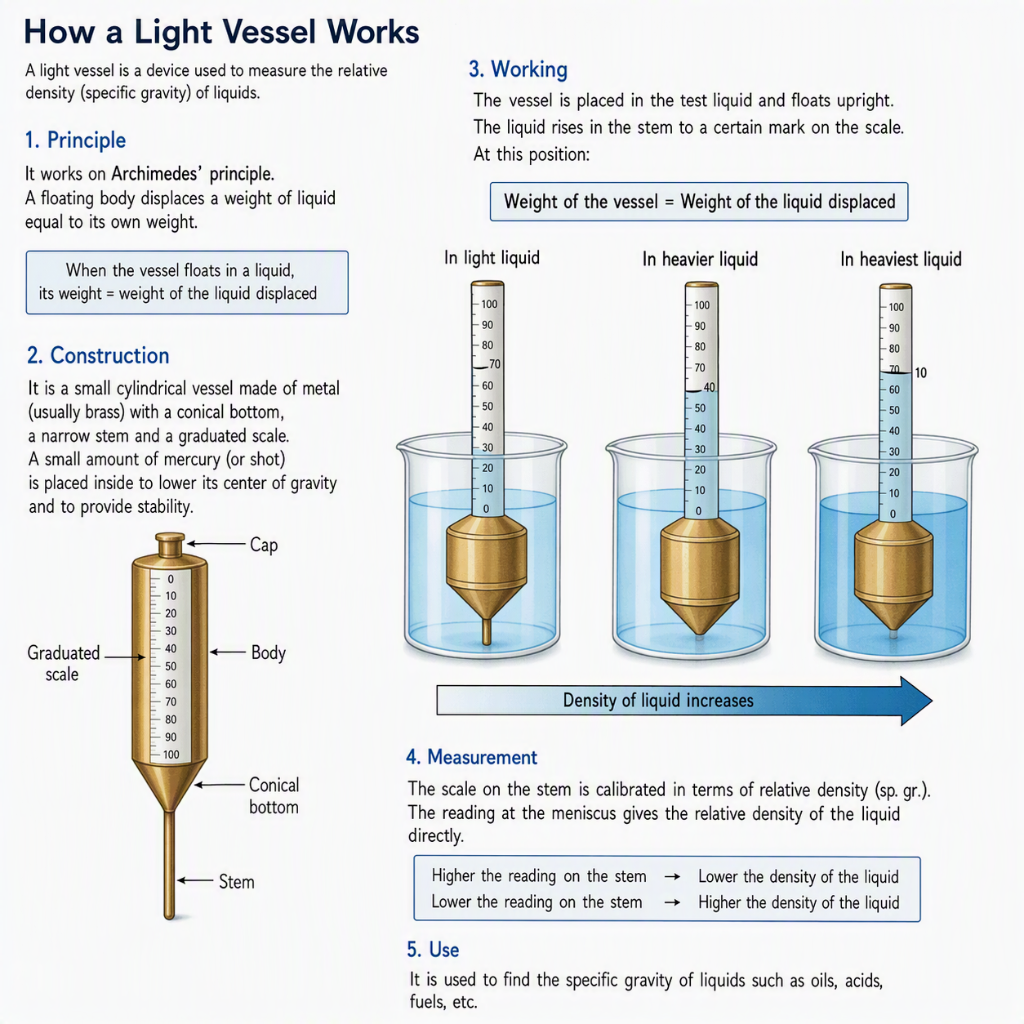
How does light vessel works?

The term “light vessel” has two very different meanings depending on the context. Here is how each one works:⚓ Maritime Navigation (The Original “Light Vessel”)A light vessel (also called a lightship) is a floating aid to navigation—essentially a lighthouse on a ship. It is anchored or moored at a specific location to mark hazards, serve as a landfall mark, or guide ships in waters where building a lighthouse is impossible.· How it works: It carries a high-intensity signal light at the top of a mast. By night, it displays a characteristic light pattern that mariners can identify.· Additional equipment: It may also carry fog signals, submarine sound signals, and radio beacons to assist navigation in poor visibility.· Visual identification: The hull and lantern tower are usually painted red, and the station name is displayed on the side for daytime recognition.💡 Optical Tweezers (“Light Vessel” as a Trap)In modern biophysics and nanotechnology, the term can refer to optical tweezers—a technique where a highly focused laser beam acts as a “vessel” to trap and manipulate microscopic objects without physical contact.· How it works: A laser is focused through a high-numerical-aperture microscope objective. The light’s intensity is highest at the focal point. When a microscopic particle (like a cell or nanoparticle) is near this point, the gradient force from the light’s momentum pulls it toward the center and holds it there.· What it does: Once trapped, the object can be moved, rotated, or sorted by steering the laser beam. It is used to study single cells, manipulate biological molecules, and probe mechanical properties of living matter.📡 Photonic Integrated Circuits (The “Light Vessel” Analogy)If you meant a vessel that carries light in a technological sense, that refers to photonic integrated circuits (PICs) or optical waveguides. These are chip-scale structures that guide, manipulate, and route light signals—essentially “pipes” for light on a silicon chip.· How it works: A waveguide confines light using total internal reflection. A core material with a higher refractive index (like silicon) is surrounded by cladding with a lower index (like silicon dioxide). Light stays trapped in the core and follows the path of the waveguide.· Building blocks: PICs integrate splitters, modulators, filters, and photodetectors on a single substrate to process optical signals for telecommunications, LiDAR, and biosensing.If you can tell me which context you were asking about—maritime navigation, optical trapping, or photonic circuits—I can go deeper into that specific technology.

How does light machine technology work?

“Light machine technology” isn’t a single device—it refers to systems that use light as a tool for computation, manufacturing, or actuation. Here’s how the core technologies work:⚡

The Foundation: How Lasers Create Coherent LightMost light machines start with a laser (Light Amplification by Stimulated Emission of Radiation). The process works in three steps:

1. Pumping: Energy is added to a “gain medium” (crystal, gas, or semiconductor), exciting electrons to higher orbits.

2. Stimulated Emission: When an excited electron drops back down, it releases a photon. That photon hits another excited electron, triggering a second identical photon—a chain reaction.

3. Amplification: Mirrors at both ends of the medium bounce photons back and forth, multiplying them until a coherent beam emerges.The result is light with coherence (waves in sync), monochromaticity (single color), and directionality (tight beam)—properties ordinary light lacks.🖥️ Photonic Computing: Using Light to Process DataInstead of electrons in wires, photonic processors use light beams to perform math.· Beam Splitting & Modulation: A laser is split into multiple paths. Spatial Light Modulators (SLMs)—tiny mirror arrays or liquid crystals—adjust the phase or amplitude of each beam.·

Parallel Operations: Because light beams can cross without interfering (if different wavelengths), massive parallel processing is possible. One system achieved 98% fidelity in vector inner products using a VCSEL array and photodetector array.· Nonlinear Activation: For AI tasks, a photodetector + micro-ring modulator unit converts optical signals back to electrical for nonlinear functions like sigmoid, then back to optical.🏭 Light-Based Manufacturing: Shaping Matter with PhotonsLight machines are replacing mechanical tools in precision fabrication.· Volumetric 3D Printing: A metasurface mask shapes a laser into a 3D hologram. When projected into resin, UV light reduces metal salts into conductive wires while visible light solidifies surrounding polymer—building metal-and-plastic structures in one step, thousands of times faster than scanning methods.· Laser Machining: A laser beam is modulated by an SLM to create a specific beam shape (e.g., inclined in the YZ plane), then focused to form modified regions inside semiconductor materials for precise cutting or fracturing.· Light-Directed Electrokinetics: A photoconductive layer (like amorphous silicon) becomes conductive only where light hits it. This creates virtual electrodes that pull particles into patterns—maskless microfabrication.🔧 Light as a Mechanical ActuatorSome systems convert light directly into force.· Photonic Actuators: Pulsed light generates mechanical displacement on the order of 2 Newtons per cubic centimeter with response times as fast as 2 milliseconds.

This avoids electromagnetic interference entirely, unlike traditional motors.💡 Key InsightLight machine technology works by controlling light’s phase, amplitude, and wavelength to perform work—whether that’s computing a matrix multiplication, curing a resin into metal, or moving a tiny actuator. The common thread is precision at the speed of light, without mechanical scanning in many cases.Would you like to dive deeper into photonic computing for AI, or light-based 3D printing.

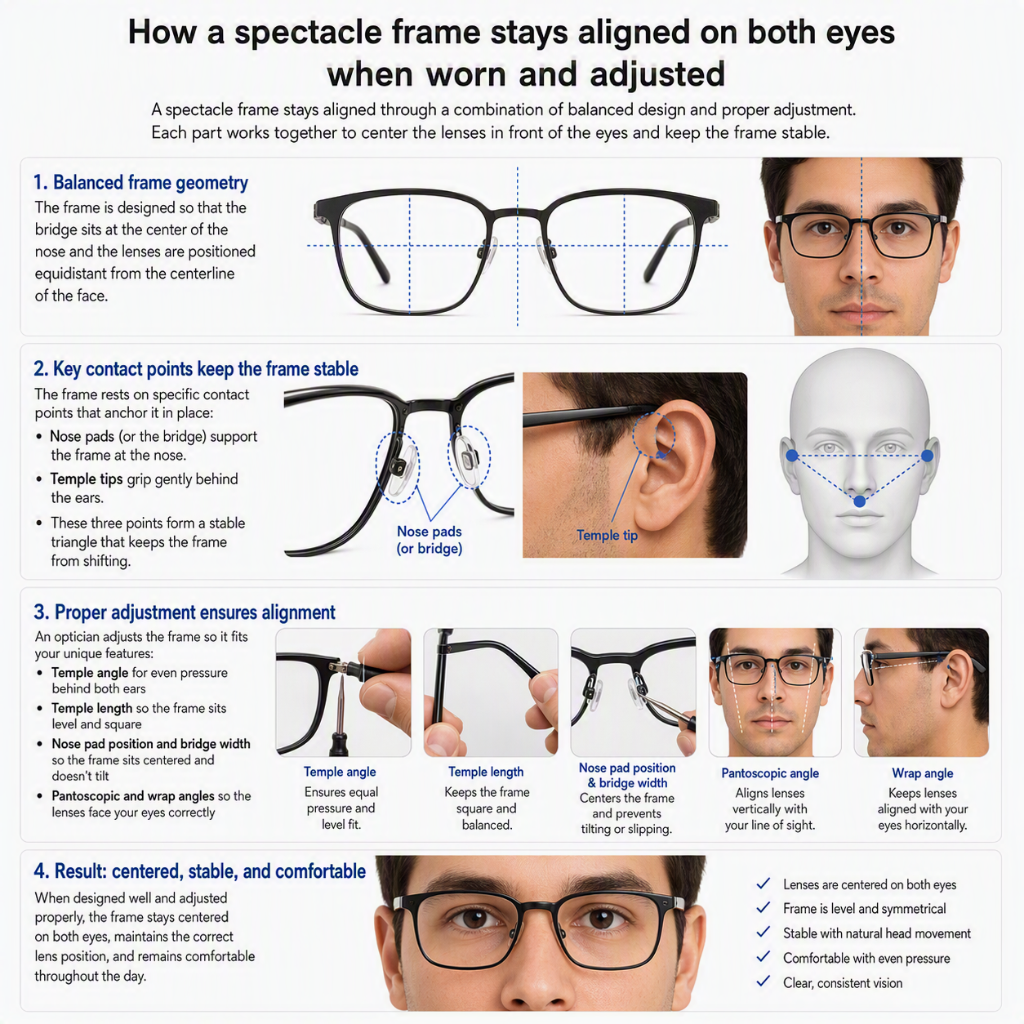
How do glasses stay properly aligned with both eyes when you wear them, and how does an optician adjust them to keep them centered?

Here is a clear, detailed answer to your improved question:How Glasses Stay Aligned with Both Eyes During WearGlasses stay aligned through a combination of precise measurements, frame design, and three-point stability. Here’s how it works:📏

1. The Measurements That MatterBefore lenses are even cut, the optician takes key measurements:Measurement What It DoesPupillary Distance (PD) Ensures each lens’s optical center sits directly over each pupilOptical Center Height Positions the lens vertically so your line of sight hits the correct zoneVertex Distance Controls the gap between lens and cornea (critical for strong prescriptions)Pantoscopic Tilt Sets the slight downward angle so light enters the eye naturallyIf these are wrong, even a perfectly fitted frame won’t align properly.👓

2. Frame Fit: The Stability SystemA frame stays centered through three-point contact:

1. Nose bridge/pads — supports the frame and controls horizontal position

2. Left temple — rests behind the left ear3. Right temple — rests behind the right earThis creates a tripod effect. If any point is off, the frame tilts or slides.🔧

3. How an Optician Adjusts ThemOpticians use specialized pliers and tools to make micro-adjustments:Horizontal Alignment (left-right)· Bends the nose pad arms so both pads contact the nose evenly·

If the frame sits too far left, the right pad is adjusted forward· Ensures both pupils are centered in their respective lensesVertical Alignment (up-down)· Adjusts nose pad height so both lenses sit at the same level· Bends temple arms to raise or lower the frame front· Checks that the frame front is perfectly level using a frame alignment gaugeTemple Adjustment (front-back stability)· Bends the temple tips to match the angle behind your ears· Ensures the frame doesn’t slide forward when you look down· Adjusts temple spread so the arms hug your head without pinchingPantoscopic Tilt· Rotates the frame front slightly downward· Critical for progressive lenses—ensures the reading zone sits correctly· Typically set between 8–12 degreesFace Form· Bends the frame front to follow the curve of your face· Prevents the lenses from sitting too flat or too angled🔄

4. What Keeps It Aligned Over Time· Spring hinges — allow slight flex without losing shape· Adjustable nose pads — can be re-bent as needed· Memory metals (like titanium) — return to shape after minor bending· Regular check-ups — opticians re-adjust every 6–12 months⚠️

5. Signs of Misalignment· One lens sits higher than the other· Frame slides down your nose constantly· One side presses behind your ear more than the other· You tilt your head to see clearly· Headaches, eye strain, or double vision🧠

6. The Brain’s RoleEven with perfect adjustment, your brain fuses the two images into one. If alignment is slightly off, the brain compensates—but this causes fatigue. That’s why even small misalignments matter.💡 SummaryStep What HappensMeasure PD, height, tilt, vertex distanceFit Three-point contact (nose + both ears)Adjust Nose pads, temples, tilt, face formMaintain Spring hinges, regular re-adjustmentBrain Fuses images, compensates for small errorsBottom line: Glasses stay aligned through accurate measurements + stable frame fit + professional adjustment. The optician’s job is to make both lenses sit optically centered on each pupil while keeping the frame comfortable and stable—so you forget you’re wearing them.Would you like to know how progressive lenses specifically maintain alignment across distance, intermediate, and near zones?

How does a spectacle frame stay aligned on both eyes when worn and adjusted?

Here are several improved versions of your question, depending on the context you want:If you mean “How does a spectacle frame stay aligned on both eyes when worn and adjusted?”·

Professional/Clinical: “What mechanical and optical principles ensure that spectacle frames maintain alignment with both pupils during wear and after adjustment?”· Patient-Friendly: “How do glasses stay properly aligned with both eyes when you wear them, and how does an optician adjust them to keep them centered?”·

Technical/Engineering: “What design features and adjustment mechanisms allow spectacle frames to maintain binocular optical alignment during daily wear?”· Short & Direct: “How are spectacles aligned to both eyes during fitting and adjustment?”If you want a broader, more research-oriented question:·

“What factors influence binocular alignment in spectacle wear, and how do frame adjustments correct misalignment?”· “How do pupillary distance, optical center height, and frame fit interact to maintain alignment with both eyes?”· “What role does professional adjustment play in ensuring spectacles remain aligned with both pupils over time?”If you want a question suitable for an exam or academic paper:·

“Discuss the optical and mechanical principles involved in aligning spectacles with both eyes, including key measurements and adjustment techniques.”· “Explain how frame fitting and adjustment ensure that each lens’s optical center aligns with the corresponding pupil.”If you want a simple, clear version:· “How do glasses get adjusted so both lenses sit correctly in front of each eye?”If you tell me where you’ll use this question (blog, exam, research paper, patient handout, video script), I can refine it further.