
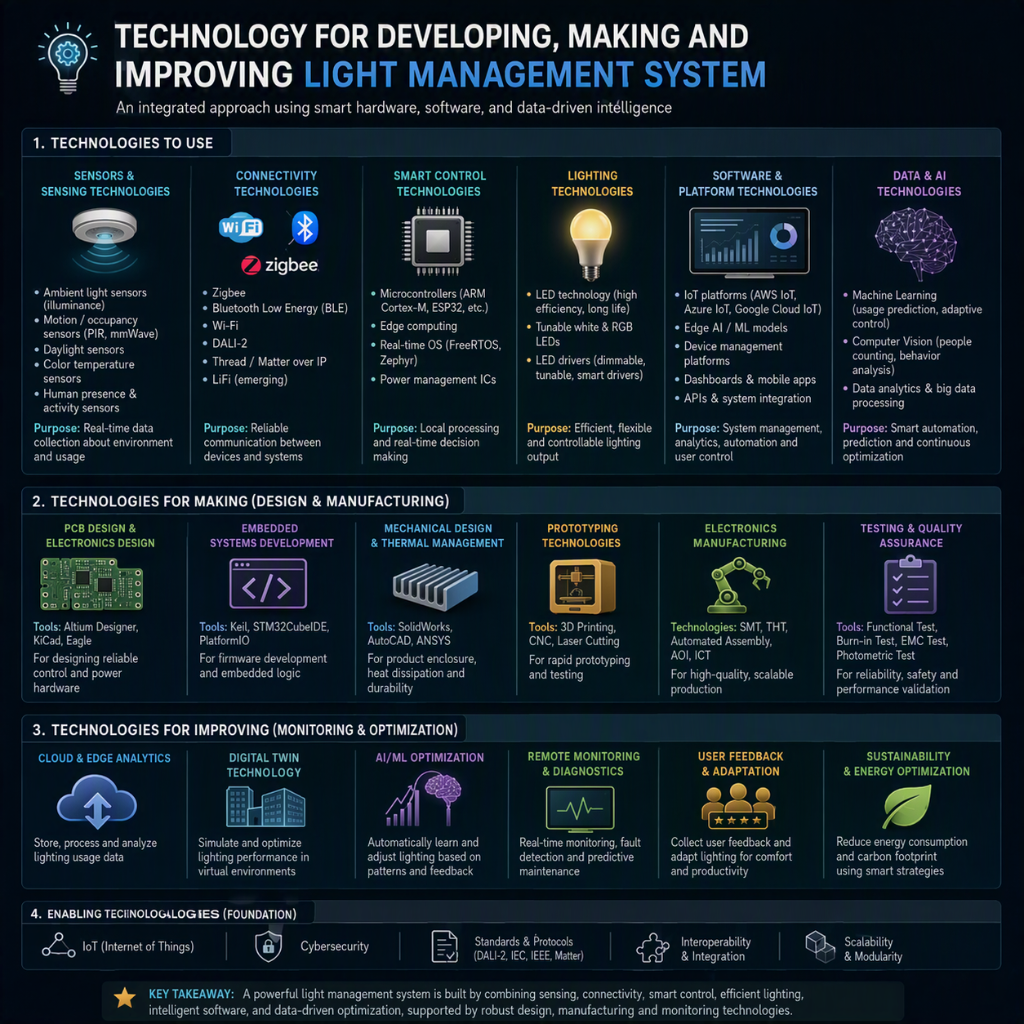
What technology should be used in developing, making and improving light management improving system?

Based on the search results, here are the key technologies used to build an intelligent light-improving system.💡

Machine Learning & Adaptive Control The core of modern intelligent lighting is its ability to learn and adapt. A Machine Learning (ML) driven system can dynamically adjust artificial light levels and color temperature based on ambient daylight or user preferences. For instance, a system using linear regression can train on collected data to produce the desired Correlated Color Temperature (CCT).

More advanced approaches use Reinforcement Learning (RL) to generate optimal spectrum policies, considering factors like color rendering index (CRI) and circadian rhythm promotion.🔄 Closed-Loop Control & FeedbackTo maintain precise lighting, a closed-loop control system is essential.

It continuously senses the environment and provides feedback to stabilize illumination despite fluctuations in natural daylight. A typical implementation uses a PID controller, where algorithms like Genetic Algorithms (GA) can automatically tune the PID parameters to adapt to nonlinear and dynamic conditions. The system can also include a feedback signal representative of the light’s properties to maintain the illumination spectrum matched to a target.📡 Multi-Sensor Data FusionAn intelligent system relies on multiple sensors to understand its environment. Data from an ambient light intensity sensor, temperature and humidity sensor, human body sensor (infrared), and air quality sensor can be fused using a weighted average algorithm. This creates a comprehensive environmental state evaluation. A Support Vector Regression (SVR) model can then predict user illumination needs based on historical behavior and real-time data.🎨

Dynamic Spectrum & Color Tuning To achieve the right light quality, the system must control its spectral output. This is done by mixing the emissions of warm white and cool white LEDs, with the intensity of each controlled individually using Pulse-Width Modulation (PWM) signals. By adjusting the LED driving current, the system can shift the color temperature—for example, to a warm tone in cooler environments or a cool tone in warmer ones—to match the environment and user needs.🔬

Advanced Optical & Hardware TechnologiesFor high-precision applications, specialized hardware is required. In automotive lighting, Digital Micromirror Device (DMD) technology uses a chip with over 1 million individually controllable micromirrors to precisely shape the light beam, enabling features like glare-free high beam and road projections. Similarly, Laser-Assist LED systems combine lasers with LEDs to increase output brightness and enable adaptive driving beam (ADB) functionality.

For machine vision, a hybrid-dimming control method can simultaneously control current intensity and on-time to avoid light saturation and capture clearer images.In short, an effective intelligent lighting system is a fusion of adaptive algorithms (ML, RL), precise control loops (PID, GA), multi-sensor fusion, and advanced optical hardware to deliver optimal, context-aware illumination.

You can search more about like…!

Would you like to dive deeper into the machine vision aspect or the automotive lighting technology?
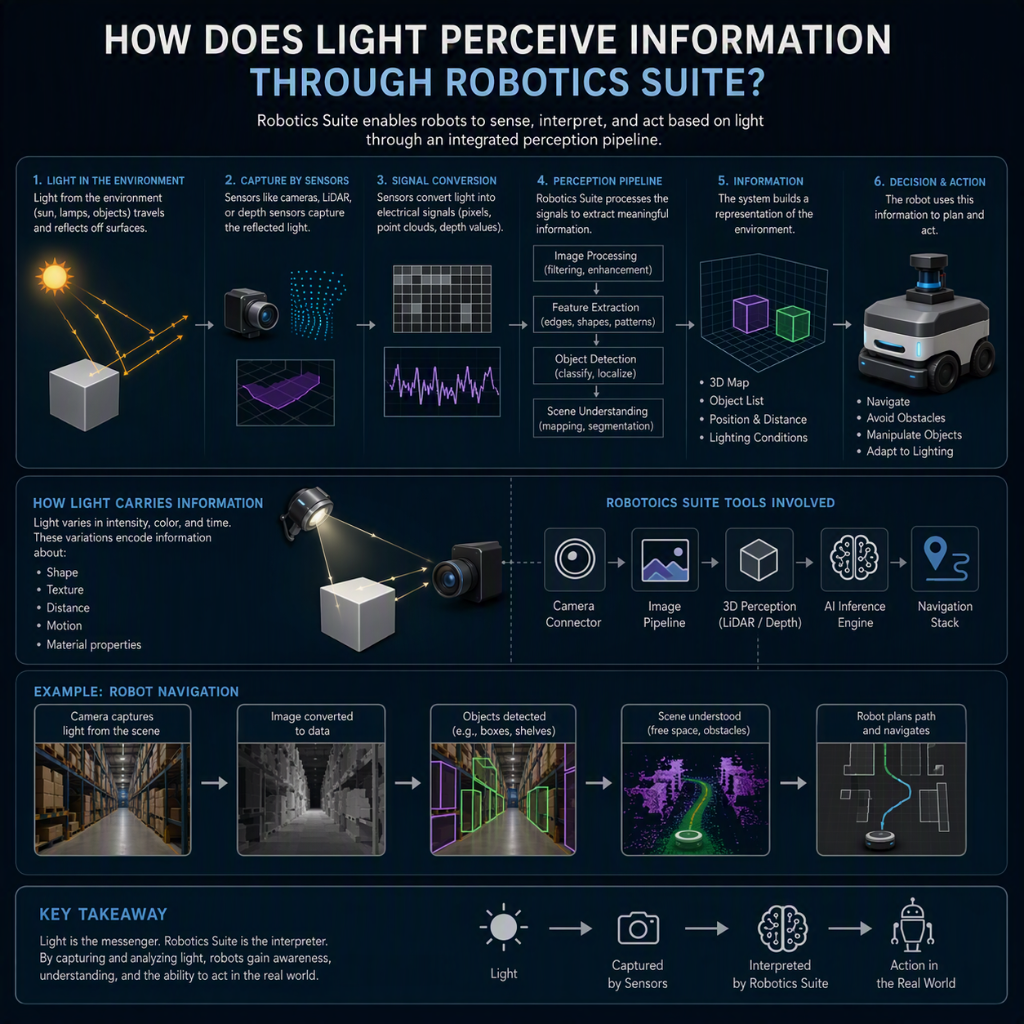
how does light percieve information through robotics suite?

In a robotics suite, light doesn’t “perceive” information on its own—it carries raw physical data that the robotic system interprets. The process works like this:💡

1. Light as an Information CarrierLight is electromagnetic radiation. When it hits an object, it changes in predictable ways:· Reflects off surfaces· Absorbs into materials· Scatters depending on texture· Refracts through transparent objects· Emits from active sources (LEDs, lasers)Each change carries information about the object’s:· Shape· Distance· Color· Material· Surface roughness· Motion📷

2. Sensing: Converting Light to DataThe robotics suite uses sensors to capture light and convert it into electrical signals:· Cameras (2D): Capture intensity and color. Each pixel becomes a number representing brightness and RGB values.· Depth Cameras (3D): Use time-of-flight (measuring how long light takes to return) or structured light (projecting patterns) to calculate distance per pixel.· LiDAR: Fires laser pulses and measures return time to build precise 3D point clouds.· Spectrometers: Measure wavelength distribution to identify materials.· Photodiodes: Detect simple presence/absence of light for triggering.🧠

3. Processing: Making Sense of Light DataRaw sensor data is meaningless without interpretation. The robotics suite processes it through:· Image Processing: Filtering, edge detection, contrast enhancement.· Computer Vision Algorithms: Object detection (YOLO, R-CNN), segmentation, feature matching.· Deep Learning: Neural networks trained to recognize patterns—faces, defects, tools, obstacles.· Sensor Fusion: Combining camera + LiDAR + IMU data to build a unified model of the environment.🔄

4. Perception: Building a World ModelThis is where “perception” actually happens. The system creates an internal representation:· Where objects are (position, orientation)· What they are (classification)· How they’re moving (tracking)· What they’re made of (material inference)· How they relate to each other (spatial reasoning)🦾

5. Action: Closing the LoopPerception drives decision-making:· Pick and place: Robot identifies object, calculates grasp point, moves arm.· Quality inspection: System detects defect from visual pattern.· Navigation: Robot maps obstacles from depth data and plans path.· Assembly: Vision guides sub-millimeter alignment.🧩 The Full Pipeline“`Light → Object Interaction → Sensor Capture → Signal Conversion → Data Processing → AI Interpretation → World Model → Decision → Robot Action → Feedback Loop“`🔬 Key InsightLight itself is passive information. The robotics suite actively interrogates light by:· Controlling illumination (structured light, lasers)· Choosing sensor types· Applying algorithms· Learning from outcomesSo the real answer: Light carries information, sensors capture it, algorithms interpret it, and the robot acts on it. The “perception” is a computational construct, not a property of light itself.

YOU CAN SEARCH MORE ABOUT on google LIKE HOW…!

Would you like to go deeper into a specific sensing method, like structured light or LiDAR?

what technology helping in improving industrial robotics eye vision industrial manufacturing of products?

Several key technologies are converging to give industrial robots reliable “eyes” for manufacturing tasks—ranging from object recognition to high-precision assembly.👁️

Vision Sensing Hardware The physical “eyes” of the robot rely on specialized sensors.· Global Shutter Sensors: Unlike rolling shutter cameras, these capture the entire frame simultaneously, eliminating motion blur when robots move quickly. This is crucial for accurate positioning on fast-moving production lines.· 2.5D and 3D Depth Perception: Systems like OnRobot’s “Eyes” provide 2.5D vision (length, width, and a degree of height), ideal for recognizing different parts for CNC machine loading or palletizing. True 3D sensors (like Teledyne’s Optimom 5D) generate detailed depth maps, allowing robots to handle complex shapes or transparent materials.·

360-Degree Sensors: The Fraunhofer “SensePRO” sensor uses a rotating laser “measuring curtain” to provide a 360-degree view. This prevents blind spots on complex workpieces, ensuring the robot always knows its position for gluing or welding.🧠

AI and Software for RecognitionHardware provides data; software gives it meaning.·

Deep Learning for Object Detection: Algorithms like YOLO are used to identify and locate objects in real time. For instance, one system achieved a 95.54% detection accuracy on a moving conveyor belt.· Synthetic Data and Generative AI: Training AI requires massive datasets. GANs (Generative Adversarial Networks) create realistic counterfeit images, helping the robot learn to recognize objects even when real-world training data is limited. Digital twins also generate labeled data for robust adaptation.·

CAD-Model Matching: For precise bin picking, software projects a 3D CAD model into 2D views, forms a point cloud, and uses algorithms like Iterative Closest Point (ICP) to match it with the real object seen by the camera.🎯 Precision and Control Technologies

Getting the robot to act on what it sees requires tight integration.·

Visual Servoing: This technique uses image feedback to control the robot’s motion. The GS-UNet framework uses a deep learning model to detect keypoints and guide the robot, achieving sub-millimeter assembly accuracy (0.27–0.49 mm position error).· Eye-in-Hand Configuration: Mounting the camera on the robot’s wrist (end-effector) provides a flexible, close-up view. This setup, combined with deep learning, enables accurate pick-and-place even with a low-cost 2D camera.·

Dynamic Grasping: To catch moving targets on a conveyor, systems use Kalman filters for trajectory prediction and deep reinforcement learning (SAC) to overcome delays, achieving a 92.5% dynamic grasping success rate.🏭 Integration PlatformsSoftware platforms tie everything together for ease of use.·

ABB OmniCore EyeMotion: This platform allows users to create vision applications by dragging and dropping function blocks. It can reduce commissioning time by up to 90% and shorten cycle times by up to 50%.· Robot Operating System (ROS): A common open-source framework used in research and industry to integrate robot arms, cameras, and deep learning models into a cohesive system.Are you interested in a specific application, such as bin picking or assembly?

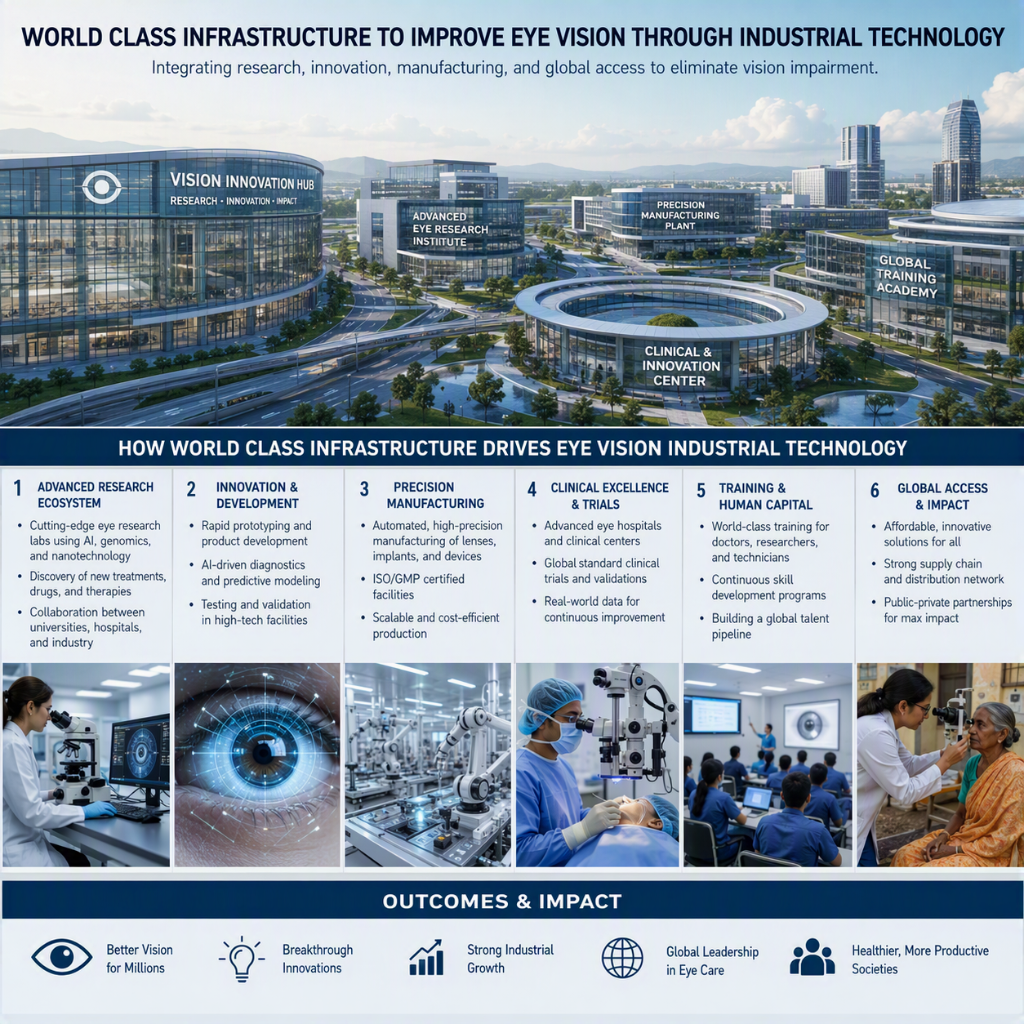
How world class infrastructure would develop to improve eye vision industrial technology?

Developing world-class infrastructure to improve eye vision industrial technology requires a coordinated effort across research, manufacturing, clinical delivery, and workforce education. The goal is to create an ecosystem where advanced technology is not just invented, but also produced at scale, distributed equitably, and continuously refined.🔬

Research and Development InfrastructureYou need facilities that bridge basic science and applied engineering.· Translational Research Centers: Establish dedicated hubs where neuroscientists, engineers, and clinicians collaborate. For example, the partnership between CynLr and the Indian Institute of Science (IISc) studies how biological brains process depth and motion, translating those insights into robotic vision systems .· Clinical Trial Networks: Build networks of eye hospitals equipped for large-scale validation of new AI tools. The University of Michigan and Aravind Eye Care System partnership provides graduate training in epidemiology and builds a sustainable research ecosystem for non-communicable eye diseases .·

Genetic and Molecular Facilities: Support facilities that can screen for genetic mutations associated with conditions like glaucoma and corneal dystrophies, moving toward personalized diagnostics .

🏭 Advanced Manufacturing and Supply ChainTo make technology accessible, you need the industrial capacity to produce it affordably.· Cost-Reduction Engineering: Focus on designing equipment that is cheaper to manufacture without sacrificing quality. Domestic manufacturers in India reduced vitrectomy system costs by 46% (from ₹52-87 lakhs to ₹28-35 lakhs), which lowered the break-even point for new surgical centers .·

Low-Cost Device Innovation: Support the development of ultra-affordable alternatives. An AI-integrated portable slit-light device was developed for under USD 500, making quantitative anterior-segment imaging feasible for community screening .·

Precision Optics Production: Invest in modern lens manufacturing technologies like digital free-form surfacing and molding processes.

These allow for the production of complex, customized lenses at scale .🏥 Clinical Delivery and Telehealth NetworksInfrastructure must connect patients to technology, regardless of geography.· Hub-and-Spoke Models: Create a tiered system. A “quaternary” referral center (like LVPEI in Hyderabad) handles complex cases, while smaller “vision centers” in rural areas provide primary screening and tele-consultation .· Portable and Tele-Ophthalmology Tools: Deploy smartphone-based slit lamps and portable AI devices. These tools allow for AI-enabled analysis of dry eye, cataracts, and corneal ulcers in areas without traditional clinics . A single scanning-slit video can be fully processed on a compact device in about 18.5 seconds, enabling battery-powered deployment .· Vision Center Expansion: Scale up the number of primary care points. A Public-Private Partnership in Bihar is setting up 200 state-of-the-art vision centers across 38 districts, equipped with auto-refractometers and telemedicine systems .🎓

Workforce Education and StandardsTechnology is only as good as the people operating it.· Global Competency Frameworks: Adopt standardized education models.

The World Council of Optometry’s new framework defines five key domains: Refractive Error, Visual Function Assessment, Ocular Health & Disease, Public Health, and Professional Practice .·

Integrating AI Ethically: Curricula must teach AI and telehealth tools while emphasizing “robot-proof” skills like clinical judgment, empathy, and trust-building that technology cannot replace .·

Task-Shifting and Training: Train community screeners and vision technicians to perform key tasks traditionally done by optometrists. An investment of approximately $2.0 billion is needed for workforce development to expand service capacity globally .📊

Data and AI Infrastructure The “industrial technology” of vision increasingly relies on data.·

Foundation Models: Develop large-scale AI models pre-trained on diverse datasets. The SonoEye model, for example, was trained on 215,356 image-text pairs to stratify risk for 18 eye diseases with 98.3% screening sensitivity .· AI-Enabled Screening Pipelines: Build systems that automate image quality control, region-of-interest detection, and disease-specific prediction. These pipelines allow portable devices to deliver clinical-grade assessments .In short, world-class infrastructure isn’t just about buying the best machines. It’s about building a self-reinforcing loop: research creates better technology, manufacturing makes it affordable, clinical networks deliver it widely, and a trained workforce uses it effectively.

how does vision lifecycle work?

The vision lifecycle describes how your eyes and visual system develop, mature, peak, and eventually decline across your lifetime. It’s shaped by biology, environment, and how well you care for your eyes.Here’s the full journey:👶

1. Infancy (0–2 years): Building the Foundation· At birth: Vision is blurry—roughly 20/400. Babies can only see high-contrast shapes and faces close up.· 0–3 months: Eyes begin tracking movement. Color vision starts developing.· 3–6 months: Depth perception and eye-hand coordination emerge. Both eyes learn to work together.· 6–12 months: Visual acuity improves rapidly. The brain forms critical neural pathways for vision.· Critical window: If a problem (like a cataract or misalignment) isn’t corrected now, permanent vision loss (amblyopia) can occur.🧒

2. Childhood (2–12 years): Refinement and Risk· 2–5 years: Vision reaches near-adult levels (20/20). Color vision and fine detail recognition mature.· 6–12 years: Eyes grow rapidly. Myopia (nearsightedness) often begins here, especially with heavy screen use and less outdoor time.· Key risk: Uncorrected refractive errors can cause learning difficulties and permanent visual deficits.🧑

3. Adolescence (13–18 years): Peak Growth and Myopia Progression· Eyeball continues to elongate, often worsening myopia.· Hormonal changes can affect tear production and cause dry eyes.· Screens and study increase eye strain.· Peak visual acuity is typically reached by late teens—around 20/20 or better if corrected.🧑‍🦱

4. Young Adulthood (19–40 years): The Golden Years of Vision· Best vision of your life. Focusing ability is at its maximum.· Presbyopia hasn’t started yet. The natural lens is still flexible.· Main risks: Digital eye strain, dry eyes, sports injuries, and early signs of retinal problems.· Protective habits now (UV protection, good nutrition, regular exams) pay off later.

🧑‍🦳 5. Middle Age (40–60 years): Presbyopia and Early Disease· Presbyopia begins around 40: The lens stiffens, making near focus harder. Reading glasses or progressives become necessary.· Tear production decreases: Dry eye becomes more common.· Disease risk rises: Glaucoma, diabetic retinopathy, and macular degeneration may start silently.· Contrast sensitivity and night vision begin to decline gradually.👴

6. Older Age (60+ years): Decline and Disease Management· Cataracts: The lens becomes cloudy—very common after 60. Surgery restores vision.· Macular degeneration: Central vision loss, affecting reading and face recognition.· Glaucoma: Optic nerve damage, often from high eye pressure. Can cause tunnel vision.· Diabetic retinopathy: Blood vessel damage from diabetes.· Reduced peripheral vision, slower adaptation to light changes, and dry eyes are common.· Regular eye exams become critical to catch and manage disease early.🔄

7. End of Life: Vision as a Quality-of-Life Factor· Vision loss in late life is linked to falls, depression, cognitive decline, and reduced independence.· Low vision rehabilitation (magnifiers, screen readers, AI tools) helps maintain quality of life.· AI and bionic eye technology are emerging to restore some vision in severe cases.📊 Summary: The Vision Lifecycle at a GlanceStage Age Key Changes Main RisksInfancy 0–2 Vision develops rapidly Amblyopia, misalignmentChildhood 2–12 Acuity matures, myopia starts Uncorrected refractive errorsAdolescence 13–18 Myopia progresses Eye strain, dry eyesYoung Adult 19–40 Peak vision Digital strain, injuriesMiddle Age 40–60 Presbyopia, early disease Glaucoma, dry eyeOlder Age 60+ Cataracts, disease AMD, glaucoma, retinopathyEnd of Life 80+ Significant loss possible Falls, depression, isolation🧠 Key InsightYour vision lifecycle is not fixed—it’s shaped by:· Genetics (family history)· Environment (screens, UV, pollution)· Lifestyle (diet, exercise, smoking)· Healthcare (regular exams, timely correction)The best time to protect your vision is now, at whatever stage you’re in.

Similar search you can search more on web like…!

Would you like to explore how to slow vision decline at a specific stage?

how eye vision improve when you cared yourself with proper wearing of eye spectacles?

When you wear your spectacles properly and consistently, your vision improves through a combination of optical, neurological, and muscular changes. Here’s what happens:👁️

1. Light Focuses Correctly on the Retina· Before glasses: Light focuses in front of or behind the retina, causing blur.· With proper glasses: The lens bends light so it lands exactly on the retina.·

Result: Images become sharp and clear immediately.🧠

2. The Brain Learns to Interpret Signals Better· Your brain’s visual cortex adapts to the new, clearer input.· Within days to weeks: The brain “recalibrates” and learns to process the sharper signals more efficiently.· Result: You don’t just see better—you understand what you see faster (better contrast sensitivity, depth perception, and recognition).💪

3. Eye Muscles Relax (No More Squinting)· Without glasses: Your ciliary muscle and eye muscles work overtime trying to focus. This causes eye strain, headaches, and fatigue.· With proper glasses: The lens does the focusing work. Your muscles relax.· Result: Less strain, fewer headaches, and more comfortable vision for longer periods.🔄

4. Binocular Vision Improves (Both Eyes Work Together)· If one eye has a different prescription, proper glasses balance both eyes.· The brain can then fuse two images into one 3D image.· Result: Better depth perception, coordination, and reduced double vision.🚫

5. Prevents Further Deterioration (In Some Cases)· In children: Proper glasses can prevent amblyopia (lazy eye) and strabismus (crossed eyes) from worsening.· In adults: Glasses don’t “cure” myopia, but they reduce eye strain that can worsen symptoms.· In presbyopia: Reading glasses reduce the strain of constant near-focus effort.🧩

6. Neuroplasticity: The Brain Rewires Itself· Studies show that wearing correct glasses changes how the brain processes visual information.· The brain creates new neural pathways to handle the clearer input.· Result: Even after removing glasses, some people briefly experience slightly improved visual memory and processing—though the optical error remains.⚠️

What Proper Wearing Means· Consistent use: Wearing them as prescribed (all day, or only for reading, etc.).· Correct fit: Glasses sitting properly on your nose, pupils centered.· Clean lenses: Dirty or scratched lenses reduce clarity.· Updated prescription: Wearing old glasses can cause strain, not improvement.📈 Summary:

What ImprovesArea ImprovementClarity Immediate sharpnessComfort Less strain, fewer headachesDepth perception Better 3D visionBrain processing Faster recognitionEye coordination Both eyes work togetherLong-term health Prevents worsening in childrenBottom line:

Proper spectacles don’t “exercise” your eyes to make them stronger—they remove the barrier between your eye and clear vision. The improvement comes from correct optics + brain adaptation + relaxed eye muscles working together.Would you like to know how long it typically takes to adapt to a new prescription?

How does vision software working in improving technology of spectacles through improving lens technology?

Vision software is the “brain” that translates your unique visual needs into a precise lens design. It works by simulating how light will interact with your eye and a potential lens, then using algorithms to find the optimal shape.🧠

How the Software “Thinks” The core process involves creating a virtual model of your eye and the lens, then running millions of light-ray simulations to minimize visual errors.· Simulation & Ray Tracing: The software builds a model of the “lens-eye system” using your prescription, frame measurements, and viewing habits. It then traces how light rays pass through the lens to your retina at hundreds of different gaze directions .· Optimization (The “Merit Function”):

It uses a mathematical formula (a “merit function”) to score the design. The goal is to minimize the difference between where light should focus (target) and where it actually focuses (error) across the entire lens surface .·

Iterative Refinement: The software adjusts the lens’s free-form surface over and over until it finds the design with the lowest possible error, creating a lens that corrects vision precisely for how you move your eyes and head .⚙️

Key Technologies in Modern Software· Digital Free-Form Surfacing: Instead of using pre-made molds, software controls a diamond-cutting tool to carve your unique prescription directly onto the lens. This enables complex designs (like aspheric or atoric lenses) that reduce peripheral distortion and make high prescriptions thinner .·

Physics-Informed Neural Networks (PINNs): Newer AI models use physics equations as a guide. This allows for highly accurate simulation of the lens’s “sagittal height” (surface shape), improving optical performance and reducing the computation time needed to design progressive lenses .·

AI and Genetic Algorithms: Some systems use genetic algorithms to automatically search for the best lens shape that minimizes spherical aberration. Others use AI to analyze your eye movement patterns and viewing habits to further personalize the lens zones .📊

What This Means for Your Glasses The precision of this software directly translates into tangible benefits:· Sharper Vision: By minimizing “higher-order aberrations” (visual imperfections beyond simple blur), digital lenses provide clearer, crisper vision, especially at night .·

Less Eye Strain: Because the lens is optimized for your natural posture and gaze angles, your eye muscles don’t have to work as hard to compensate for lens flaws .·

Wider Clear Field: The software reduces distortion at the edges, so you can comfortably use the entire lens area without having to turn your whole head .

If you’re curious you can explore more it on searching about how these designs are physically manufactured or what “wavefront” technology means for your prescription, feel free to ask.

How does spectacles technology work?

Spectacles technology works by bending light before it enters your eye, so it lands exactly on the retina—the light-sensitive layer at the back of the eye—instead of in front of it or behind it. Here’s the full picture:🔬 The Core Principle: RefractionYour eye has two main focusing elements:·

Cornea (fixed focus)· Lens (adjustable focus)When these don’t bend light correctly, you get a refractive error. Spectacles add a third focusing element in front of the eye to correct it.👓

How Each Lens Type Works1.

Myopia (Nearsightedness)· Problem: Eye is too long, or cornea too curved. Light focuses in front of the retina.· Fix: Concave (minus) lenses—thinner at center, thicker at edges. They diverge light slightly before it enters the eye, pushing the focus back onto the retina.

2. Hyperopia (Farsightedness)· Problem: Eye is too short, or cornea too flat. Light would focus behind the retina.· Fix: Convex (plus) lenses—thicker at center, thinner at edges. They converge light, pulling the focus forward onto the retina.

3. Astigmatism· Problem: Cornea is shaped like a rugby ball instead of a basketball. Light focuses at two different points.· Fix: Cylindrical lenses—curved in one direction only. They correct the uneven focus, bringing both points together.

4. Presbyopia (Age-related)· Problem: The eye’s natural lens loses flexibility, so it can’t focus up close.· Fix: Progressive or bifocal lenses—different zones for distance, intermediate, and near vision.⚙️

Modern Lens Technology

1. Lens Materials· CR-39 (plastic): Standard, lightweight, good optics.· Polycarbonate: Impact-resistant, built-in UV protection. Good for kids and sports.· Trivex: Lightweight, high clarity, impact-resistant.· High-index (1.67, 1.74): Thinner and lighter for strong prescriptions.

2. Coatings· Anti-reflective (AR): Reduces glare, improves night vision, makes lenses look nearly invisible.· Scratch-resistant: Hard coat on top.· UV400: Blocks 100% of UVA/UVB.· Blue light filter: Reduces screen glare (evidence mixed, but many find it comfortable).· Hydrophobic/oleophobic: Repels water and oil.

3. Special Designs· Aspheric: Flatter curve, thinner, reduces distortion at edges.· Digital/Free-form: Computer-designed for your exact prescription and frame shape.· Photochromic: Darken in sunlight, clear indoors.🧠

The Brain’s RoleSpectacles don’t just fix the eye—they retrain the brain. Your visual cortex adapts to the new input. That’s why:· New glasses may feel weird for a few days.· Strong prescription changes can cause temporary dizziness.· The brain “learns” to ignore distortions at lens edges.🔮 Future Tech· Smart glasses: AR displays, health monitoring.· Adaptive lenses: Auto-focus like the human lens.· Wavefront-guided:

Custom correction beyond standard prescriptions.

Tags

Would you like me to go deeper into any specific lens type or coating?

How to find best eye spectacles which are helping improving vision and eyesight and fitable in wearing around face?

Finding the best spectacles comes down to balancing three things: correct vision, comfortable fit, and personal style.

A beautiful frame is useless if it slips or gives you headaches, and a perfect optical fit means nothing if you dread wearing it.Here is a step-by-step guide to finding your ideal pair.👁️

Step 1: Get the Vision Right (The Lenses)The frame is the hardware; the lenses are the software that actually fixes your sight.· Match Lens Index to Your Prescription: If you have a strong prescription, standard lenses will look thick and heavy. Ask for high-index lenses. They bend light more efficiently, so you need less material. This makes them thinner, lighter, and more flattering . Indices like 1.67 or 1.74 are common for stronger prescriptions .·

Consider Aspheric Design: These lenses have a flatter curve than standard ones. They are often thinner and reduce the “bug-eye” magnification (for farsightedness) or “bottle-bottom” minification (for nearsightedness) effect .·

Material Matters: Polycarbonate or Trivex are excellent if you need impact resistance (for sports, children, or safety) as they are very durable and lightweight .📐

Step 2: Get the Fit Right (The Frame)This is the most critical step for comfort. If your glasses hurt or slide, you won’t wear them.· Bridge Fit (The #1 Cause of Slipping): Your nose shape determines if glasses stay up. · High Bridge: Frames often slide down. Look for keyhole bridges or adjustable nose pads that can grip the higher, narrower part of your nose . ·

Low/Flat Bridge: Standard frames often slide off. You need frames specifically designed with a lower, wider bridge or larger nose pads. These sit higher on your nose and prevent your cheeks from pushing the glasses up when you smile .·

Width and Temple Length: The frame front should be about as wide as your face. The temples (arms) should be long enough to reach behind your ears without pinching. If you have a larger head or long face, look for long-temple frames (145mm or more) to prevent tightness or slipping .· The “Smile Test”: When you try frames on, smile broadly. If the frame lifts off your nose or the lenses press hard into your cheeks, the fit is wrong. It will only get more annoying in daily life .🎨

Step 3: Match to Your Face Shape (The Style)

Use your face shape as a guide, not a rule. The goal is usually to create balance.· Round Face: Add angles. Rectangular or geometric frames add structure and definition to soft curves .·

Square Face: Soften the angles. Round or oval frames provide a nice counterpoint to a strong jawline .· Heart-Shaped Face (Wider Forehead): Balance the width with frames that are slightly wider than your forehead or rimless styles. Rounder lower rims work well .·

Oval Face: You are lucky; most shapes suit you. Just avoid frames that are extremely narrow, which can exaggerate length .·

Long Face: Break up the vertical line with frames that have more depth (taller lenses). Very narrow frames will make your face look longer .💡

Practical Final Checks Before you commit, do a quick physical check:· Eye Position: Your pupils should sit roughly in the center of the lenses (or slightly above center) .·

Weight: Do they feel heavy on your nose after a few minutes? Lighter materials like titanium help here .·

Professional Adjustment: Always buy from a place that will adjust the frames to your face (bending the temples, adjusting nose pads). A good optician can make a decent frame fit perfectly, but a bad fit will never improve on its own .If you want, tell me your prescription strength and face shape, and I can give you more specific pointers on what to look for.

how does eye helps in shaping the world?

The eye doesn’t just see the world—it actively shapes it. Here’s how:🌍

1. The Eye Built civilization Navigation & migration: Vision let early humans read landscapes, stars, and seasons—enabling migration, agriculture, and maps.· Writing & records: The eye→hand→tool loop created writing, mathematics, and eventually science. Without vision, no written language.· Architecture & engineering: Every structure was imagined visually first. The eye allows mental simulation of 3D space before building.🎨

2. The Eye Created Culture· Art & aesthetics: Painting, sculpture, film—all exist because we have eyes that respond to color, contrast, and form.· Symbols & meaning: Letters, numbers, religious icons, traffic signs—all are visual codes the eye decodes.· Fashion & design: What we wear, build, and buy is driven by visual preference.🧠

3. The Eye Shapes How We Think· Visual metaphors dominate language: “I see your point,” “clear vision,” “bright idea,” “dark future.” We think in visual terms even about abstract things.· Memory & imagination: Most people “see” their memories and imagine in pictures. Vision is the primary interface of thought.· Perspective & depth: Binocular vision taught us that two viewpoints create a richer truth—a foundation of philosophy and art.🔬

4. The Eye Drives Science & Technology· Observation → discovery: Telescopes, microscopes, cameras—all extensions of the eye. They let us see cells, galaxies, and atoms.· Computer vision: AI learns to “see” by mimicking the eye-brain system. Cameras, LiDAR, and facial recognition are technological eyes.· Medical imaging: X-rays, MRI, OCT—we convert invisible signals into images the eye can read.❤️

5. The Eye Connects Us Emotionally· Eye contact: Builds trust, love, and empathy. Infants bond through gaze.· Reading emotion: Micro-expressions in the eyes reveal fear, joy, sadness—social glue.· Shared attention: When two people look at the same thing, they create shared reality—the basis of community.🧩

6. The Eye Limits and Defines Reality· We only see visible light (400–700 nm)—a tiny slice of the electromagnetic spectrum. Our “world” is shaped by what our eyes can’t see too.· Illusions reveal brain rules: Optical illusions show the eye-brain system doesn’t just record—it constructs reality.· Color is invented: Objects don’t have color; the eye-brain creates it. The world is literally painted by our biology.🔄 In ShortThe eye is not a passive window. It is an active sculptor—of knowledge, culture, technology, emotion, and reality itself. Without eyes, the human world as we know it would not exist.Would you like to explore how AI is learning to “shape the world” through computer vision, or how vision loss changes a person’s reality?