
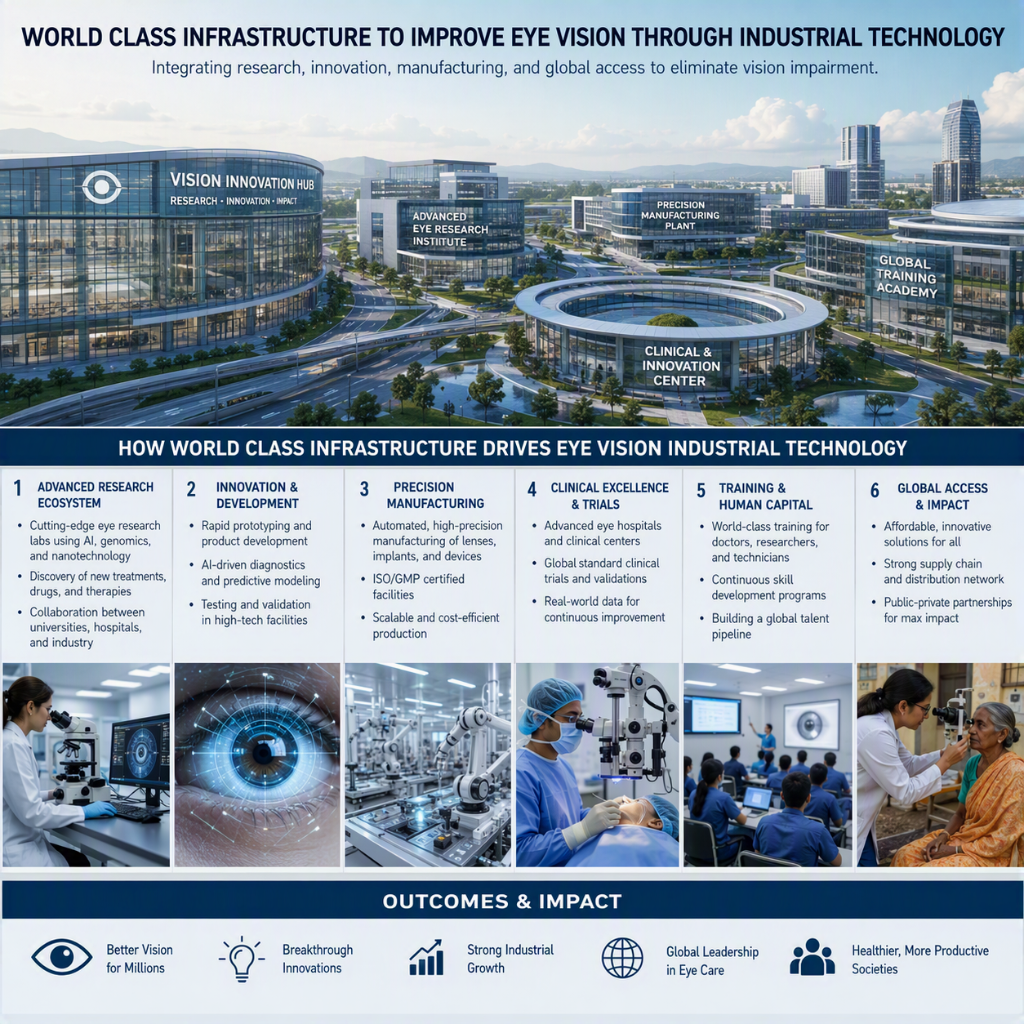
Developing world-class infrastructure to improve eye vision industrial technology requires a coordinated effort across research, manufacturing, clinical delivery, and workforce education. The goal is to create an ecosystem where advanced technology is not just invented, but also produced at scale, distributed equitably, and continuously refined.🔬
Research and Development InfrastructureYou need facilities that bridge basic science and applied engineering.· Translational Research Centers: Establish dedicated hubs where neuroscientists, engineers, and clinicians collaborate. For example, the partnership between CynLr and the Indian Institute of Science (IISc) studies how biological brains process depth and motion, translating those insights into robotic vision systems .· Clinical Trial Networks: Build networks of eye hospitals equipped for large-scale validation of new AI tools. The University of Michigan and Aravind Eye Care System partnership provides graduate training in epidemiology and builds a sustainable research ecosystem for non-communicable eye diseases .·
Genetic and Molecular Facilities: Support facilities that can screen for genetic mutations associated with conditions like glaucoma and corneal dystrophies, moving toward personalized diagnostics .
🏭 Advanced Manufacturing and Supply ChainTo make technology accessible, you need the industrial capacity to produce it affordably.· Cost-Reduction Engineering: Focus on designing equipment that is cheaper to manufacture without sacrificing quality. Domestic manufacturers in India reduced vitrectomy system costs by 46% (from ₹52-87 lakhs to ₹28-35 lakhs), which lowered the break-even point for new surgical centers .·
Low-Cost Device Innovation: Support the development of ultra-affordable alternatives. An AI-integrated portable slit-light device was developed for under USD 500, making quantitative anterior-segment imaging feasible for community screening .·
Precision Optics Production: Invest in modern lens manufacturing technologies like digital free-form surfacing and molding processes.
These allow for the production of complex, customized lenses at scale .🏥 Clinical Delivery and Telehealth NetworksInfrastructure must connect patients to technology, regardless of geography.· Hub-and-Spoke Models: Create a tiered system. A “quaternary” referral center (like LVPEI in Hyderabad) handles complex cases, while smaller “vision centers” in rural areas provide primary screening and tele-consultation .· Portable and Tele-Ophthalmology Tools: Deploy smartphone-based slit lamps and portable AI devices. These tools allow for AI-enabled analysis of dry eye, cataracts, and corneal ulcers in areas without traditional clinics . A single scanning-slit video can be fully processed on a compact device in about 18.5 seconds, enabling battery-powered deployment .· Vision Center Expansion: Scale up the number of primary care points. A Public-Private Partnership in Bihar is setting up 200 state-of-the-art vision centers across 38 districts, equipped with auto-refractometers and telemedicine systems .🎓
Workforce Education and StandardsTechnology is only as good as the people operating it.· Global Competency Frameworks: Adopt standardized education models.
The World Council of Optometry’s new framework defines five key domains: Refractive Error, Visual Function Assessment, Ocular Health & Disease, Public Health, and Professional Practice .·
Integrating AI Ethically: Curricula must teach AI and telehealth tools while emphasizing “robot-proof” skills like clinical judgment, empathy, and trust-building that technology cannot replace .·
Task-Shifting and Training: Train community screeners and vision technicians to perform key tasks traditionally done by optometrists. An investment of approximately $2.0 billion is needed for workforce development to expand service capacity globally .📊
Data and AI Infrastructure The “industrial technology” of vision increasingly relies on data.·
Foundation Models: Develop large-scale AI models pre-trained on diverse datasets. The SonoEye model, for example, was trained on 215,356 image-text pairs to stratify risk for 18 eye diseases with 98.3% screening sensitivity .· AI-Enabled Screening Pipelines: Build systems that automate image quality control, region-of-interest detection, and disease-specific prediction. These pipelines allow portable devices to deliver clinical-grade assessments .In short, world-class infrastructure isn’t just about buying the best machines. It’s about building a self-reinforcing loop: research creates better technology, manufacturing makes it affordable, clinical networks deliver it widely, and a trained workforce uses it effectively.