What is the use of lens in making and analazying small nano & microbes objects?

Lenses are essential tools for both making and analyzing nano-objects, but they work in fundamentally different ways depending on the task: optical lenses use light to manipulate or observe, while electron lenses use electromagnetic fields to achieve atomic-scale resolution.

🔬 Making Nano-Objects: Optical Lithography

For manufacturing, lenses focus light to “write” patterns on a tiny scale.

· Immersion Lithography: A high-index liquid (like water) is placed between the lens and the silicon wafer, increasing the Numerical Aperture (NA) and allowing smaller features to be printed.
· Solid Immersion Lens (SIL): A high-index solid lens is placed in near-contact with the sample. It focuses light into a spot smaller by a factor of the material’s index (n or n²), enabling sub-wavelength patterning.

👁️ Analyzing Nano-Objects: Breaking the Diffraction Limit

For observation, lenses either enhance optical resolution or switch to electrons entirely.

· Super-Resolution Optical Techniques: Microsphere lenses placed near the sample convert near-field (evanescent) waves into propagating ones, allowing standard microscopes to resolve features as small as 65–87 nm. Metasurfaces (flat lenses) can also track nanoparticles with 10 nm accuracy.
· Electron Lenses (TEM/SEM): Because electrons have much shorter wavelengths, electromagnetic “lenses” can resolve down to sub-0.1 nm (atomic scale). This is far beyond the ~200 nm limit of visible light.

🎯 Manipulating Nano-Objects: Optical Tweezers

Lenses are also used to trap and move individual nanoparticles.

· Optical Tweezers: A tightly focused laser beam creates a gradient force that holds a particle at the focus. By steering the beam, particles can be moved, stretched (like DNA), or sorted.

If you’d like to dive deeper into a specific technique, such as how immersion lithography prints chips or how electron lenses correct aberrations, feel free to ask.
what is the scope of vision technology?

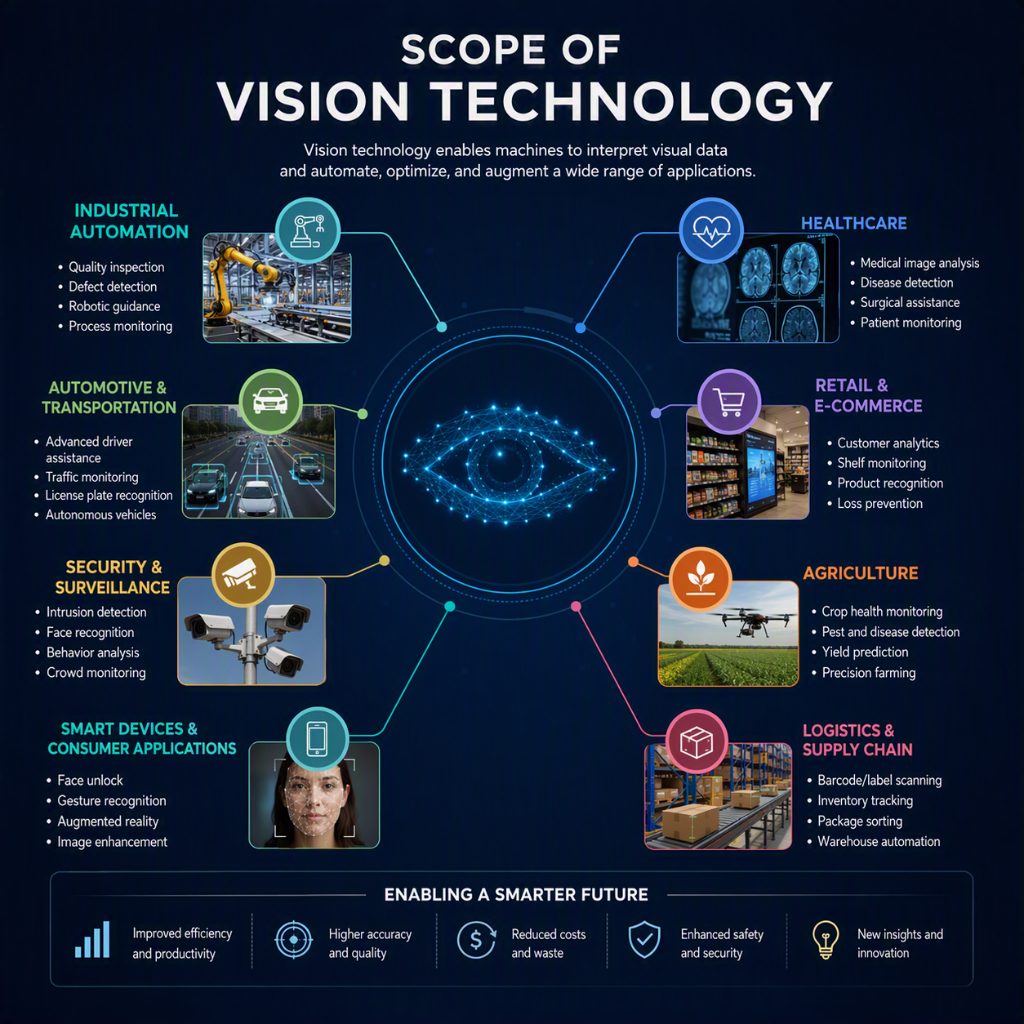
The scope of vision technology is remarkably broad, spanning from correcting basic refractive errors to restoring sight and even revealing signs of systemic diseases. It bridges clinical ophthalmology, advanced engineering, and artificial intelligence.🔬

Clinical Vision Care & Correction This is the most established scope, focused on diagnosing and correcting vision problems. It includes designing spectacle lenses, contact lenses, and intraocular lenses (IOLs), as well as fitting low vision aids like magnifiers and telescopes for patients with partial sight . Modern ophthalmic optics has moved toward free-form technology, allowing lenses to be digitally designed for a user’s unique requirements .🧠 AI-Powered Diagnostics & ScreeningArtificial intelligence is expanding how eye diseases are detected and monitored. Vision-language foundation models like RETFound and VisionFM can diagnose conditions such as diabetic retinopathy and glaucoma with high accuracy (AUC exceeding 0.90) across diverse datasets . AI also makes advanced imaging practical: a method called RRTGAN reduces the data needed for adaptive optics imaging by three-fourths, enabling cellular-level retinal scans in busy clinics . The eye is also being explored as a “canary in the coal mine” for systemic conditions like Alzheimer’s and heart disease through AI-powered retinal analysis .⚙️ Vision Restoration & ProstheticsFor irreversible vision loss, the scope extends to neural prosthetics that bypass damaged eye structures. The SIGHTED project is developing a 1,000-electrode implant that stimulates the lateral geniculate nucleus (LGN) in the brain, aiming for high-resolution vision restoration with human trials planned . At EPFL, researchers use AI models to predict optimal stimulation patterns for cortical prosthetics, aiming to evoke images of faces and objects rather than simple light spots . Commercial efforts like Neuralink’s Blindsight also target direct brain stimulation .🏭 Industrial & Computer VisionVision technology has a massive footprint in manufacturing and automation. Vision AI systems inspect products on assembly lines in real time, detecting surface defects, misalignments, or missing components with far greater accuracy than human eyes—essential in semiconductor production with its 2,000+ process steps . Beyond manufacturing, computer vision enables autonomous vehicles to recognize road signs and pedestrians, and powers retail shelf monitoring for real-time inventory updates .💡 Emerging FrontiersThe field is also expanding into augmented vision—AR systems that don’t just correct vision but enhance it beyond traditional glasses, offering task-specific visual enhancements and modifying the incoming light field .

Visual prosthetics are moving toward object-level perception, and research is exploring whether the same AI modeling can restore hearing through cochlear implants .Would you like to explore a specific area in more depth, such as AI foundation models for diagnostics or the engineering behind vision prosthetics?

What is the use of artificial vr ar headsets?

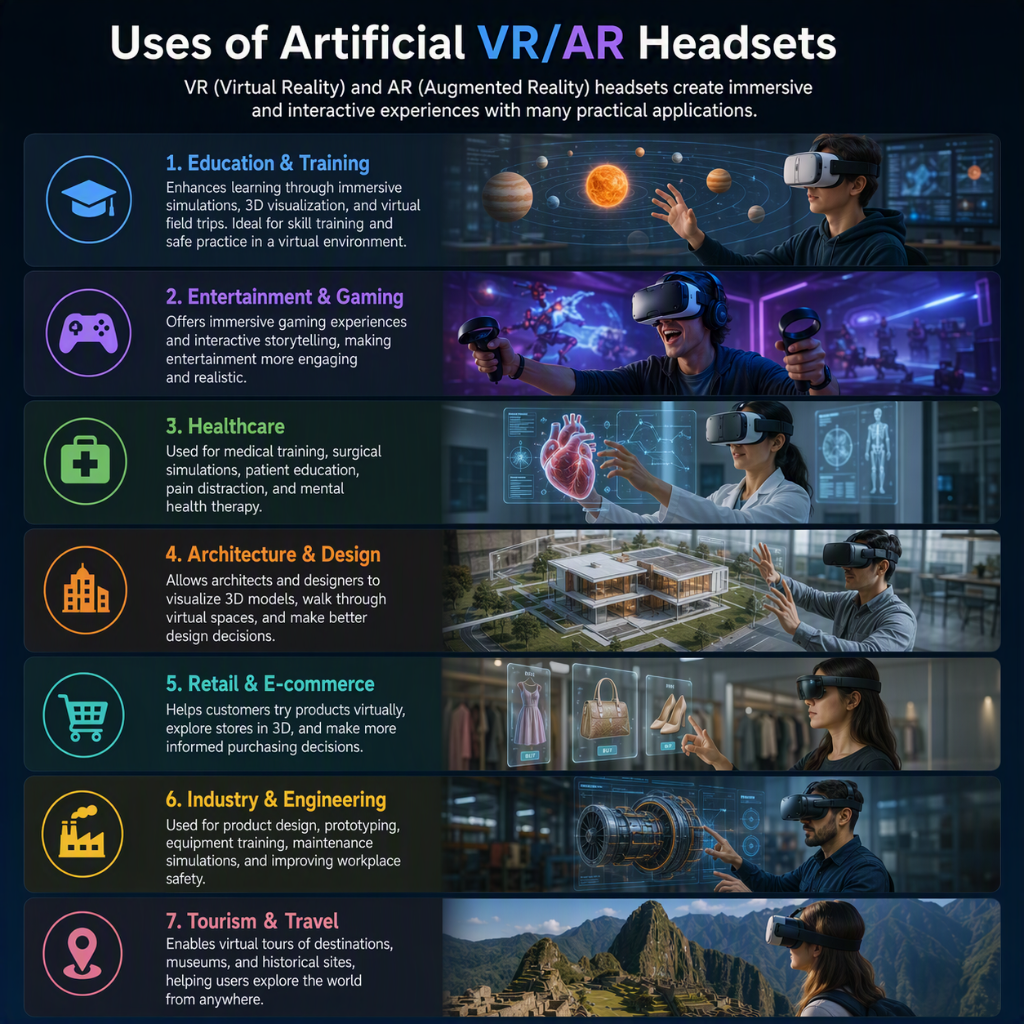
Artificial VR/AR headsets are primarily used to overlay digital intelligence onto the real world, transforming how people work, learn, and interact. Their core value is delivering context-aware information and guidance without requiring you to look away at a screen.🏭 Professional & Industrial TrainingThis is one of the most mature applications. Headsets create safe, repeatable environments for high-stakes skills.· Surgical & Medical Training: Doctors train on AI-generated virtual patients that react in real-time.

If a mistake is made, the system simulates consequences like bleeding or vital changes, offering a “quiet guidance layer” to correct technique without risking real lives.· Industrial & High-Risk Safety: Workers practice rare, dangerous scenarios (like nuclear reactor coolant failures or chemical plant emergencies) repeatedly. The AI varies each simulation so people learn to react, not just memorize steps.· Enterprise Productivity: Technicians can pull up interactive, on-screen instruction guides that appear alongside real-world equipment, helping them navigate unfamiliar wiring or machinery without pausing to consult a manual.🩺

Clinical & Surgical NavigationAR headsets are moving into operating rooms as a software-only navigation tool.· Mixed Reality Neurosurgery: The ARGUS AI platform overlays reconstructed 3D CT/MRI scans and highlighted tumour/risk structures directly into the surgeon’s field of view. This replaces bulky hardware, reducing cognitive load and potentially cutting the cost of advanced navigation by over 80%.🧠 Smart Assistants & Context-Aware InteractionAI turns headsets from passive displays into active, hands-free helpers.· Natural Language Queries: Systems like “Words into World” let users ask compound spatial questions (e.g., “Which screwdriver is within reach on the desk?”) and receive answers grounded in 3D space, not just 2D image recognition.·

Adaptive Immersion: Samsung’s patents describe systems that automatically adjust how much virtual content you see based on your attention. If you’re focused on a task, the headset increases immersion; if you need to be aware of your surroundings, it dials back to light floating notifications.🎓 Education & Skill DevelopmentAI-powered characters and environments make learning interactive and personalized.· AI Peer Mentors: Platforms like AlgeVerse use AI-powered virtual peers in VR to give learners guidance and feedback. Users might not be able to tell which avatars are real students and which are AI.· Language & Cultural Exchange: Students from different countries can meet in a shared VR space and communicate in real-time, with AI translation breaking down language barriers.⚡ The Underlying Enabling TechnologyThese uses are made possible by several key AI-driven advances:· Foveated Rendering: Eye-tracking determines where you’re looking, rendering that area in high resolution and reducing detail in peripheral vision. This significantly reduces the computing power needed, making high-quality VR feasible on lighter headsets.· Real-Time On-Device AI: AI models are being optimized to run directly on the headset, enabling low-latency features like real-time object detection and language understanding without relying on a cloud connection.If you’re curious about a specific field like medical training or industrial maintenance, I can go deeper into how those workflows actually operate.

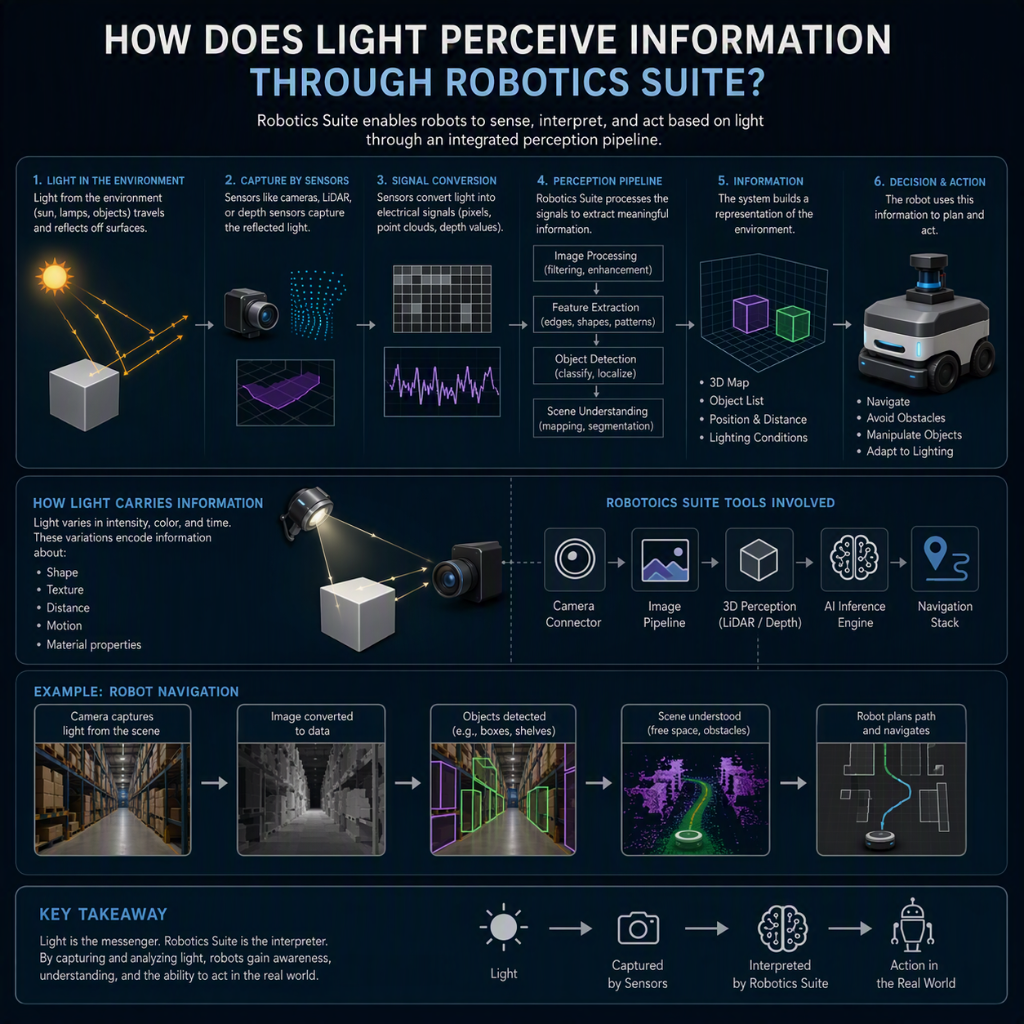
how does light percieve information through robotics suite?

In a robotics suite, light doesn’t “perceive” information on its own—it carries raw physical data that the robotic system interprets. The process works like this:💡

1. Light as an Information CarrierLight is electromagnetic radiation. When it hits an object, it changes in predictable ways:· Reflects off surfaces· Absorbs into materials· Scatters depending on texture· Refracts through transparent objects· Emits from active sources (LEDs, lasers)Each change carries information about the object’s:· Shape· Distance· Color· Material· Surface roughness· Motion📷

2. Sensing: Converting Light to DataThe robotics suite uses sensors to capture light and convert it into electrical signals:· Cameras (2D): Capture intensity and color. Each pixel becomes a number representing brightness and RGB values.· Depth Cameras (3D): Use time-of-flight (measuring how long light takes to return) or structured light (projecting patterns) to calculate distance per pixel.· LiDAR: Fires laser pulses and measures return time to build precise 3D point clouds.· Spectrometers: Measure wavelength distribution to identify materials.· Photodiodes: Detect simple presence/absence of light for triggering.🧠

3. Processing: Making Sense of Light DataRaw sensor data is meaningless without interpretation. The robotics suite processes it through:· Image Processing: Filtering, edge detection, contrast enhancement.· Computer Vision Algorithms: Object detection (YOLO, R-CNN), segmentation, feature matching.· Deep Learning: Neural networks trained to recognize patterns—faces, defects, tools, obstacles.· Sensor Fusion: Combining camera + LiDAR + IMU data to build a unified model of the environment.🔄

4. Perception: Building a World ModelThis is where “perception” actually happens. The system creates an internal representation:· Where objects are (position, orientation)· What they are (classification)· How they’re moving (tracking)· What they’re made of (material inference)· How they relate to each other (spatial reasoning)🦾

5. Action: Closing the LoopPerception drives decision-making:· Pick and place: Robot identifies object, calculates grasp point, moves arm.· Quality inspection: System detects defect from visual pattern.· Navigation: Robot maps obstacles from depth data and plans path.· Assembly: Vision guides sub-millimeter alignment.🧩 The Full Pipeline“`Light → Object Interaction → Sensor Capture → Signal Conversion → Data Processing → AI Interpretation → World Model → Decision → Robot Action → Feedback Loop“`🔬 Key InsightLight itself is passive information. The robotics suite actively interrogates light by:· Controlling illumination (structured light, lasers)· Choosing sensor types· Applying algorithms· Learning from outcomesSo the real answer: Light carries information, sensors capture it, algorithms interpret it, and the robot acts on it. The “perception” is a computational construct, not a property of light itself.

YOU CAN SEARCH MORE ABOUT on google LIKE HOW…!

Would you like to go deeper into a specific sensing method, like structured light or LiDAR?

what technology helping in improving industrial robotics eye vision industrial manufacturing of products?

Several key technologies are converging to give industrial robots reliable “eyes” for manufacturing tasks—ranging from object recognition to high-precision assembly.👁️

Vision Sensing Hardware The physical “eyes” of the robot rely on specialized sensors.· Global Shutter Sensors: Unlike rolling shutter cameras, these capture the entire frame simultaneously, eliminating motion blur when robots move quickly. This is crucial for accurate positioning on fast-moving production lines.· 2.5D and 3D Depth Perception: Systems like OnRobot’s “Eyes” provide 2.5D vision (length, width, and a degree of height), ideal for recognizing different parts for CNC machine loading or palletizing. True 3D sensors (like Teledyne’s Optimom 5D) generate detailed depth maps, allowing robots to handle complex shapes or transparent materials.·

360-Degree Sensors: The Fraunhofer “SensePRO” sensor uses a rotating laser “measuring curtain” to provide a 360-degree view. This prevents blind spots on complex workpieces, ensuring the robot always knows its position for gluing or welding.🧠

AI and Software for RecognitionHardware provides data; software gives it meaning.·

Deep Learning for Object Detection: Algorithms like YOLO are used to identify and locate objects in real time. For instance, one system achieved a 95.54% detection accuracy on a moving conveyor belt.· Synthetic Data and Generative AI: Training AI requires massive datasets. GANs (Generative Adversarial Networks) create realistic counterfeit images, helping the robot learn to recognize objects even when real-world training data is limited. Digital twins also generate labeled data for robust adaptation.·

CAD-Model Matching: For precise bin picking, software projects a 3D CAD model into 2D views, forms a point cloud, and uses algorithms like Iterative Closest Point (ICP) to match it with the real object seen by the camera.🎯 Precision and Control Technologies

Getting the robot to act on what it sees requires tight integration.·

Visual Servoing: This technique uses image feedback to control the robot’s motion. The GS-UNet framework uses a deep learning model to detect keypoints and guide the robot, achieving sub-millimeter assembly accuracy (0.27–0.49 mm position error).· Eye-in-Hand Configuration: Mounting the camera on the robot’s wrist (end-effector) provides a flexible, close-up view. This setup, combined with deep learning, enables accurate pick-and-place even with a low-cost 2D camera.·

Dynamic Grasping: To catch moving targets on a conveyor, systems use Kalman filters for trajectory prediction and deep reinforcement learning (SAC) to overcome delays, achieving a 92.5% dynamic grasping success rate.🏭 Integration PlatformsSoftware platforms tie everything together for ease of use.·

ABB OmniCore EyeMotion: This platform allows users to create vision applications by dragging and dropping function blocks. It can reduce commissioning time by up to 90% and shorten cycle times by up to 50%.· Robot Operating System (ROS): A common open-source framework used in research and industry to integrate robot arms, cameras, and deep learning models into a cohesive system.Are you interested in a specific application, such as bin picking or assembly?