What are the key APIs and SDKs for building AR — ARKit, ARCore, OpenXR, WebXR?

The key APIs and SDKs for building AR each serve a distinct purpose, from platform-specific development to cross-platform standards and web-based accessibility.🍎

ARKit (Apple) ARKit is Apple’s native framework for building AR experiences on iOS, iPadOS, and visionOS . It provides the essential building blocks like motion tracking (6DoF), scene understanding (plane detection, image/object tracking), and people occlusion.

You typically pair ARKit with RealityKit for high-performance 3D rendering or SceneKit for simpler scenes .🤖

ARCore (Google)ARCore is Google’s cross-platform SDK for Android and iOS . Its core capabilities mirror ARKit: motion tracking, environmental understanding (detecting horizontal/vertical surfaces), and light estimation . A standout feature is Geospatial API, which uses Google’s Street View data for precise outdoor location anchoring, and Cloud Anchors for persistent, shared AR experiences .🌐

OpenXR (Khronos Group) OpenXR is not a specific AR SDK but an open, royalty-free standard for accessing VR/AR devices and runtimes .

Its goal is to let developers write code once and run it across many headsets (like Meta Quest, HoloLens, and SteamVR) without rewriting for each platform . It abstracts device features like display, tracking, input, and haptics into a unified API .🕸️

WebXR (W3C) WebXR is a web standard that brings AR/VR to browsers .

It lets you access immersive devices directly from a web page without installing an app.

On Android, it uses ARCore behind the scenes; on visionOS, it uses Apple’s ARKit . It’s ideal for accessible, link-shareable AR but currently supports fewer advanced features (like plane detection) compared to native SDKs .💡

How to Choose· ARKit for deep, native integration on Apple devices.· ARCore for broad reach across Android and iOS.· OpenXR when you need your app to run on many different headsets.· WebXR for instant, browser-based experiences.

Find and explore a specific use case, like building for headsets or web-based AR?

how lens innovation shapes the future of ai?

Lens innovation is not just supporting AI—it is shaping its future by providing the eyes, the speed, and the sensory data that AI needs to become more capable, more efficient, and more integrated into daily life. Here’s how:

1. Lenses Give AI Its EyesAI is only as good as the data it receives. Lenses are the primary source of visual data:AI Application Lens Role ImpactComputer vision Camera lens Object detectionFacial recognition IR + RGB lens Identity verificationAutonomous vehicles LiDAR + camera NavigationMedical AI Microscope lens DiagnosisRobotics Depth lens ManipulationDrones Multispectral lens MappingSecurity Zoom lens SurveillanceWithout lenses, AI would be blind.

2. Lens Innovation Enables New AI CapabilitiesLens Innovation AI Capability UnlockedEvent-based cameras Ultra-low latency, low power AI Meta surfaces Flat, tiny, multi-function AI eyesComputational lenses AI-powered image reconstructionLight field lenses Depth-aware AI visionHyperspectral lenses Material-aware AIPolarization lenses Surface-aware AIQuantum lenses Entangled photon AINew lenses = new AI senses.

3. Lenses Make AI FasterAI processing is limited by data quality and speed. Lens innovation removes bottlenecks:Bottleneck Lens Solution AI Speed GainLow light Large aperture lens Faster detectionMotion blur Stabilized lens Clearer framesGlare AR coating Better contrastNarrow field Wide-angle lens More contextSlow focus Liquid lens Instant focusData overload Computational lens On-lens processingBetter lenses = faster AI decisions.

4. Lenses Make AI More EfficientEnergy is AI’s biggest constraint. Lens innovation reduces computation:Approach How It Helps AI Optical preprocessing Lens does work before AIAnalog computing Light does math, not chipsDiffractive lenses Passive neural networks Metasurfaces Multi-function, one layerComputational imaging Fewer pixels, same infoEvent cameras Only changes, not framesSmart lenses = less AI computation = less energy.

5. Lenses Enable Edge AIAI is moving from cloud to device. Lenses make this possible:Edge AI Device Lens Innovation BenefitSmartphone Multi-lens array Portrait, night modeSmart glasses Waveguide lens AR overlaySmart contact lens Micro-lens Health monitoringSecurity camera AI lens On-device detectionDrone Lightweight lens Real-time decisionsRobot Depth lens Safe navigationCar LiDAR lens Instant reactionSmall lenses = powerful edge AI.

6. Lenses Enable AI to See Beyond Human VisionAI can process what humans cannot see. Lenses unlock this:Lens Type AI Sees Application Infrared Heat Night vision, security Ultraviolet UV patterns Material analysis Hyperspectral Chemical signatures Agriculture, miningPolarization Surface stress Quality controlTerahertz Through walls Security scanningQuantum Entangled photons Secure communicationAI + advanced lenses = superhuman vision.

7. Lenses Enable AI to Understand 3D SpaceDepth perception is critical for AI:Lens Technology AI CapabilityStereo lenses Depth mappingLiDAR lens 3D point cloudsStructured light Precise 3D scanningTime-of-flight lens Real-time depthLight field lens Post-capture focusHolographic lens True 3D display3D lenses = AI that understands space.

8. Lenses Enable AI to Predict and AnticipatePredictive AI needs rich, real-time data:Lens Innovation AI PredictionEye-tracking lens Where you’ll look nextGaze prediction Intent anticipationMotion tracking Where things will moveEvent camera What will changeAR lens What you need to seeAdaptive lens What you need to focus onPredictive lenses = proactive AI.

9. Lenses Enable AI-Human IntegrationThe future is AI that works with humans, not just for them:Integration Lens RoleAR glasses Overlay AI info on worldSmart contacts Invisible AI interfaceRetinal implants Direct AI-to-brainBrain-computer interface Optical neural linkEye tracking Intent detectionGaze control Hands-free interactionLenses = the interface between AI and human.

10. Lenses Enable AI to Learn BetterTraining AI requires massive visual data:Lens Innovation AI Training BenefitHigh-res lenses More detailMulti-spectral More dimensions 3D lenses Spatial understandingEvent cameras Temporal dynamicsComputational lenses Synthetic dataSimulation lenses Virtual trainingBetter lenses = better training data = smarter AI.

11. Lenses Enable Optical AI ComputingThe future of AI may be light-based:Technology How It Works AI ImpactOptical neural networks Light does matrix math 1000× fasterDiffractive deep networks Layers of lenses Passive AIPhotonic chips Light-based processors Low powerHolographic memory Light stores data Massive capacityQuantum optics Entangled photons Exponential speedupLenses are the hardware of future AI.

12. Lens Innovation + AI = New IndustriesIndustry Lens + AI InnovationHealthcare AI diagnosis via lens imaging Automotive Self-driving via LiDAR + AIAgriculture Precision farming via drone lens + AIManufacturing Quality control via machine visionSecurity Facial recognition via IR lensRetail Customer tracking via camera lensEducation AR learning via waveguide lensEntertainment VR/AR via headset lensFinance Eye-tracking security Space Autonomous exploration

13. The Co-Evolution of Lenses and AI Lens innovation ↓Better visual data ↓Smarter AI ↓AI designs better lenses ↓Even better visual data ↓Even smarter AI ↓ They improve each other in a continuous loop.

14. Real-World ExamplesCompany/Product Lens + AI InnovationTesla Camera lenses + AI = self-drivingApple LiDAR lens + AI = AR appsGoogle Lens + AI = Google LensMeta Waveguide lens + AI = AR glassesXPANCEO Smart contact lens + AI = ARNVIDIA Lens + AI = autonomous machinesBoston Dynamics Depth lens + AI = robotsJohn Deere Camera lens + AI = precision farming

15. The Future of AI Is OpticalTrend Lens RoleEdge AI Small, efficient lenses AR/VR Immersive lenses Autonomous systems Reliable, multi-modal lensesBrain-computer interface Optical neural links Quantum AI Entangled photon lenses Optical computing Light-based processors Smart contacts Invisible AI interfaces

16. The Strategic Value of Lens Innovation for AIDimension ValueSensing AI gets better eyes Speed AI reacts faster Efficiency AI uses less power Capability AI sees beyond human Integration AI merges with life Intelligence AI learns betterFuture AI becomes optical🔑

The Core IdeaLens innovation shapes the future of AI by:

1. Giving AI eyes — visual data input

2. Making AI faster — removing bottlenecks

3. Making AI efficient — optical preprocessing

4. Enabling edge AI — small, powerful lenses

5. Extending AI vision — IR, UV, hyperspectral

6. Adding 3D understanding — depth, space

7. Enabling prediction — gaze, motion, intent

8. Integrating with humans — AR, smart contacts

9. Enabling optical computing — light-based AI

10. Creating new industries — healthcare, auto, agricultureThe future of AI is not just digital—it is optical. And lenses are the key.

Every lens innovation opens a new door for AI. Every AI advance demands a better lens.

They are co-evolving toward a future where AI sees the world as clearly as—or better than—humans do.

Explore deeper into any area—like optical neural networks, event-based cameras for AI, or how smart contact lenses will interface with AI?

How does ai reshaping the structure and manufacturing of lens to improve it’s daily capability to make vision more brighter and 3d augmented?

AI is reshaping lenses from the ground up—not just making them faster or cheaper, but fundamentally changing how they are designed, manufactured, and what they can do. The result is vision that is brighter, sharper, and eventually, an augmented layer of reality itself.🔬

Reshaping the Structure: From Geometry to IntelligenceTraditional lenses are built on simple spherical curves. AI enables the design of freeform optics with complex, non-intuitive surfaces that correct aberrations impossible to fix before.· Generative Design: AI models generate optimal surface shapes from scratch, exploring millions of parameters at once. This creates lenses that squeeze maximum optical performance from a minimum of material.· Personalized Optics:

Machine learning models can predict the exact lens parameters needed for a specific patient’s eye, including higher-order aberrations that standard prescriptions miss. This is already being applied to custom scleral contact lenses.·

Dynamic Correction: Patents describe AI systems that analyze a user’s visual field and manipulate live image data to compensate for defects, enhancing what the wearer sees in real-time.🏭 Reshaping Manufacturing: The Path to “Lights Off” ProductionAI is turning lens factories into intelligent, self-optimizing systems.

The goal is autonomous manufacturing where machines monitor and adjust themselves.· Real-Time Process Control: Sensors track acoustic emissions and optical data during grinding. AI models instantly classify defects like cracks or misalignment, allowing corrections to happen mid-process instead of after a lens is ruined.· Adaptive Compensation: Graph neural networks predict how tool wear or machine vibration will affect the final surface. The system then calculates and applies the perfect compensation in real-time to hit sub-micron accuracy.· Integrated Production:

Platforms like SCHNEIDER’s Modulo system use AI to connect surfacing, coating, and edging into a single flow. The system dynamically adjusts parameters to eliminate bottlenecks and maximize throughput.👁️

Improving Daily Capability: Brighter, Sharper VisionAI is directly enhancing what the human eye can perceive, both through improved traditional lenses and entirely new categories of vision devices.· Brighter Vision: AI optimizes anti-reflective coatings and surface geometries to maximize light transmission, reducing glare and improving contrast in low-light conditions. This makes everyday vision feel noticeably brighter and clearer.· 3D Augmented Reality: The ultimate application is smart contact lenses. Companies like XPANCEO are developing lenses with integrated micro-displays that project images directly onto the retina. Because the display sits on the eye, it uses a fraction of the power of AR glasses while providing perfect optical efficiency—no brightness issues or field-of-view constraints.· Seamless Augmentation:

These lenses act as an “ambient layer of intelligence,” using onboard biosensors to monitor health while AI interprets the data and delivers augmented visual information, overlaying 3D digital content onto the real world without a bulky headset.In essence, AI is moving lenses from being passive optical tools to active, intelligent interfaces that correct, enhance, and augment human vision in ways that were purely science fiction just a few years ago.

How does lens helps in increasing eyesight capabilities?

A lens helps increase eyesight capabilities by correcting optical errors, enhancing light capture, compensating for biological limits, and in some cases, augmenting vision beyond natural human ability. Here’s how:

1. Correcting Refractive Errors — The FoundationThe eye has natural limits. A lens extends them:Error What happens Lens solutionMyopia Light focuses before retina Concave lens diverges light backHyperopia Light focuses behind retina Convex lens converges light forwardAstigmatism Light focuses at multiple points Cylindrical lens corrects one axisPresbyopia Natural lens loses flexibility Progressive/bifocal lens adds near powerResult: Light lands exactly on the retina → sharp vision.

2. Increasing Visual Acuity — Beyond 20/20A lens can push vision beyond normal:· 20/20 = standard vision· 20/15 = better than average· 20/10 = exceptional (some athletes, pilots)How:· Precise aberration correction· Wavefront-guided lens design· Custom FreeForm surfacing· Compensation for higher-order aberrationsExample: Fighter pilots and Olympic archers often wear custom lenses that correct subtle optical errors to achieve 20/10 or better.

3. Expanding Field of ViewNatural human vision:· Central vision: ~60° (sharp)· Peripheral vision: ~180° (motion detection)Lenses can expand this:Lens Type EffectWide-angle spectacle lenses Reduce peripheral distortionPanoramic lenses Wrap-around design for wider viewFresnel prisms Expand field for hemianopia patientsReverse Galilean telescopes Minify scene to fit more into viewUsed in: Driving, sports, low vision rehabilitation.

4. Magnification — Seeing the UnseenLenses magnify to reveal detail:Application Magnification HowReading glasses +1.00 to +4.00 D Simple convex lensLow vision aids 2× to 20× Telescopic systemsSurgical loupes 2.5× to 8× Prism + lens combinationMicroscopes 40× to 1000× Compound lens systemsTelescopes 10× to 1000×+ Objective + eyepiece lensesResult: Details invisible to the naked eye become clear.

5. Light Enhancement — Seeing in the DarkLenses improve night vision by:· Anti-reflective coatings — reduce light loss, more light reaches retina· High-transmission materials — let more light through· Large aperture lenses — capture more light (like a camera)· Image intensifiers — amplify available light (night vision goggles)· IR lenses — see infrared (thermal imaging)Example: Night vision goggles use lenses to focus near-infrared light onto an image intensifier, turning darkness into visible green images.

6. Contrast Enhancement — Separating Signal from NoiseLenses improve contrast by:Method How it worksPolarized lenses Block scattered light, reduce glareYellow/amber lenses Enhance contrast in low lightBlue-blocking lenses Reduce chromatic aberrationSelective absorption Filter specific wavelengthsAnti-reflective coating Reduce stray reflectionsUsed in: Shooting sports, aviation, driving, skiing.

7. Depth Perception & 3D VisionLenses help the brain judge distance:· Prism lenses — shift image position to align both eyes· Aniseikonia correction — make images equal size in both eyes· Stereoscopic lenses — enhance depth cues· VR/AR lenses — create artificial depthResult: Better hand-eye coordination, sports performance, driving safety.

8. Color Vision EnhancementLenses can enhance or correct color perception:Lens EffectColor-blind correction lenses Filter wavelengths to improve red-green discriminationEnChroma lenses Enhance color contrast for deuteranomalySurgical lenses Enhance tissue differentiationArt restoration lenses Reveal faded pigments

9. Compensating for Biological LimitsThe eye has physical limits. Lenses compensate:Limit Lens SolutionFixed focal length Progressive/bifocal lensesSlow accommodation Auto-focus electronic lensesLimited light sensitivity Image intensifiersBlind spot Prism expansionRetinal damage Telescopic implantsCataract IOL replacement10. Augmenting Vision — Beyond HumanModern lenses can add capabilities:Technology EnhancementNight vision See in near-total darknessThermal imaging See heat signaturesUV imaging See UV patterns (bees, astronomy)IR imaging See through smoke, fogAugmented reality Overlay digital informationZoom lenses Variable magnificationAuto-focus Electronic adjustmentImage stabilization Reduce blur from movementExample: Military helmets use multi-spectral lenses that switch between visible, IR, and thermal—giving soldiers “superhuman” vision.

11. Lenses in Low Vision RehabilitationFor people with irreversible vision loss:Condition Lens AidMacular degeneration Telescopic glasses, prism spectaclesGlaucoma Field-expanding prismsDiabetic retinopathy Magnification + contrast enhancementHemianopia Prism to shift image into seeing fieldNystagmus Contact lenses to reduce oscillation

12. The Full Enhancement Chain“`Natural eye limits ↓Lens corrects refractive errors ↓Lens reduces aberrations ↓Lens enhances light capture ↓Lens improves contrast ↓Lens expands field ↓Lens magnifies ↓Lens adds digital/augmented layers ↓Vision beyond natural capability

13. Real-World ExamplesPerson Lens Solution EnhancementFighter pilot Custom AR + tinted 20/10 vision, glare reductionSurgeon Loupes + headlight 4× magnification, depth perceptionAthlete Sport-tinted contact lenses Contrast, peripheral awarenessNight driver Anti-reflective + yellow Reduced glare, better contrastLow vision patient Telescopic spectacles 4×–8× magnificationSoldier Multi-spectral goggles Night vision, thermal, ARAstronomer Large aperture lenses See faint light from deep space🔑 The Core IdeaA lens increases eyesight capabilities by:

1. Correcting — fixing refractive errors

2. Enhancing — improving light, contrast, color

3. Expanding — widening field, adding magnification

4. Compensating — working around biological limits

5. Augmenting — adding capabilities beyond humanIt’s not just about restoring normal vision—it’s about extending what the eye can do.

From 20/20 to 20/10, from darkness to night vision, from single focus to progressive—lenses push the boundaries of human sight.

Explore more deeper into any area—like wavefront-guided lenses, night vision technology, or low vision rehabilitation optics?

How Lenses Work: The Science, Engineering, and Manufacturing of Modern Optics (How AR stacks are designed, how photochromic molecules work, or how films are tested for durability?)

For AR stacks, photochromic molecules, and durability testing, the underlying principle is engineering materials at the nanoscale to manipulate light and withstand real-world wear.🎨 How AR Stacks Are DesignedAnti-reflective (AR) stacks rely on destructive interference: they cancel out reflections by using multiple thin layers of alternating high (HI) and low (LI) refractive index materials.· Materials: HI layers typically use metal oxides like TiO₂, ZrO₂, or Ta₂O₅ (n > 1.55). LI layers use SiO₂ or MgF₂ (n < 1.55).· Thickness: Each layer is precisely tuned to roughly quarter-wavelength optical thickness to cancel specific colors of light.

Structure: A typical stack has 4 to 7 layers alternating HI/LI, though designs can vary. The exact thickness and order are calculated to reduce reflection across the visible spectrum.🧪 How Photochromic Molecules WorkPhotochromic lenses darken via a reversible chemical reaction triggered by UV light.

There are two main types:· Organic (in-mass): Molecules like spirooxazines or naphthopyrans undergo a structural change (ring-opening) when hit by UV.

This shifts their absorption into the visible range, darkening the lens. When UV is removed, they revert to their transparent form.· Inorganic (glass): Tiny silver halide crystals trap electrons when exposed to UV, forming tiny clusters of silver metal that darken the glass. Heat or visible light reverses the process.🛡️ How Films Are Tested for DurabilityDurability is verified using standardized tests (like ISO 8980-4) that simulate years of wear in a lab.·

Environmental Cycling: Lenses are exposed to cycles of UV radiation, heat, and water to test for delamination or cracking.· Rubbing Sequences:

A controlled mechanical rub (often with a specific eraser or cloth) tests the coating’s abrasion resistance and adhesion to the lens.·

Evaluation: After testing, lenses are checked for surface defects, coating removal, or changes in reflectivity to ensure they still meet performance standards.If you’d like to explore the specific materials used in high-index AR coatings or the exact ISO test parameters, feel free to ask.

how does lens films work?

A lens film—usually called a coating or film layer—works by manipulating light at a microscopic level using thin-film physics. Each film is only nanometers to microns thick, yet it completely changes how the lens behaves. Here’s how:

1. What Is a Lens Film?

A lens film is a thin, transparent layer deposited on the lens surface. It’s not a sticker or paint—it’s bonded at the molecular level using vacuum deposition, chemical vapor deposition, or spin coating.Film Type Thickness PurposeHard coat 2–10 microns Scratch resistanceAR coating 100–500 nm Reduce reflectionHydrophobic 5–20 nm Repel waterOleophobic 5–20 nm Repel oilUV block 100–300 nm Block UVMirror 50–200 nm Reflect lightPhotochromic 10–50 microns Darken in UV

2. The Core Physics: Thin-Film InterferenceThis is the key principle behind most functional films:

Light hits film surface ↓Part reflects off TOP of film ↓Part travels through film ↓Part reflects off BOTTOM of film ↓Two reflected waves interfere“`· If waves are in phase → they add up (bright reflection)· If waves are out of phase → they cancel (no reflection)Film thickness controls which wavelengths cancel or amplify.

3. How Anti-Reflective (AR) Film WorksAR coating uses destructive interference to eliminate reflection:· Film thickness = ¼ wavelength of light· Light reflecting off top surface and bottom surface are 180° out of phase· They cancel each other out· Result: More light passes through, less glareSingle-layer AR:· Works for one wavelength (usually green, 550 nm)· Leaves purple/blue residual reflectionMulti-layer AR:· Stacks 4–9 layers of different materials· Each layer targets a different wavelength· Broad-spectrum reflection reduction· Result: Nearly invisible lens

4. How Hard Coat Film WorksHard coat is a polymer or silica-based layer that:· Increases surface hardness (3–5 H pencil hardness)· Resists scratches from cleaning, dropping, wearing· Acts as a base for other coatings· Applied by dip coating or spin coating· Cured with heat or UVWithout hard coat, AR coating would scratch off easily.

5. How Hydrophobic & Oleophobic Films WorkThese are surface energy modifiers:Hydrophobic (water-repelling)· Low surface energy → water beads up· Contact angle > 90°· Water rolls off, taking dust with it· Made from fluoropolymers or silanesOleophobic (oil-repelling)· Repels skin oils, fingerprints· Makes cleaning easier· Often combined with hydrophobic in one layerHow it works:

Water droplet on untreated lens → spreads flatWater droplet on treated lens → beads up and rolls off“`The film changes the surface energy so liquids can’t spread.

6. How UV-Blocking Film Works

Two mechanisms:Absorption· Organic UV absorbers in the film· Absorb UV photons, convert to heat· Example: benzotriazole compoundsReflection· Dielectric mirror layers· Reflect UV wavelengths back· Transparent to visible lightStack design:“`UV → [reflected] ← filmVisible → [passes through] → eye

7. How Mirror Film WorksMirror coating is a dielectric stack or metallic layer:· Metallic: Thin chromium or silver layer (5–50 nm)· Dielectric: Multiple layers of alternating high/low index materials· Reflects specific wavelengths· Can be tuned for color (blue, green, red mirror)How it reflects:· Each layer adds to reflected wave· Bragg reflection amplifies specific wavelengths· Result: Strong mirror effect at chosen color

8. How Photochromic Film WorksPhotochromic lenses contain silver halide crystals or organic molecules:“`UV hits film ↓Molecule changes shape (isomerization) ↓Absorbs visible light → darkens ↓UV removed ↓Molecule returns to original shape → clears“`· Inorganic (silver halide): Slower, lasts longer· Organic (spirooxazine): Faster, can be in-film or in-mass

9. How Films Are AppliedMethod How it works Used forVacuum deposition Vaporized material condenses on lens AR, mirror, hard coatSputtering Ions knock material onto lens AR, conductive filmsSpin coating Liquid spun evenly, then cured Hard coat, photochromic Dip coating Lens dipped in solution, withdrawn slowly Hard coat, hydrophobicCVD Gas reacts on surface to form film Specialty coatings

10. How Films Stack TogetherA modern premium lens has 7–12 layers:┌─────────────────────────────┐│ Hydrophobic (5 nm) │ ← Water repels├─────────────────────────────┤│ Oleophobic (5 nm) │ ← Oil repels├─────────────────────────────┤│ AR Layer 4 (100 nm) │ ← Blue block├─────────────────────────────┤│ AR Layer 3 (100 nm) │ ← Green cancel├─────────────────────────────┤│ AR Layer 2 (100 nm) │ ← Red cancel├─────────────────────────────┤│ AR Layer 1 (100 nm) │ ← Base AR├─────────────────────────────┤│ Hard Coat (5 microns) │ ← Scratch resist├─────────────────────────────┤│ UV Absorber (in material) │ ← UV block├─────────────────────────────┤│ Lens Material │ ← CR-39, poly, etc.└─────────────────────────────┘“`

Each layer has a specific job. Together, they create a complete optical defense system.

11. The Full Film Function Chain“`Light hits lens ↓Hydrophobic layer → water rolls off ↓Oleophobic layer → oil repels ↓AR layers → reflection cancelled ↓UV layer → UV absorbed/reflected ↓Hard coat → protects below ↓Lens material → refracts light ↓Eye receives clean, safe, focused light“`🔑 The Core IdeaA lens film works by engineering light at the nanoscale. Each film uses one or more of these principles:

1. Interference — cancel or amplify specific wavelengths

2. Absorption — soak up harmful light

3. Reflection — bounce light away

4. Surface energy — control how liquids behave5. Hardness — protect the lens surfaceThe film doesn’t just sit on the lens—it actively manipulates light using physics that operates at the wavelength scale. That’s why a lens with 10 layers of film can cost more than the lens material itself.

Explore to go deeper into any part—like how AR stacks are designed, how photochromic molecules work, or how films are tested for durability?

how light passes through lens?

Light passing through a lens is a story of refraction — the bending of light as it changes speed between materials. Here’s how it works:

1. The Fundamental Principle: RefractionLight travels at different speeds in different materials:· Air: ~300,000 km/s (fastest)· Glass/Plastic: ~200,000 km/s (slower)·

High-index material: ~170,000 km/s (even slower)When light hits a lens surface at an angle, the speed change causes it to bend. This is governed by Snell’s Law:“`n₁ × sin(θ₁) = n₂ × sin(θ₂)“`Where:· n = refractive index of each material· θ = angle of light relative to the surface normal

2. Why a Curved Surface Matters A flat glass sheet doesn’t focus light — it just shifts it slightly. A curved surface makes the bending uneven:· Center of lens: Light hits nearly perpendicular → bends slightly· Edge of lens: Light hits at a steep angle → bends moreThis difference in bending is what converges (convex lens) or diverges (concave lens) light.

3. Convex Lens (Converging)Used for hyperopia (farsightedness):“`Light rays → ) → converge to a point“`· Parallel rays enter the lens· Each ray bends toward the center axis· All rays meet at the focal point· The distance from lens to focal point = focal lengthThe thicker the center, the shorter the focal length, the stronger the lens.

4. Concave Lens (Diverging)Used for myopia (nearsightedness): Light rays → ( → spread apart Parallel rays enter the lens· Each ray bends away from the center axis· Rays appear to come from a virtual focal point behind the lens· The thicker the edge, the stronger the divergence

5. The Two-Surface JourneyLight actually bends twice — once entering, once exiting:Stage What happensEntering Light slows down, bends toward normalTraveling inside Light moves through lens materialExiting Light speeds up, bends away from normalThe combined effect of both surfaces determines the final direction. This is why lens designers can create complex prescriptions by varying both front and back curves independently.

6. How the Eye Receives ItThe lens’s job is to pre-focus light so the eye’s own lens can finish the job:· Perfect vision: Light converges exactly on the retina· Myopia: Light converges before the retina → concave lens diverges it back· Hyperopia: Light would converge behind the retina → convex lens converges it forward· Astigmatism: Light converges at multiple points → cylindrical lens corrects one axis

7. Beyond Simple RefractionModern lenses do more than just bend light:· Aspheric surfaces: Vary curvature across the lens to reduce aberrations· Diffractive zones: Tiny ridges that bend light through interference (used in multifocal IOLs)· Gradient index (GRIN): Material changes refractive index internally, bending light gradually· Coatings: Thin films that control reflection, transmission, and wavelength8. The Full Path — Step by Step“`

1. Light wave hits front surface

2. Refracts (bends) based on curvature + index

3. Travels through lens material

4. Hits back surface

5. Refracts again based on back curvature

6. Exits toward the eye

7. Cornea bends it further

8. Eye’s crystalline lens fine-tunes it

9. Lands on retina → signal to brain → vision🔑

The Core IdeaLight passing through a lens is controlled refraction. The curve of the surface, the material’s refractive index, and the angle of incoming light all work together to bend rays precisely where they need to go.

A lens doesn’t “focus” light by magic — it shapes the path of every ray so they all arrive at the same point.Want me to go deeper into any part — like how Snell’s Law is derived, how aspheric lenses reduce aberration, or how the eye’s lens works with the cornea?

How does software bringing vision into reality?

Software brings vision into reality by acting as the translator between abstract optical theory and physical machine movement.

It converts numbers (prescription, measurements) into geometry (a 3D surface), then into machine code (coordinates), and finally into a real lens.

Here’s the full chain:

1. From Prescription to Mathematical ModelThe software starts with raw data:· Sphere, cylinder, axis, add power, prism· PD, fitting height, frame trace· Pantoscopic tilt, wrap angle, vertex distanceIt then builds a virtual eye-lens system — a 3D mathematical model that simulates how light rays travel through the lens and where they land on the retina.

2. Ray Tracing — Simulating VisionThis is the heart of the process:· The software fires thousands of light rays through the virtual lens· Each ray is traced using Snell’s Law at every surface point· It calculates where each ray focuses — center, edge, corridor, periphery· It measures aberrations (blur, distortion, color fringing) at every pointThe goal: minimize error across the entire lens surface, not just the center.

3. Optimization — Finding the Best SurfaceThe software doesn’t just calculate one surface — it iterates:· FreeForm design: The surface is divided into a grid (e.g., 10,000+ points)· Each point’s curvature is adjusted slightly· Ray tracing runs again· An error function scores the result· The software repeats until the error is minimizedThis is called iterative optimization — the same principle used in aerospace and AI training.

4. Compensation — Matching Real LifeA lens on a computer isn’t a lens on a face. Software applies corrections:Factor What software doesPantoscopic tilt Tilts the optical axis in the modelWrap angle Rotates the surface mathematicallyVertex distance Adjusts effective powerFrame curve Warps the edge geometryReading inset Shifts near zone inwardWithout this, the patient gets blur or headaches — especially in high prescriptions.

5. From Surface to Machine CodeOnce the optimal surface is calculated:· The 3D surface is converted into a point cloud (X, Y, Z coordinates)· This becomes CNC toolpaths — instructions for the diamond lathe· The software adds tool compensation (accounting for tool radius, wear, vibration)· It also applies material shrinkage factors (plastics expand/contract during curing)

6. Simulation Before CuttingModern software runs a virtual manufacturing simulation:· Predicts surface quality· Checks for tool collisions· Verifies thickness at every point· Confirms the lens will fit the frameOnly after passing simulation does the file go to the machine.

7. Closing the Loop — Feedback & LearningAfter manufacturing:· The lens is measured (focimeter, lensmapper, wavefront sensor)· Results are fed back into the software· If errors exist, the design algorithm is adjusted· Over time, the software learns the behavior of each material and machineThis is called closed-loop manufacturing — the same concept behind self-driving cars and smart factories.8. The Full Digital Thread“`Prescription → Optical Model → Ray Tracing → Optimization → Compensation → Point Cloud → CNC Code → Machining → Inspection → Feedback → Improved Design“`Every step is software-driven. The factory isn’t just making a lens — it’s executing a mathematical vision that was calculated, tested, and verified entirely in the digital world before a single photon passes through the finished product.🔑 The Core IdeaSoftware brings vision into reality by:1. Modeling how light should behave2. Optimizing the surface to achieve it3. Compensating for real-world conditions4. Translating geometry into machine instructions5. Verifying and learning from every lens madeIt’s the bridge between optical science and physical manufacturing — and it’s why modern lenses can be personalized to a degree that was impossible even 20 years ago.

Learn more by dwelling into by any part — like how ray tracing algorithms work, how CNC code is generated, or how AI is now being used in lens design?

How rimless frames are engineered?

Rimless frames are engineered through precision mounting systems that attach the bridge and temples directly to the lenses—no surrounding frame material. The engineering challenge is balancing invisibility with structural security.🔩

Core Mounting MethodsScrew-Mounted (Traditional Drill Mount)The most common approach. Two or more through-bores are drilled into the lens edge area. The bridge and end pieces have barbed metal pins or threaded posts that pass through these holes, secured with screws and nuts or compression bushings .

A patent describes using a plastic filament (nylon) through auxiliary holes to invisibly anchor the bridge and temple elements, keeping hardware hidden .Compression/Clamp MountingA newer approach that avoids drilling entirely. The bridge and end pieces have protrusions that clamp onto the lens surface. The fixing body is lowered over the lens and fastened with a nut, creating a pressure seal . This prevents lens cracking from shock and extends lens life by eliminating holes as stress points.

Groove-Mounted (Rimway/Cortland Style)A groove is cut around the lens edge. A support line (often fishing line or nylon) sits in the groove and threads through holes in the bridge and end pieces . This provides stability while keeping the attachment nearly invisible.📐 Engineering the Drill HolesDrilling rimless lenses requires precision to avoid star cracks or flaking:· Hole angle: The system must account for the surface curve of the demo lens versus the actual prescribed lens. A software method selects drilling angles—normal to the demo lens, normal to the actual lens, or arbitrarily set—and calculates hole position data to compensate for curvature differences .·

Material selection: Trivex is preferred for drilled rimless because it is least affected by drilling, reducing star cracks. Its tensile strength allows thinner edges without chipping . Polycarbonate is also recommended for safety .· Edge thickness: A minimum of 2.0 to 2.2 mm edge thickness is maintained for groove-mount rimless. High-index lenses with thinner edges (1.8 mm) flake during fabrication or later .🔧 Structural Stability SystemsTo prevent lenses from rotating or shifting, engineers add:· Anti-rotation features: Non-cylindrical pins (oval, square) prevent relative rotation between lens and mount .· Three-point fit: Nose pads and temples create tripod stability, keeping lenses aligned .· Spring hinges: Integrated spring mechanisms allow temples to flex without breaking the mount .⚠️

Trade-OffsRimless frames are lightest and most invisible but least durable. The mounting points are stress concentrators—loose screws cause lens shift, affecting vision and risking cracks . They require more frequent professional checks of mounting hardware .Would you like to explore specific mounting hardware designs, or how drilling parameters are calculated for different lens curvatures?

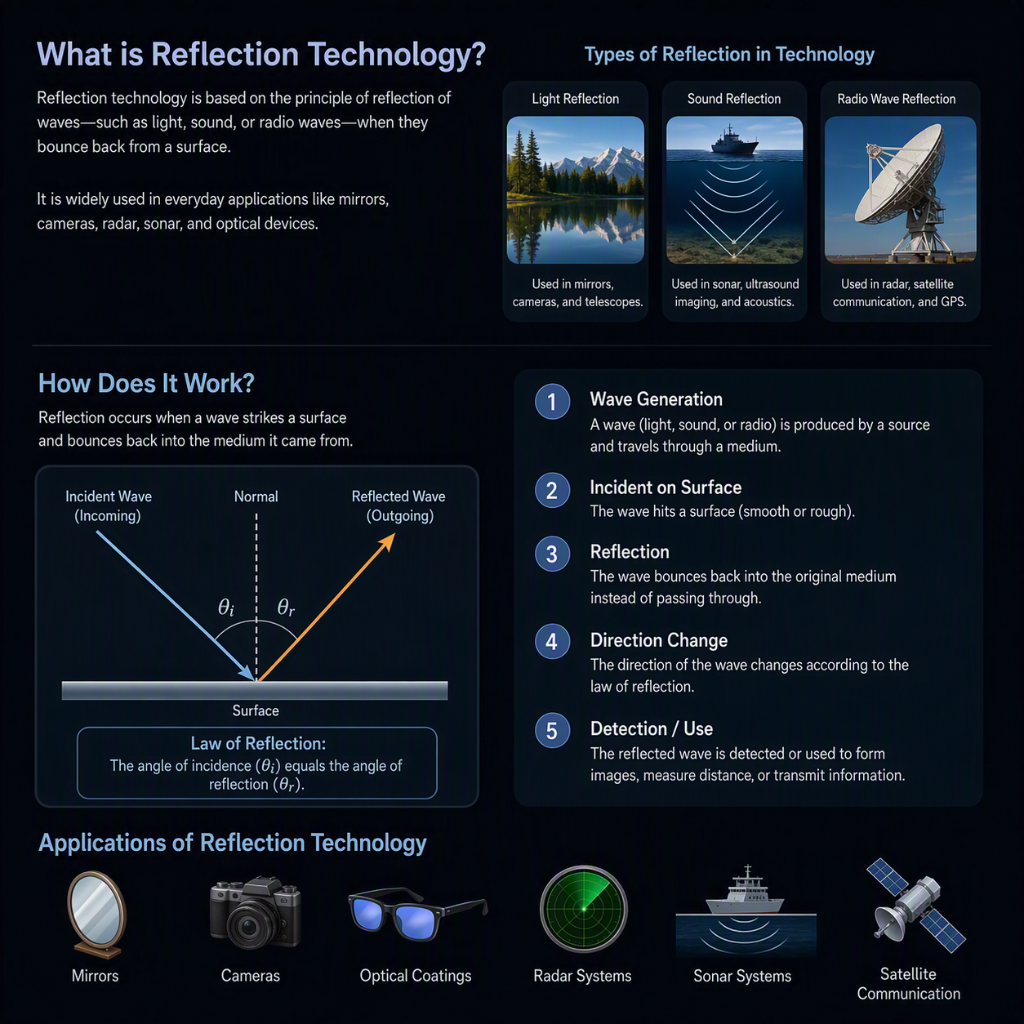
what is the reflection technology? How does it work?

Reflection technology refers to systems that use the bouncing of light (or other waves) off surfaces to detect, measure, identify, or manipulate objects. It works on a simple principle: send a signal out, measure what comes back, and calculate what that tells you about the target.🔦 The Core PrincipleWhen light hits a surface, some of it reflects. How it reflects depends on:· Surface angle — flat mirrors reflect cleanly; rough surfaces scatter· Material — metal reflects differently than glass or skin· Wavelength — infrared, visible, and UV behave differently· Distance — time delay reveals how far away the object is📡 How It Works: Step by Step“`1. Emit a signal (light, laser, IR, radar, sound) ↓2. Signal travels to target ↓3. Signal bounces off target ↓4. Sensor captures the returning signal ↓5. System measures: time, angle, intensity, wavelength shift ↓6. Algorithm converts data into information“`🔬 Types of Reflection Technology1. Time-of-Flight (ToF)· Sends a pulse of light (usually IR)· Measures how long it takes to return· Formula: Distance = (Speed of Light × Time) ÷ 2· Used in: Depth cameras, LiDAR, iPhone Face ID2. LiDAR (Light Detection and Ranging)· Fires thousands of laser pulses per second in a grid pattern· Builds a 3D point cloud of the environment· Used in: Autonomous cars, drones, mapping, archaeology3. Radar (Radio Detection and Ranging)· Uses radio waves instead of light· Works through fog, rain, and darkness· Used in: Air traffic control, weather tracking, adaptive cruise control4. Sonar (Sound Navigation and Ranging)· Uses sound waves (underwater)· Measures echo return time· Used in: Submarine navigation, fishing, medical ultrasound5. Optical Reflectometry· Sends light into a fiber or surface· Analyzes the reflected pattern to detect faults, temperature, or strain· Used in: Fiber optic networks, structural health monitoring6. Specular vs. Diffuse Reflection Sensing· Specular: Mirror-like reflection — used in laser barcode scanners· Diffuse: Scattered reflection — used in optical mice, proximity sensors🧠 How the System Interprets ReflectionThe reflected signal carries information:What Changes What It RevealsTime delay Distance to objectAngle of return Direction and shapeIntensity Surface reflectivity, materialWavelength shift Speed of object (Doppler)Polarization change Surface roughness, stressPhase shift Sub-millimeter precision🏭 Real-World ApplicationsMedical Imaging· Optical Coherence Tomography (OCT): Uses reflected near-infrared light to create cross-sectional images of the retina — detecting macular degeneration, glaucoma, and even coronary plaque.Automotive· LiDAR and radar let self-driving cars “see” obstacles, lane markings, and pedestrians in 3D.Consumer Tech· Face ID: Projects 30,000 IR dots onto your face and measures the reflected pattern.· Optical mice: LED light reflects off the desk surface; a sensor tracks movement.· Proximity sensors: Your phone screen turns off when it detects your face’s reflection.Industrial· Laser profilometers: Scan surfaces to detect defects in manufacturing.· Fiber Bragg Grating sensors: Measure strain in bridges and pipelines via reflected wavelength shifts.Military & Aerospace· Laser range finders: Measure distance to targets.· Synthetic Aperture Radar (SAR): Creates high-resolution images through clouds and darkness.💡 Key InsightReflection technology works because light (or waves) carry information when they bounce. The system doesn’t just see the object—it measures how the object changed the signal. That change reveals distance, shape, material, motion, and even internal structure.Would you like to go deeper into a specific type, such as LiDAR for autonomous vehicles or OCT for medical imaging?