
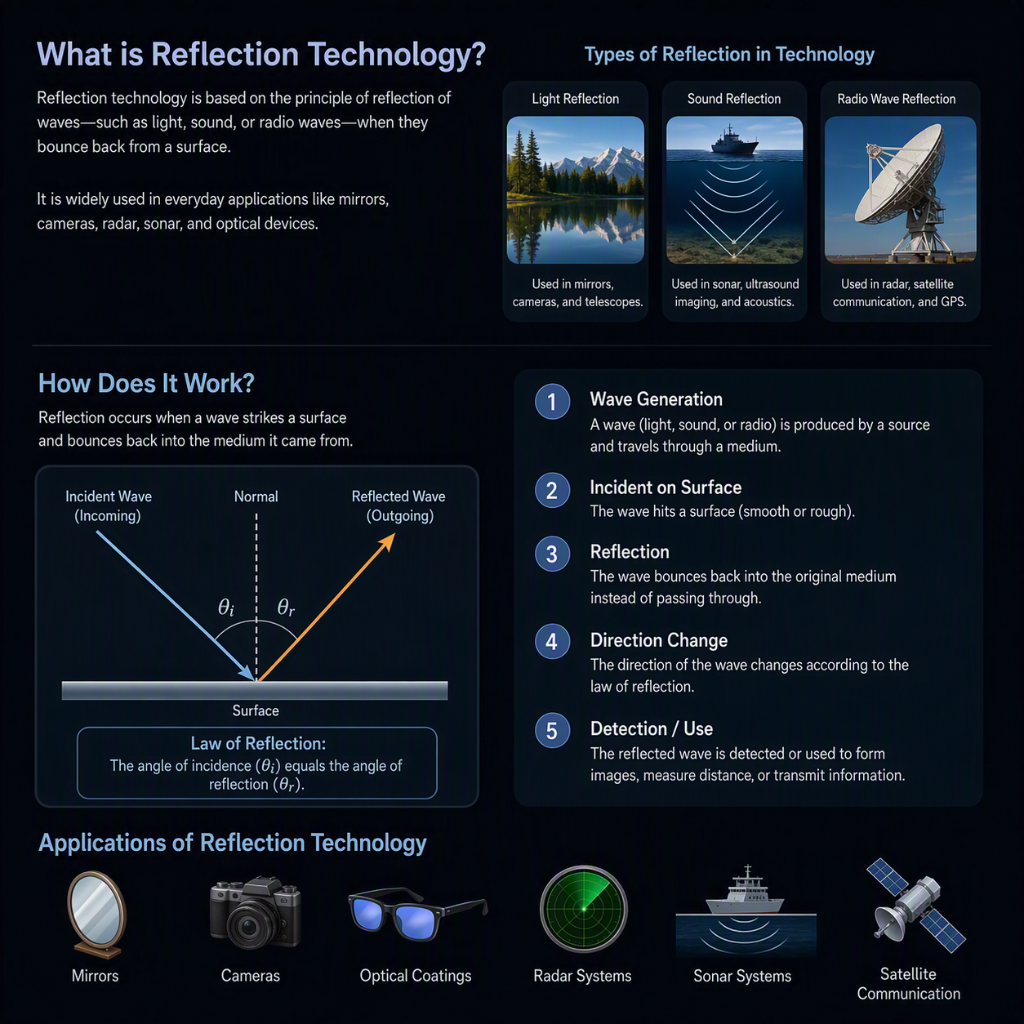
Reflection technology refers to systems that use the bouncing of light (or other waves) off surfaces to detect, measure, identify, or manipulate objects. It works on a simple principle: send a signal out, measure what comes back, and calculate what that tells you about the target.🔦 The Core PrincipleWhen light hits a surface, some of it reflects. How it reflects depends on:· Surface angle — flat mirrors reflect cleanly; rough surfaces scatter· Material — metal reflects differently than glass or skin· Wavelength — infrared, visible, and UV behave differently· Distance — time delay reveals how far away the object is📡 How It Works: Step by Step“`1. Emit a signal (light, laser, IR, radar, sound) ↓2. Signal travels to target ↓3. Signal bounces off target ↓4. Sensor captures the returning signal ↓5. System measures: time, angle, intensity, wavelength shift ↓6. Algorithm converts data into information“`🔬 Types of Reflection Technology1. Time-of-Flight (ToF)· Sends a pulse of light (usually IR)· Measures how long it takes to return· Formula: Distance = (Speed of Light × Time) ÷ 2· Used in: Depth cameras, LiDAR, iPhone Face ID2. LiDAR (Light Detection and Ranging)· Fires thousands of laser pulses per second in a grid pattern· Builds a 3D point cloud of the environment· Used in: Autonomous cars, drones, mapping, archaeology3. Radar (Radio Detection and Ranging)· Uses radio waves instead of light· Works through fog, rain, and darkness· Used in: Air traffic control, weather tracking, adaptive cruise control4. Sonar (Sound Navigation and Ranging)· Uses sound waves (underwater)· Measures echo return time· Used in: Submarine navigation, fishing, medical ultrasound5. Optical Reflectometry· Sends light into a fiber or surface· Analyzes the reflected pattern to detect faults, temperature, or strain· Used in: Fiber optic networks, structural health monitoring6. Specular vs. Diffuse Reflection Sensing· Specular: Mirror-like reflection — used in laser barcode scanners· Diffuse: Scattered reflection — used in optical mice, proximity sensors🧠 How the System Interprets ReflectionThe reflected signal carries information:What Changes What It RevealsTime delay Distance to objectAngle of return Direction and shapeIntensity Surface reflectivity, materialWavelength shift Speed of object (Doppler)Polarization change Surface roughness, stressPhase shift Sub-millimeter precision🏭 Real-World ApplicationsMedical Imaging· Optical Coherence Tomography (OCT): Uses reflected near-infrared light to create cross-sectional images of the retina — detecting macular degeneration, glaucoma, and even coronary plaque.Automotive· LiDAR and radar let self-driving cars “see” obstacles, lane markings, and pedestrians in 3D.Consumer Tech· Face ID: Projects 30,000 IR dots onto your face and measures the reflected pattern.· Optical mice: LED light reflects off the desk surface; a sensor tracks movement.· Proximity sensors: Your phone screen turns off when it detects your face’s reflection.Industrial· Laser profilometers: Scan surfaces to detect defects in manufacturing.· Fiber Bragg Grating sensors: Measure strain in bridges and pipelines via reflected wavelength shifts.Military & Aerospace· Laser range finders: Measure distance to targets.· Synthetic Aperture Radar (SAR): Creates high-resolution images through clouds and darkness.💡 Key InsightReflection technology works because light (or waves) carry information when they bounce. The system doesn’t just see the object—it measures how the object changed the signal. That change reveals distance, shape, material, motion, and even internal structure.Would you like to go deeper into a specific type, such as LiDAR for autonomous vehicles or OCT for medical imaging?