
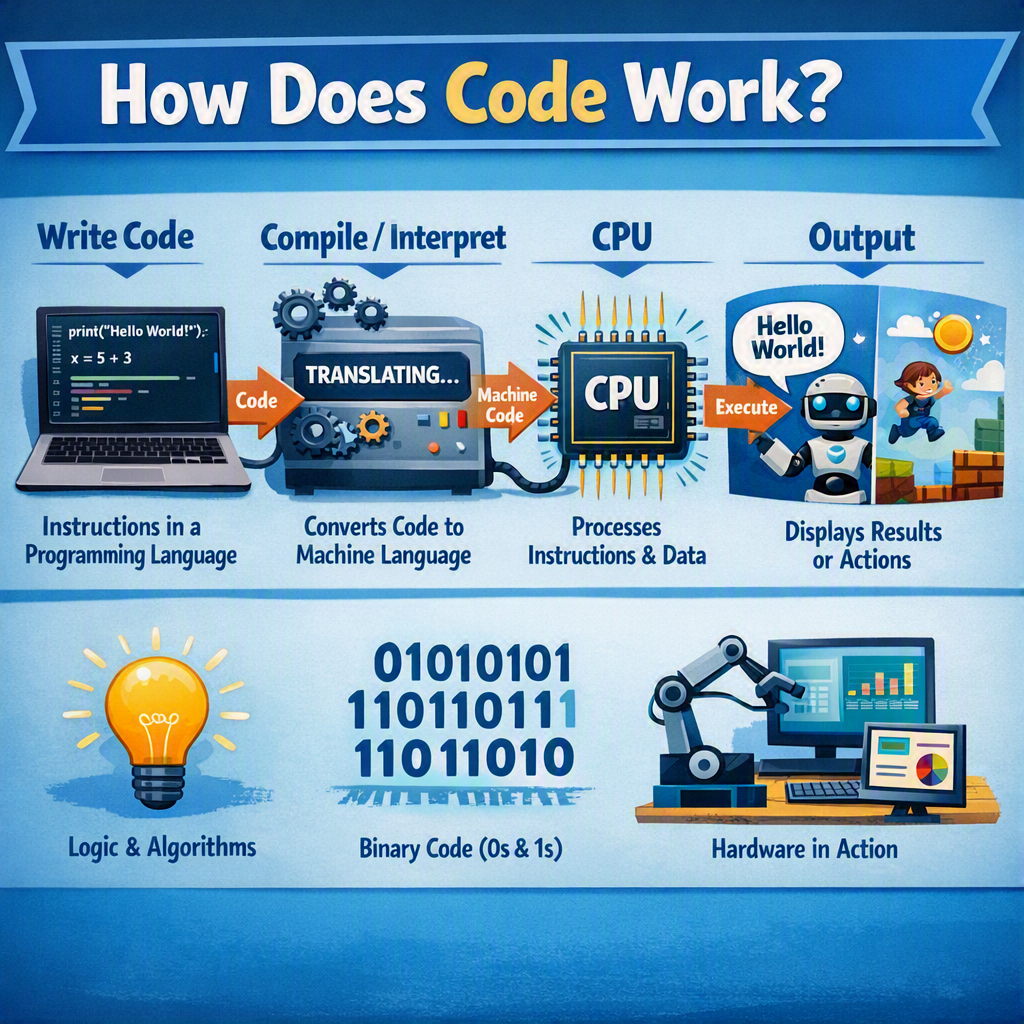
To understand how code works, imagine it as a set of step-by-step instructions (like a recipe) that a computer translates into action. Here is the 30,000-foot summary:1. You write source codeYou type human-readable languages (like Python, Java, or C++) into text files.2. Translation (Compilation or Interpretation)Computers only understand machine code (binary/1s and 0s). Your code must be translated:· Compiled languages (C++, Rust): The entire program is translated into a standalone executable file before you run it. (Faster startup, more efficient).· Interpreted languages (Python, JavaScript): The code is translated line-by-line while it runs by an “interpreter.” (More flexible, easier to debug).· Hybrid (Java, C#): Compile to an intermediate bytecode, then run on a Virtual Machine (JVM/.NET) that translates it just-in-time (JIT).3. Execution (The CPU)The translated instructions are sent to the CPU (the computer’s brain). The CPU performs a constant Fetch-Decode-Execute cycle:· Fetch: Gets the next instruction from memory (RAM).· Decode: Figures out what the instruction means (e.g., “add these two numbers”).· Execute: Performs the math/logic or moves data around.4. Memory & DataWhile running, the program uses RAM to store active data (variables, open files). The CPU manipulates this data using registers (ultra-fast storage inside the CPU).5. Input/Output (I/O)The code interacts with the outside world via the OS (Operating System), talking to hardware like your keyboard, monitor, hard drive, or network card to produce the final result you see.—The Golden Rule: Code is just logic + data. The entire system is an elaborate chain of translating human intent into electrical signals that switch tiny transistors on and off inside the silicon.Would you like a deeper dive into any specific part (e.g., compilers, memory management, or CPU architecture)?To understand how code works, imagine it as a set of step-by-step instructions (like a recipe) that a computer translates into action. Here is the 30,000-foot summary:1. You write source codeYou type human-readable languages (like Python, Java, or C++) into text files.2. Translation (Compilation or Interpretation)Computers only understand machine code (binary/1s and 0s). Your code must be translated:· Compiled languages (C++, Rust): The entire program is translated into a standalone executable file before you run it. (Faster startup, more efficient).· Interpreted languages (Python, JavaScript): The code is translated line-by-line while it runs by an “interpreter.” (More flexible, easier to debug).· Hybrid (Java, C#): Compile to an intermediate bytecode, then run on a Virtual Machine (JVM/.NET) that translates it just-in-time (JIT).3. Execution (The CPU)The translated instructions are sent to the CPU (the computer’s brain). The CPU performs a constant Fetch-Decode-Execute cycle:· Fetch: Gets the next instruction from memory (RAM).· Decode: Figures out what the instruction means (e.g., “add these two numbers”).· Execute: Performs the math/logic or moves data around.4. Memory & DataWhile running, the program uses RAM to store active data (variables, open files). The CPU manipulates this data using registers (ultra-fast storage inside the CPU).5. Input/Output (I/O)The code interacts with the outside world via the OS (Operating System), talking to hardware like your keyboard, monitor, hard drive, or network card to produce the final result you see.—The Golden Rule: Code is just logic + data. The entire system is an elaborate chain of translating human intent into electrical signals that switch tiny transistors on and off inside the silicon.Would you like a deeper dive into any specific part (e.g., compilers, memory management, or CPU architecture)?