
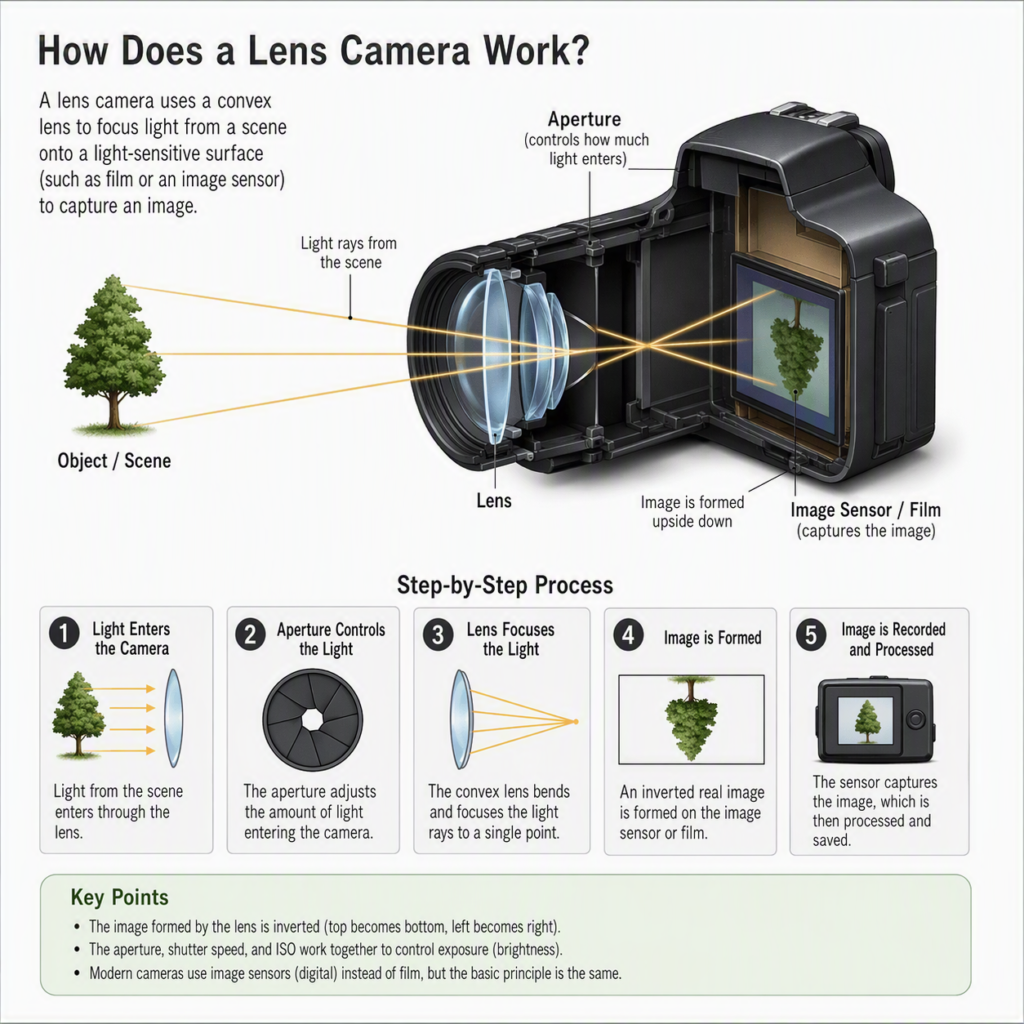
A lens camera works by using a lens to focus light from a scene onto a light-sensitive surface (film or a digital sensor), which records the image.Here’s the basic process:
1. Light enters through the lens Light rays bounce off objects in the scene and travel in many directions. The lens is shaped (usually convex) so it bends these rays.
2. The lens focuses the light The lens bends (refracts) the light rays so they converge and meet at a specific point. This creates a sharp, upside-down image of the scene inside the camera.
3. Focusing adjusts for distance · In a fixed-focus camera, the lens is set so everything beyond a certain distance is acceptably sharp. · In a focusable camera, the lens (or lens elements) moves closer to or farther from the sensor/film so that objects at different distances are in sharp focus.
4. Aperture controls how much light passes The aperture is an adjustable opening in the lens. A larger opening lets in more light (good for dark scenes) but reduces depth of field (less is in focus). A smaller opening lets in less light but increases depth of field.
5. Shutter controls how long light hits the sensor The shutter opens for a set time (shutter speed). Longer times let in more light but risk blur from motion.
6. The image is recorded · Film camera: Light causes a chemical reaction on the film, creating a latent image that’s later developed. · Digital camera: A sensor (CMOS or CCD) converts light into electrical signals, which are processed into a digital image file.7. The image is inverted Because light rays cross at the lens, the image forms upside-down and reversed. The camera (or your brain, when viewing) corrects this.In short: The lens gathers and bends light, the aperture and shutter control the amount and duration of light, and the sensor or film captures the focused image.