
how did canon’s lens design philosophy develop

Canon’s lens design philosophy is fundamentally guided by a single core idea: “Enabling photographers to capture the images they envision”. To achieve this, Canon has historically adopted a stance of vertical integration—developing its own materials, manufacturing techniques, and electronics when existing options fell short.🎯

Core Design PillarsCanon’s optical strategy is built on several consistent principles aimed at professional reliability and high performance:·

High Image Quality Across the Frame: Prioritizing sharpness, contrast, and faithful color reproduction from center to edge.·

Natural Bokeh: Designing optical formulas specifically to render smooth, pleasing background blur.· Durability & Reliability: Meeting the rigorous demands of professional use, including weather resistance and robust construction.📜

Key Historical ErasThe philosophy has evolved through distinct technical milestones:· The Fluorite & Aspherical Era (1960s–1970s): Canon pioneered the use of artificial fluorite crystals in 1969 to eliminate chromatic aberration (color fringing) far more effectively than standard glass.

Shortly after, in 1971, they released the FD55mm f/1.2AL, the world’s first SLR lens with a ground aspherical element, which corrected spherical aberration and distortion.· The “L” Series & Autofocus (1978–1980s): The Luxury (L) series was born in 1978, denoted by a red ring, symbolizing the use of these special optical materials. With the 1987 EOS system, Canon shifted to a fully electronic EF mount.

This larger diameter (54mm) was specifically designed to enable ultra-fast f/1.0 lenses and allowed for the Ultrasonic Motor (USM) to be built directly into the lens for silent, fast autofocus.· The Digital & RF Era (2000s–Present): Innovations shifted toward coatings and compact designs.

Canon introduced Subwavelength Structure Coating (SWC) in 2008 to combat ghosting. The 2018 RF mount further leveraged a short flange distance to enable “impossible” optics, such as the RF 28-70mm f/2L, a zoom lens with a constant f/2 aperture that rivals prime lenses.Would you like to dive deeper into a specific technology, such as how Canon manufactures its large fluorite elements?
how are progressive lenses manufactured?

Progressive lenses are manufactured using a combination of mass-produced semi-finished blanks and computer-controlled precision surfacing to create the custom prescription on the back surface.🏭

Mass Production:

Creating the Semi-Finished Blank The complex progressive surface (the corridor) is mass-produced on the front of the lens using cast polymerization:·

Mold Assembly: A glass mold with the progressive curve is paired with another mold and held together by a gasket or tape.

Casting: A liquid plastic monomer (like CR-39) is poured into the cavity and cured in an oven .· Result: This produces a “blank” with a finished front surface but a thick, unfinished back surface .💻

Customization: Free-Form Surfacing To fulfill your specific prescription (including cylinder and prism), the back surface is machined:·

Digital Design: Software calculates the exact 3D shape needed to work with the front progressive curve .·

Precision Machining: A CNC generator mills the back surface, followed by fine turning and polishing .·

Prism Thinning: To keep the lens thin, the back surface is often tilted or cut asymmetrically to distribute thickness more evenly .

🧪 Alternative Methods·

Glass Lenses: Historically made by heating a glass blank until it sags into a progressive mold using vacuum pressure .·

Injection Molding: Used for some materials like polycarbonate, where hot polymer is injected into a precision mold .

Are you interested in the specific materials used, or how the “corridor” design is digitally calculated?

how does lens magnification works with convex lens?

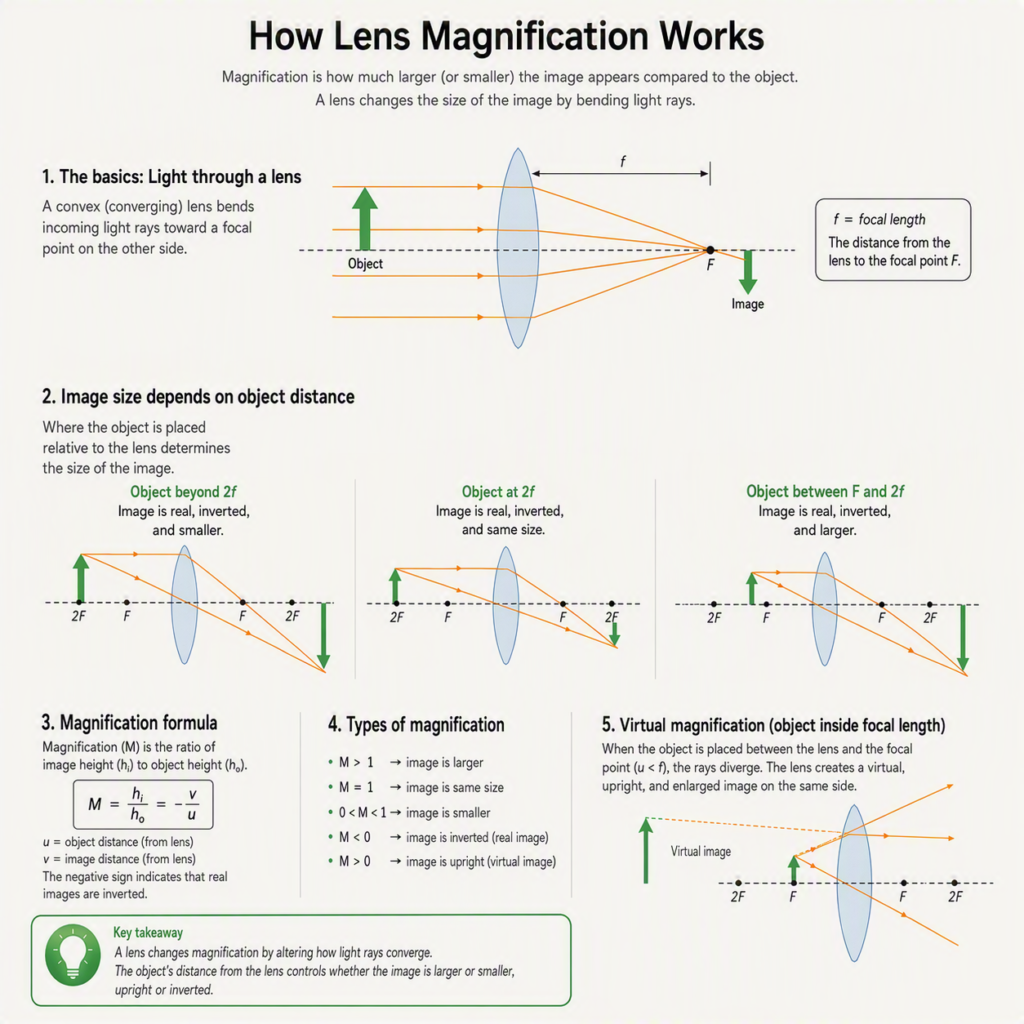
With a convex lens (a lens that bulges outward, thicker in the middle), magnification works through refraction and the geometry of ray diagrams. Here’s how it breaks down:

  1. The Basic Principle: Refraction

A convex lens bends light rays inward (converging them). Parallel rays entering the lens all meet at a single point called the focal point (F). The distance from the lens to this point is the focal length (f).

  1. The Thin Lens Equation

This governs where an image forms:

1/f = 1/dₒ + 1/dᵢ

· f = focal length
· dₒ = object distance (from lens to object)
· dᵢ = image distance (from lens to image)

  1. The Magnification Formula

Magnification (M) tells you how much bigger or smaller the image is compared to the object:

M = -dᵢ / dₒ = hᵢ / hₒ

· hᵢ = image height
· hₒ = object height
· The negative sign means the image is inverted (upside down)

  1. How Magnification Changes with Object Distance

This is the key insight. As you move the object closer to the lens, magnification increases:

Object Position Image Type Magnification
Far away (dₒ > 2f) Real, inverted, smaller M < 1 (reduced) At 2f (dₒ = 2f) Real, inverted, same size M = 1 Between f and 2f Real, inverted, larger M > 1
At f (dₒ = f) No image formed Infinite (rays parallel)
Inside f (dₒ < f) Virtual, upright, larger M > 1 (magnifying glass)

  1. Ray Diagram: How It Actually Works

Three principal rays show where the image forms:

  1. Ray parallel to axis → refracts through the focal point on the other side
  2. Ray through the center → passes straight through undeviated
  3. Ray through the near focal point → emerges parallel to the axis

Where these rays intersect is where the image forms. The farther the intersection is from the axis, the larger the magnification.

  1. The Magnifying Glass Case (Most Common)

When you hold a convex lens closer than f to an object:

· The rays diverge after passing through the lens
· Your eye traces them backward to form a virtual image
· This virtual image is upright and larger
· M = 1 + (25cm / f) for a relaxed eye (25cm = near point of human vision)

Example: A lens with f = 5cm gives M = 1 + 25/5 = 6× magnification

  1. Why Convex Lenses Magnify (Intuition)

Think of it this way:

· A convex lens compresses the angle of incoming light rays
· Your eye receives rays that appear to come from a larger object farther away
· The brain interprets this as a bigger object
· The closer the object is to the focal point, the more extreme this effect becomes

  1. Real vs. Virtual Images

· Real image (dₒ > f): Can be projected on a screen. Inverted. Used in cameras, projectors.
· Virtual image (dₒ < f): Cannot be projected. Upright. Used in magnifying glasses, eyeglasses.

Summary

A convex lens magnifies by refracting light to converge rays, forming an image whose size depends on the ratio of image distance to object distance. Move the object closer to the focal point → magnification increases. Inside the focal point → you get an upright virtual image (magnifying glass). Beyond it → you get an inverted real image (camera/projector).

How does lens magnification work?

Here is a clear breakdown of how lens magnification works, from the basic physics to the practical photography terms.

1. The Fundamental Physics: It’s All About AnglesAt its core, a lens doesn’t actually “magnify” an object like a microscope does. Instead, it changes the angle of view.Imagine looking at a mountain.

With your naked eye, you see a wide scene. If you put a lens in front of your eye, the lens bends (refracts) the light rays coming from the mountain so that they take up a larger portion of your retina. The lens isn’t making the mountain bigger; it’s narrowing the angle of view so the mountain fills more of your vision.

2. The Three Key FactorsMagnification in a lens is determined by three things:· Focal Length (f): This is the distance (in mm) from the lens to the sensor when focused on infinity.

A longer focal length (e.g., 200mm) gives a narrower angle of view and higher magnification. A shorter focal length (e.g., 24mm) gives a wider view and lower magnification.· Distance to Subject (d): The closer you are, the larger the subject appears. Magnification is a ratio of the image size on the sensor to the actual subject size.· Sensor Size: This doesn’t change the lens’s magnification, but it changes the field of view. A smaller sensor (like APS-C) captures only the center of the image circle, making it appear more magnified (this is called crop factor).

3. The Magnification Formula (For Close-Up Work)For macro photography, magnification is expressed as a ratio (e.g., 1:1, 1:2, 2:1).Magnification (M) = Image Size on Sensor / Actual Subject Size· 1:1 (Life Size): A 10mm insect projects a 10mm image on the sensor.· 1:2 (Half Life Size): A 10mm insect projects a 5mm image.· 2:1: A 5mm insect projects a 10mm image (2x magnification).You can calculate this with:M = f / (d – f)(Where f is focal length and d is distance from lens to subject)

4. How Zoom Lenses WorkA zoom lens changes its effective focal length by moving lens elements inside the barrel.· Wide (e.g., 24mm): Light rays are bent gently. The image circle is large, so you see a wide scene.· Telephoto (e.g., 200mm): Light rays are bent more sharply. The image circle is smaller, so you see a narrow, magnified slice of the scene.Important: Zooming does not change perspective. If you stand in the same spot and zoom in, the background appears to compress (larger relative to the foreground), but that’s just because you’re cropping into a smaller area.

5. Magnification vs. ResolutionA common misconception: More magnification ≠ More detail.· If you magnify an image digitally (cropping), you lose resolution.· If you magnify optically (with a longer lens), you preserve resolution because you’re using more of the sensor’s pixels to capture that specific area.· However, every lens has a resolution limit (diffraction). Beyond a certain point (e.g., f/22), magnifying further just makes the image blurrier, not more detailed.6.

Practical Examples· Bird Photography: A 600mm lens on a full-frame camera gives high magnification, filling the frame with a small bird.· Macro Photography: A 100mm macro lens at 1:1 magnification lets you fill the frame with a coin.· Smartphone:

Tiny lenses with short focal lengths. They use digital zoom (cropping) for “magnification,” which degrades quality. Optical zoom on phones uses multiple physical lenses.SummaryLens magnification is the result of focal length narrowing the angle of view, projecting a larger image of the subject onto the sensor.

For close-ups, it’s a ratio of sensor image size to real-life size. Zoom lenses change focal length mechanically, while sensor size affects the field of view, not the true magnification.

How does light technology works?

You can understand A traditional incandescent light bulb and technology works by passing an electric current through a thin wire coil called a filament. The electrical resistance in the wire heats it to a white-hot glow, which produces visible light.

Light has several important characteristics (or features) that describe how it behaves:

Light is a form of energy
It carries energy from one place to another.
The Sun is the main natural source of light for Earth.
Light travels in straight lines
This is called rectilinear propagation.
Shadows are formed because light travels in straight paths.
Light travels very fast
In a vacuum, its speed is about 300,000 km/s (3 × 10⁸ m/s).
Light can be reflected
When light strikes a surface, it can bounce back.
Mirrors work because of reflection.
Light can be refracted
It bends when it passes from one medium to another (such as air to water).
This is why a straw in water appears bent.
Light can be dispersed
White light can split into different colors.
A prism creates a spectrum of colors (rainbow effect).
Light can be absorbed
Materials can absorb light energy and convert it into heat or other forms of energy.
Light shows wave-particle duality
It behaves both as a wave and as tiny particles called photons.
Light has different wavelengths and frequencies
Different wavelengths produce different colors.
Visible light is only a small part of the electromagnetic spectrum.
Light does not require a medium to travel
Unlike sound, light can travel through the vacuum of space.

These properties make light essential for vision, communication, photography, astronomy, and many modern technologies.

How does light bulb works?

Who was thomas elva edison?

He was the inventor of the light and the bulb.

How does optical lens works?

It worked by lens technology where spectacles are connected with optical lens integerated with spectacles where when light passes throught it reflect back bad light and get good light get into through it on eye to see better and study of lens known as opthamology. The lens has different like cyclindral ,speherical and oval with various dynamics power and there is options of getting understanding of its through it by studying of about eye such as eye movement and its ecosystem and various things of studying about of light such reflection, refraction and prism of light and its instrument. The study field of optomecian also known as optometry.

How does musical instrument sound box work?

Musical Instrument Sound Box works through sound mechanics architect where wires and electronics are connected with speaker connected through magnets and musical dial connected through musical processing instrument to make musical sound and there are best speaker box companies are available like fender and roland.

How does computer work?

Computer works through power of electricity and its hardware and processor. The processor helps in processing large information produced by user through its components such ram, graphics cards and user keyboard connected through screen, memory card such sdd and hdd and sata drive interconnected in motherboard powerd by ups and all. The hardware operates through operating system like windows and macintosh and there is also utility software installed in the os such web searching software like mozilla, chrome and safari and there is other software also like notepad, ccleaner and computer files apps and microsoft apps like wordpad and microsoft powerpoint and microsoft words and editing software like adobe photoshop and etc.