
how does vision lifecycle work?

The vision lifecycle describes how your eyes and visual system develop, mature, peak, and eventually decline across your lifetime. It’s shaped by biology, environment, and how well you care for your eyes.Here’s the full journey:👶

1. Infancy (0–2 years): Building the Foundation· At birth: Vision is blurry—roughly 20/400. Babies can only see high-contrast shapes and faces close up.· 0–3 months: Eyes begin tracking movement. Color vision starts developing.· 3–6 months: Depth perception and eye-hand coordination emerge. Both eyes learn to work together.· 6–12 months: Visual acuity improves rapidly. The brain forms critical neural pathways for vision.· Critical window: If a problem (like a cataract or misalignment) isn’t corrected now, permanent vision loss (amblyopia) can occur.🧒

2. Childhood (2–12 years): Refinement and Risk· 2–5 years: Vision reaches near-adult levels (20/20). Color vision and fine detail recognition mature.· 6–12 years: Eyes grow rapidly. Myopia (nearsightedness) often begins here, especially with heavy screen use and less outdoor time.· Key risk: Uncorrected refractive errors can cause learning difficulties and permanent visual deficits.🧑

3. Adolescence (13–18 years): Peak Growth and Myopia Progression· Eyeball continues to elongate, often worsening myopia.· Hormonal changes can affect tear production and cause dry eyes.· Screens and study increase eye strain.· Peak visual acuity is typically reached by late teens—around 20/20 or better if corrected.🧑‍🦱

4. Young Adulthood (19–40 years): The Golden Years of Vision· Best vision of your life. Focusing ability is at its maximum.· Presbyopia hasn’t started yet. The natural lens is still flexible.· Main risks: Digital eye strain, dry eyes, sports injuries, and early signs of retinal problems.· Protective habits now (UV protection, good nutrition, regular exams) pay off later.

🧑‍🦳 5. Middle Age (40–60 years): Presbyopia and Early Disease· Presbyopia begins around 40: The lens stiffens, making near focus harder. Reading glasses or progressives become necessary.· Tear production decreases: Dry eye becomes more common.· Disease risk rises: Glaucoma, diabetic retinopathy, and macular degeneration may start silently.· Contrast sensitivity and night vision begin to decline gradually.👴

6. Older Age (60+ years): Decline and Disease Management· Cataracts: The lens becomes cloudy—very common after 60. Surgery restores vision.· Macular degeneration: Central vision loss, affecting reading and face recognition.· Glaucoma: Optic nerve damage, often from high eye pressure. Can cause tunnel vision.· Diabetic retinopathy: Blood vessel damage from diabetes.· Reduced peripheral vision, slower adaptation to light changes, and dry eyes are common.· Regular eye exams become critical to catch and manage disease early.🔄

7. End of Life: Vision as a Quality-of-Life Factor· Vision loss in late life is linked to falls, depression, cognitive decline, and reduced independence.· Low vision rehabilitation (magnifiers, screen readers, AI tools) helps maintain quality of life.· AI and bionic eye technology are emerging to restore some vision in severe cases.📊 Summary: The Vision Lifecycle at a GlanceStage Age Key Changes Main RisksInfancy 0–2 Vision develops rapidly Amblyopia, misalignmentChildhood 2–12 Acuity matures, myopia starts Uncorrected refractive errorsAdolescence 13–18 Myopia progresses Eye strain, dry eyesYoung Adult 19–40 Peak vision Digital strain, injuriesMiddle Age 40–60 Presbyopia, early disease Glaucoma, dry eyeOlder Age 60+ Cataracts, disease AMD, glaucoma, retinopathyEnd of Life 80+ Significant loss possible Falls, depression, isolation🧠 Key InsightYour vision lifecycle is not fixed—it’s shaped by:· Genetics (family history)· Environment (screens, UV, pollution)· Lifestyle (diet, exercise, smoking)· Healthcare (regular exams, timely correction)The best time to protect your vision is now, at whatever stage you’re in.

Similar search you can search more on web like…!

Would you like to explore how to slow vision decline at a specific stage?
how eye vision improve when you cared yourself with proper wearing of eye spectacles?

When you wear your spectacles properly and consistently, your vision improves through a combination of optical, neurological, and muscular changes. Here’s what happens:👁️

1. Light Focuses Correctly on the Retina· Before glasses: Light focuses in front of or behind the retina, causing blur.· With proper glasses: The lens bends light so it lands exactly on the retina.·

Result: Images become sharp and clear immediately.🧠

2. The Brain Learns to Interpret Signals Better· Your brain’s visual cortex adapts to the new, clearer input.· Within days to weeks: The brain “recalibrates” and learns to process the sharper signals more efficiently.· Result: You don’t just see better—you understand what you see faster (better contrast sensitivity, depth perception, and recognition).💪

3. Eye Muscles Relax (No More Squinting)· Without glasses: Your ciliary muscle and eye muscles work overtime trying to focus. This causes eye strain, headaches, and fatigue.· With proper glasses: The lens does the focusing work. Your muscles relax.· Result: Less strain, fewer headaches, and more comfortable vision for longer periods.🔄

4. Binocular Vision Improves (Both Eyes Work Together)· If one eye has a different prescription, proper glasses balance both eyes.· The brain can then fuse two images into one 3D image.· Result: Better depth perception, coordination, and reduced double vision.🚫

5. Prevents Further Deterioration (In Some Cases)· In children: Proper glasses can prevent amblyopia (lazy eye) and strabismus (crossed eyes) from worsening.· In adults: Glasses don’t “cure” myopia, but they reduce eye strain that can worsen symptoms.· In presbyopia: Reading glasses reduce the strain of constant near-focus effort.🧩

6. Neuroplasticity: The Brain Rewires Itself· Studies show that wearing correct glasses changes how the brain processes visual information.· The brain creates new neural pathways to handle the clearer input.· Result: Even after removing glasses, some people briefly experience slightly improved visual memory and processing—though the optical error remains.⚠️

What Proper Wearing Means· Consistent use: Wearing them as prescribed (all day, or only for reading, etc.).· Correct fit: Glasses sitting properly on your nose, pupils centered.· Clean lenses: Dirty or scratched lenses reduce clarity.· Updated prescription: Wearing old glasses can cause strain, not improvement.📈 Summary:

What ImprovesArea ImprovementClarity Immediate sharpnessComfort Less strain, fewer headachesDepth perception Better 3D visionBrain processing Faster recognitionEye coordination Both eyes work togetherLong-term health Prevents worsening in childrenBottom line:

Proper spectacles don’t “exercise” your eyes to make them stronger—they remove the barrier between your eye and clear vision. The improvement comes from correct optics + brain adaptation + relaxed eye muscles working together.Would you like to know how long it typically takes to adapt to a new prescription?

How does vision software working in improving technology of spectacles through improving lens technology?

Vision software is the “brain” that translates your unique visual needs into a precise lens design. It works by simulating how light will interact with your eye and a potential lens, then using algorithms to find the optimal shape.🧠

How the Software “Thinks” The core process involves creating a virtual model of your eye and the lens, then running millions of light-ray simulations to minimize visual errors.· Simulation & Ray Tracing: The software builds a model of the “lens-eye system” using your prescription, frame measurements, and viewing habits. It then traces how light rays pass through the lens to your retina at hundreds of different gaze directions .· Optimization (The “Merit Function”):

It uses a mathematical formula (a “merit function”) to score the design. The goal is to minimize the difference between where light should focus (target) and where it actually focuses (error) across the entire lens surface .·

Iterative Refinement: The software adjusts the lens’s free-form surface over and over until it finds the design with the lowest possible error, creating a lens that corrects vision precisely for how you move your eyes and head .⚙️

Key Technologies in Modern Software· Digital Free-Form Surfacing: Instead of using pre-made molds, software controls a diamond-cutting tool to carve your unique prescription directly onto the lens. This enables complex designs (like aspheric or atoric lenses) that reduce peripheral distortion and make high prescriptions thinner .·

Physics-Informed Neural Networks (PINNs): Newer AI models use physics equations as a guide. This allows for highly accurate simulation of the lens’s “sagittal height” (surface shape), improving optical performance and reducing the computation time needed to design progressive lenses .·

AI and Genetic Algorithms: Some systems use genetic algorithms to automatically search for the best lens shape that minimizes spherical aberration. Others use AI to analyze your eye movement patterns and viewing habits to further personalize the lens zones .📊

What This Means for Your Glasses The precision of this software directly translates into tangible benefits:· Sharper Vision: By minimizing “higher-order aberrations” (visual imperfections beyond simple blur), digital lenses provide clearer, crisper vision, especially at night .·

Less Eye Strain: Because the lens is optimized for your natural posture and gaze angles, your eye muscles don’t have to work as hard to compensate for lens flaws .·

Wider Clear Field: The software reduces distortion at the edges, so you can comfortably use the entire lens area without having to turn your whole head .

If you’re curious you can explore more it on searching about how these designs are physically manufactured or what “wavefront” technology means for your prescription, feel free to ask.

How does spectacles technology work?

Spectacles technology works by bending light before it enters your eye, so it lands exactly on the retina—the light-sensitive layer at the back of the eye—instead of in front of it or behind it. Here’s the full picture:🔬 The Core Principle: RefractionYour eye has two main focusing elements:·

Cornea (fixed focus)· Lens (adjustable focus)When these don’t bend light correctly, you get a refractive error. Spectacles add a third focusing element in front of the eye to correct it.👓

How Each Lens Type Works1.

Myopia (Nearsightedness)· Problem: Eye is too long, or cornea too curved. Light focuses in front of the retina.· Fix: Concave (minus) lenses—thinner at center, thicker at edges. They diverge light slightly before it enters the eye, pushing the focus back onto the retina.

2. Hyperopia (Farsightedness)· Problem: Eye is too short, or cornea too flat. Light would focus behind the retina.· Fix: Convex (plus) lenses—thicker at center, thinner at edges. They converge light, pulling the focus forward onto the retina.

3. Astigmatism· Problem: Cornea is shaped like a rugby ball instead of a basketball. Light focuses at two different points.· Fix: Cylindrical lenses—curved in one direction only. They correct the uneven focus, bringing both points together.

4. Presbyopia (Age-related)· Problem: The eye’s natural lens loses flexibility, so it can’t focus up close.· Fix: Progressive or bifocal lenses—different zones for distance, intermediate, and near vision.⚙️

Modern Lens Technology

1. Lens Materials· CR-39 (plastic): Standard, lightweight, good optics.· Polycarbonate: Impact-resistant, built-in UV protection. Good for kids and sports.· Trivex: Lightweight, high clarity, impact-resistant.· High-index (1.67, 1.74): Thinner and lighter for strong prescriptions.

2. Coatings· Anti-reflective (AR): Reduces glare, improves night vision, makes lenses look nearly invisible.· Scratch-resistant: Hard coat on top.· UV400: Blocks 100% of UVA/UVB.· Blue light filter: Reduces screen glare (evidence mixed, but many find it comfortable).· Hydrophobic/oleophobic: Repels water and oil.

3. Special Designs· Aspheric: Flatter curve, thinner, reduces distortion at edges.· Digital/Free-form: Computer-designed for your exact prescription and frame shape.· Photochromic: Darken in sunlight, clear indoors.🧠

The Brain’s RoleSpectacles don’t just fix the eye—they retrain the brain. Your visual cortex adapts to the new input. That’s why:· New glasses may feel weird for a few days.· Strong prescription changes can cause temporary dizziness.· The brain “learns” to ignore distortions at lens edges.🔮 Future Tech· Smart glasses: AR displays, health monitoring.· Adaptive lenses: Auto-focus like the human lens.· Wavefront-guided:

Custom correction beyond standard prescriptions.

Tags

Would you like me to go deeper into any specific lens type or coating?

How to find best eye spectacles which are helping improving vision and eyesight and fitable in wearing around face?

Finding the best spectacles comes down to balancing three things: correct vision, comfortable fit, and personal style.

A beautiful frame is useless if it slips or gives you headaches, and a perfect optical fit means nothing if you dread wearing it.Here is a step-by-step guide to finding your ideal pair.👁️

Step 1: Get the Vision Right (The Lenses)The frame is the hardware; the lenses are the software that actually fixes your sight.· Match Lens Index to Your Prescription: If you have a strong prescription, standard lenses will look thick and heavy. Ask for high-index lenses. They bend light more efficiently, so you need less material. This makes them thinner, lighter, and more flattering . Indices like 1.67 or 1.74 are common for stronger prescriptions .·

Consider Aspheric Design: These lenses have a flatter curve than standard ones. They are often thinner and reduce the “bug-eye” magnification (for farsightedness) or “bottle-bottom” minification (for nearsightedness) effect .·

Material Matters: Polycarbonate or Trivex are excellent if you need impact resistance (for sports, children, or safety) as they are very durable and lightweight .📐

Step 2: Get the Fit Right (The Frame)This is the most critical step for comfort. If your glasses hurt or slide, you won’t wear them.· Bridge Fit (The #1 Cause of Slipping): Your nose shape determines if glasses stay up. · High Bridge: Frames often slide down. Look for keyhole bridges or adjustable nose pads that can grip the higher, narrower part of your nose . ·

Low/Flat Bridge: Standard frames often slide off. You need frames specifically designed with a lower, wider bridge or larger nose pads. These sit higher on your nose and prevent your cheeks from pushing the glasses up when you smile .·

Width and Temple Length: The frame front should be about as wide as your face. The temples (arms) should be long enough to reach behind your ears without pinching. If you have a larger head or long face, look for long-temple frames (145mm or more) to prevent tightness or slipping .· The “Smile Test”: When you try frames on, smile broadly. If the frame lifts off your nose or the lenses press hard into your cheeks, the fit is wrong. It will only get more annoying in daily life .🎨

Step 3: Match to Your Face Shape (The Style)

Use your face shape as a guide, not a rule. The goal is usually to create balance.· Round Face: Add angles. Rectangular or geometric frames add structure and definition to soft curves .·

Square Face: Soften the angles. Round or oval frames provide a nice counterpoint to a strong jawline .· Heart-Shaped Face (Wider Forehead): Balance the width with frames that are slightly wider than your forehead or rimless styles. Rounder lower rims work well .·

Oval Face: You are lucky; most shapes suit you. Just avoid frames that are extremely narrow, which can exaggerate length .·

Long Face: Break up the vertical line with frames that have more depth (taller lenses). Very narrow frames will make your face look longer .💡

Practical Final Checks Before you commit, do a quick physical check:· Eye Position: Your pupils should sit roughly in the center of the lenses (or slightly above center) .·

Weight: Do they feel heavy on your nose after a few minutes? Lighter materials like titanium help here .·

Professional Adjustment: Always buy from a place that will adjust the frames to your face (bending the temples, adjusting nose pads). A good optician can make a decent frame fit perfectly, but a bad fit will never improve on its own .If you want, tell me your prescription strength and face shape, and I can give you more specific pointers on what to look for.

how does eye helps in shaping the world?

The eye doesn’t just see the world—it actively shapes it. Here’s how:🌍

1. The Eye Built civilization Navigation & migration: Vision let early humans read landscapes, stars, and seasons—enabling migration, agriculture, and maps.· Writing & records: The eye→hand→tool loop created writing, mathematics, and eventually science. Without vision, no written language.· Architecture & engineering: Every structure was imagined visually first. The eye allows mental simulation of 3D space before building.🎨

2. The Eye Created Culture· Art & aesthetics: Painting, sculpture, film—all exist because we have eyes that respond to color, contrast, and form.· Symbols & meaning: Letters, numbers, religious icons, traffic signs—all are visual codes the eye decodes.· Fashion & design: What we wear, build, and buy is driven by visual preference.🧠

3. The Eye Shapes How We Think· Visual metaphors dominate language: “I see your point,” “clear vision,” “bright idea,” “dark future.” We think in visual terms even about abstract things.· Memory & imagination: Most people “see” their memories and imagine in pictures. Vision is the primary interface of thought.· Perspective & depth: Binocular vision taught us that two viewpoints create a richer truth—a foundation of philosophy and art.🔬

4. The Eye Drives Science & Technology· Observation → discovery: Telescopes, microscopes, cameras—all extensions of the eye. They let us see cells, galaxies, and atoms.· Computer vision: AI learns to “see” by mimicking the eye-brain system. Cameras, LiDAR, and facial recognition are technological eyes.· Medical imaging: X-rays, MRI, OCT—we convert invisible signals into images the eye can read.❤️

5. The Eye Connects Us Emotionally· Eye contact: Builds trust, love, and empathy. Infants bond through gaze.· Reading emotion: Micro-expressions in the eyes reveal fear, joy, sadness—social glue.· Shared attention: When two people look at the same thing, they create shared reality—the basis of community.🧩

6. The Eye Limits and Defines Reality· We only see visible light (400–700 nm)—a tiny slice of the electromagnetic spectrum. Our “world” is shaped by what our eyes can’t see too.· Illusions reveal brain rules: Optical illusions show the eye-brain system doesn’t just record—it constructs reality.· Color is invented: Objects don’t have color; the eye-brain creates it. The world is literally painted by our biology.🔄 In ShortThe eye is not a passive window. It is an active sculptor—of knowledge, culture, technology, emotion, and reality itself. Without eyes, the human world as we know it would not exist.Would you like to explore how AI is learning to “shape the world” through computer vision, or how vision loss changes a person’s reality?

how AI predicts myopia progression or the technology behind bionic eyes?

AI Predicts Myopia Progression, not by “reading a crystal ball,” but by analyzing massive amounts of eye data to find hidden patterns.👁️

AI Predicts Myopia: Two Different Tasks Current AI performs very differently on predicting onset versus predicting progression rate :· Predicting Onset (Future Myopia): Performs excellently. AI can precisely capture spatial features in the fundus through ResNet34 and track changes over time with LSTM, achieving AUC above 0.94 and even above 0.98 for high myopia .· Predicting Progression (How Fast It Worsens): Currently a global challenge. Because myopia progression is nonlinear, past progression history has limited predictive value for the future .

AI often excels at predicting “will myopia develop” while struggling with “how much will it increase next year” .💡

How AI “Sees Through” Myopia ProgressionAI doesn’t just look at “diopters” but more at ocular biometric parameters:· Monitoring Axial Length: Myopia progression is essentially axial elongation.

AI can identify previously overlooked key predictors. For example, pupil size (importance score 100) and corneal thickness are more critical than age for predicting axial growth rate .·

Extracting Image Biomarkers:

AI extracts subtle features from fundus photographs and OCT (optical coherence tomography) images that are difficult for the human eye to notice, automatically discovering “image biomarkers” related to progression .🔬

The Core Technology of Bionic EyesBionic eyes (visual prostheses) essentially bypass damaged photoreceptors and directly stimulate remaining neurons with electricity. AI plays the role of “translator,” responsible for converting camera images into electrical signals the brain can understand.·

Image Encoding and “Phosphenes”: The camera captures images, and AI processes them into stimulation patterns for phosphenes (light spots).

AI selectively highlights key information like obstacles, ground, and faces to help users navigate independently.·

Hardware Architecture Mimicking the Retina: Advanced research uses Spiking Neural Networks (SNN) to simulate the hierarchical processing of the retina (photoreceptors → bipolar cells → ganglion cells), making electrical stimulation patterns closer to natural neural signals .·

Closed-Loop Optimization: AI algorithms handle image processing while optimizing stimulation strategies in real-time based on user feedback, helping users recognize objects and navigate more easily.

Example like If you’re interested in a specific technology (such as what the images seen through bionic eyes actually look like), we can continue exploring.

How does machine learning and artificial intelligence role in developing and improving eye sight vision?

Machine learning (ML) and artificial intelligence (AI) are transforming eye care across diagnosis, surgical planning, and even vision restoration. Here is how they are developing and improving eyesight.🔍

Early Detection and Diagnosis AI excels at spotting subtle patterns in eye images that may be missed by the human eye.· Refractive Errors & Myopia: Deep learning models analyze fundus photographs to predict refractive power with remarkable accuracy, aiding early detection in children .

AI can predict myopia onset using factors like age, baseline refraction, and axial length .·

Disease Screening: AI algorithms detect diabetic retinopathy on retinal images with sensitivities up to 96% and specificities up to 98% . They also identify keratoconus by analyzing corneal topography with over 98% specificity .

🛠️ Improving Surgical OutcomesAI is being used to personalize and refine vision correction procedures.· Refractive Surgery Planning: Machine learning models predict the best surgical approach (LASIK, SMILE, etc.) with up to 81-93% accuracy .

AI-developed nomograms also achieve a higher percentage of eyes hitting the target refraction post-surgery compared to traditional methods .·

Cataract Surgery: AI improves the calculation of intraocular lens (IOL) power, which is critical for restoring clear vision after cataract removal, especially for patients who had prior refractive surgery .🔬

Vision Restoration TechnologyFor those with severe vision loss, AI is central to developing visual prostheses (bionic eyes).·

Smart Bionic Eye: Researchers are developing AI-driven retinal implants that don’t just replicate vision but provide task-specific visual augmentations. Deep learning filters information to help users with face recognition, navigation, and object identification in real time .·

Optimizing Implants: AI is used to process images into stimulation patterns that the brain can interpret. Spiking neural models and attention mechanisms help the implants mimic how the human retina processes visual information, improving the fidelity of what the user sees .⚠️

Current LimitationsDespite the promise, challenges remain. AI models can function as “black boxes,” and their performance can drop if they are trained on non-diverse datasets (e.g., mostly East Asian or Caucasian populations), leading to biases . Real-world validation is still limited, and results can vary depending on the specific imaging device used .Would you like to dive deeper into a specific area, such as for example how AI predicts myopia progression or the technology behind bionic eyes?

how to improve eye vision?

While you can’t reverse serious eye conditions like cataracts or glaucoma without medical intervention, you can improve your visual comfort, eye health, and focusing ability with these habits.

1. Follow the 20-20-20 Rule Every 20 minutes, look at something 20 feet away for at least 20 seconds. This relaxes the ciliary muscle inside your eye that gets stuck in “near-focus” mode during screen work.

2. Get the Right Prescription If you squint or get headaches, see an optometrist. An outdated or wrong prescription causes constant eye strain. Consider anti-reflective coating and, if you use screens heavily, blue light filtering lenses (though evidence on blue light is mixed, many find it reduces fatigue).

3. Optimize Your Environment· Lighting: Avoid working in a dark room with a bright screen. Use ambient light and position your screen to avoid glare.· Distance: Keep monitors about an arm’s length away, slightly below eye level.· Humidity: Use a humidifier if your eyes feel dry, and blink consciously during screen use.

4. Lubricate Your EyesDry eyes blur vision. Use preservative-free artificial tears if needed. Stay hydrated. Omega-3 fatty acids (fish oil, flaxseed) may help some people with dry eye.

5. Nutrition for Eye Health· Lutein & Zeaxanthin (leafy greens, eggs): Build macular pigment.· Vitamin A (carrots, sweet potatoes): Prevents night blindness.· Vitamin C & E (citrus, nuts): Antioxidants.· Zinc (beans, meat): Helps retina health.· Omega-3s: Supports tear film and retinal health.

6. Eye Exercises (Marginal but Helpful for Strain)· Near-far focus: Alternate looking at your thumb (6 inches away) and a distant object.· Palming: Rub hands warm, cup over closed eyes, relax for 1 minute.· Figure-eight tracking:

Follow an imaginary figure eight with your eyes. These don’t fix refractive errors but can reduce fatigue.

7. Protect Your Eyes· Wear UV400 sunglasses outdoors.· Wear safety glasses for risky activities.· Don’t rub your eyes hard—it can deform the cornea over time (keratoconus).

8. Lifestyle Factors· Sleep: Your eyes repair themselves during sleep. 7–9 hours is ideal.· Exercise: Aerobic exercise lowers eye pressure and improves blood flow.· Blood sugar: Uncontrolled diabetes damages retinal blood vessels.· Smoking: Strongly linked to macular degeneration and cataracts.9. When to See a DoctorGet a dilated eye exam if you notice:· Sudden floaters or flashes· Loss of peripheral vision· Persistent blur or double vision· Eye pain or rednessWhat won’t work: Eye exercises won’t cure nearsightedness, and there’s no diet that lets you throw away glasses. But the habits above can slow decline, reduce strain, and keep your eyes comfortable.Would you like tips specific to screen work, dry eyes, or a certain condition?

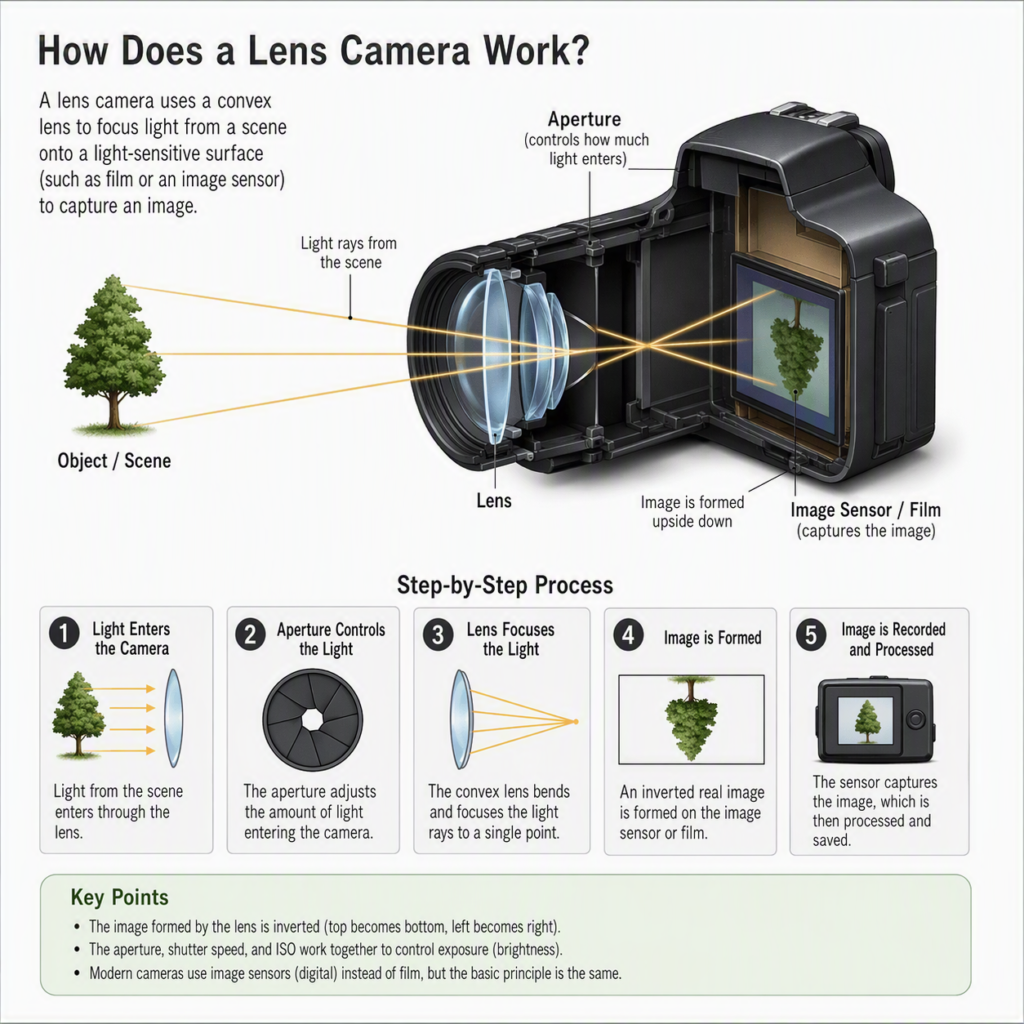
how does lens camera work?

A lens camera works by using a lens to focus light from a scene onto a light-sensitive surface (film or a digital sensor), which records the image.Here’s the basic process:

1. Light enters through the lens Light rays bounce off objects in the scene and travel in many directions. The lens is shaped (usually convex) so it bends these rays.

2. The lens focuses the light The lens bends (refracts) the light rays so they converge and meet at a specific point. This creates a sharp, upside-down image of the scene inside the camera.

3. Focusing adjusts for distance · In a fixed-focus camera, the lens is set so everything beyond a certain distance is acceptably sharp. · In a focusable camera, the lens (or lens elements) moves closer to or farther from the sensor/film so that objects at different distances are in sharp focus.

4. Aperture controls how much light passes The aperture is an adjustable opening in the lens. A larger opening lets in more light (good for dark scenes) but reduces depth of field (less is in focus). A smaller opening lets in less light but increases depth of field.

5. Shutter controls how long light hits the sensor The shutter opens for a set time (shutter speed). Longer times let in more light but risk blur from motion.

6. The image is recorded · Film camera: Light causes a chemical reaction on the film, creating a latent image that’s later developed. · Digital camera: A sensor (CMOS or CCD) converts light into electrical signals, which are processed into a digital image file.7. The image is inverted Because light rays cross at the lens, the image forms upside-down and reversed. The camera (or your brain, when viewing) corrects this.In short: The lens gathers and bends light, the aperture and shutter control the amount and duration of light, and the sensor or film captures the focused image.