
AI can make great software by acting less like an “autonomous coder” and more like a very fast engineering partner.The basic loop is:Understand → Design → Build → Test → Observe → Improve1. Understand the real problemAI can turn vague requirements into concrete behavior:“I need an app where customers can upload invoices and get the important numbers.”AI can help clarify:Who uses it?What counts as an invoice?What information matters?What happens when extraction fails?What are the security/privacy requirements?This prevents the classic problem of building the wrong thing very efficiently.2. Design before codingAI can propose:architecturedatabase schemasAPIsUI flowserror-handling strategiestesting strategiesA good developer then challenges those designs rather than blindly accepting them.3. Generate code quicklyAI is particularly good at producing the repetitive 60–90% of implementation:CRUD endpointsUI componentsdatabase queriesAPI integrationstestsmigrationsdocumentationrefactoringThe important part is that the code is generated inside a coherent architecture, rather than as isolated snippets.4. Let tests fight the AIThis is one of the biggest advantages.Instead of:AI writes code → human hopes it worksuse:AI writes code → tests run → failures go back to AI → AI fixes them → tests run againYou can add:unit testsintegration teststype checkinglintingbrowser testssecurity checksperformance testsAI becomes much more reliable when it gets objective feedback.5. Give AI the ability to inspect the whole systemThe strongest coding workflows let AI see:the repositoryexisting code conventionsdatabase structuretestsbuild errorslogsdocumentationgit historyThen it can reason about changes in context.For example:“Add subscriptions. Follow the existing authentication and billing patterns. Don’t break the current API. Add tests.”That’s dramatically better than:“Write a subscription system.”6. Humans remain responsible for judgmentAI is excellent at generating possibilities. Humans are still especially valuable for deciding:“Should we build this at all?”and:“Is this actually good for the user?”Great software isn’t merely code that compiles. It has good:product decisionsUXsecurityreliabilityperformancemaintainabilitybusiness logicThe interesting futureThe biggest shift isn’t simply “AI writes code faster.”It’s that software development can become a continuous feedback system:User need ↓AI + human design ↓AI implements ↓Automated tests ↓Real-world telemetry ↓AI analyzes failures ↓Human approves important changes ↓Improved software ↺In other words, AI can make great software when it’s surrounded by good specifications, strong tests, real feedback, and human judgment.The limiting factor increasingly becomes engineering/product judgment, not typing code.
An In-Depth Guide to Selecting the Right AI Software for Your Business
Understanding Your Business Needs
The business need of any software is to get it done and integrate with software to improve it.
Key Factors in Selecting AI Software
It helps in getting success in business.
Questions to Ask Potential Vendors
To make business works.
Comparative Analysis of Available Options
its together make it work and worthful.❤️
AI Software Implementation Guide for Small Businesses
Understanding AI Software
Assessing Your Business Needs
Steps for AI Software Implementation
Challenges and Best Practices
Top Use Cases for AI Software in Different Industries
Software Industry
Finance Sector
Retail and E-commerce
Manufacturing and Logistics
Top 5 Benefits of Implementing AI Software in Your Business
Improved Efficiency
Cost Reduction
Enhanced Decision-Making
Competitive Advantage
how does ai software work?
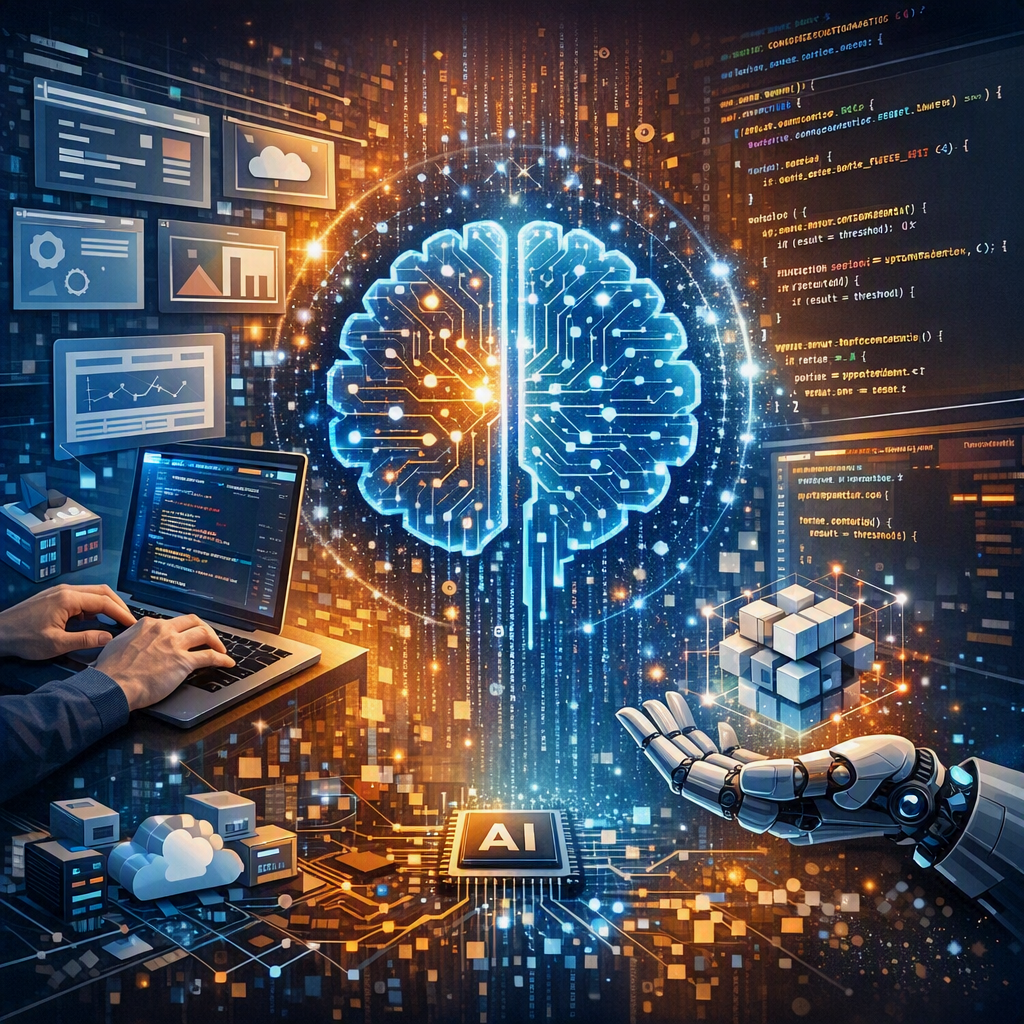
Here is the complete, full-length summary tying everything together from the ground up:—The Complete Picture: Software, Code, and AI. What is software, fundamentally?At its core, all software is just instructions—a sequence of commands written by a human, stored as text, and translated into binary (1s and 0s) that the computer’s CPU can execute. The CPU performs a never-ending Fetch-Decode-Execute cycle: grab an instruction, figure out what it means, and do it (math, move data, or talk to hardware). The software uses RAM for active data and the OS to handle input/output (keyboard, screen, network). This is the foundation for everything.2.
Traditional software = explicit human logicIn normal programming (C++, Python, Java, etc.), the developer writes hard-coded rules: “If the user clicks The Complete Picture: Software, Code, and AI1, do that,” or “Calculate tax by multiplying price by 0.1.” The behavior is deterministic—same input always produces the same output. The computer is a fast idiot savant; it does exactly what you tell it, nothing more, nothing less. You are the sole source of intelligence.3.
AI software = learned logic from dataAI flips the script. Instead of writing rules, you write a learning algorithm (typically a neural network) and feed it massive datasets. During training:· Data goes in, a prediction comes out (forward pass).· The error is measured (loss function).· The algorithm adjusts thousands/millions/billions of internal weights backwards through the network (backpropagation) to reduce future errors. This repeats billions of times until the model recognizes patterns—edges in images, grammar in text, etc. The “program” is now a frozen file full of numbers (weights) that encodes all that learned knowledge.4. Running AI (Inference)Once trained, AI becomes regular software again. When you use ChatGPT or ask Siri, you’re running the frozen model through forward passes—pure math (matrix multiplications) on a CPU or, more commonly, a GPU which can do thousands of calculations simultaneously. No learning happens here; it’s just executing the discovered rules as fast as possible. The output is probabilistic—it’s a best guess, not a guaranteed fact.
5. The relationship between AI and software· AI is a subset of software. All AI runs on the same hardware (CPU/GPU/RAM) and uses the same operating systems as traditional apps.· The difference is the source of logic: human-written vs. data-learned.· The similarity is execution: both ultimately boil down to math operations on silicon.· The integration: modern software increasingly embeds AI models inside traditional code—e.g., a normal photo app uses traditional code for the UI, but calls an AI model for face detection.—The Grand Unified Summary (One Paragraph)All software is human-written instructions translated to binary and executed by a CPU. Traditional software relies on explicit, deterministic rules coded by developers. AI software replaces those rules with a neural network that discovers its own rules by training on data, then packages that knowledge into a static mathematical model. During execution (inference), AI runs exactly like any other program—just math on silicon—but instead of following strict commands, it makes probabilistic predictions based on learned patterns. Therefore, AI is not magic; it’s self-programming software that runs on the same infrastructure, using the same principles, but with the logic derived from data rather than written by hand.—The Ultimate One-Liner:Traditional code = you give it a manual; AI = you give it data and it writes its own manual, then runs like any other program.That’s the full story from transistors to transformers.😊
How does code works?
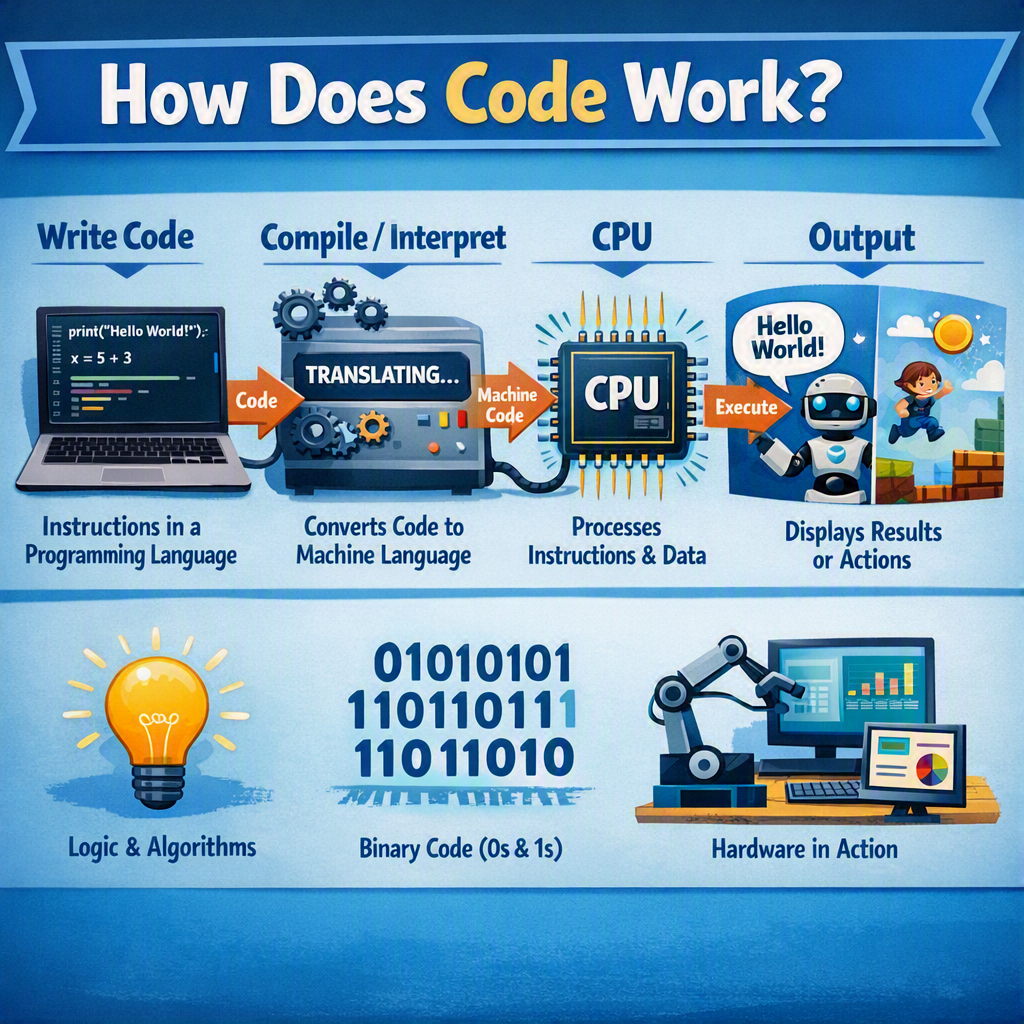
To understand how code works, imagine it as a set of step-by-step instructions (like a recipe) that a computer translates into action. Here is the 30,000-foot summary:1. You write source codeYou type human-readable languages (like Python, Java, or C++) into text files.2. Translation (Compilation or Interpretation)Computers only understand machine code (binary/1s and 0s). Your code must be translated:· Compiled languages (C++, Rust): The entire program is translated into a standalone executable file before you run it. (Faster startup, more efficient).· Interpreted languages (Python, JavaScript): The code is translated line-by-line while it runs by an “interpreter.” (More flexible, easier to debug).· Hybrid (Java, C#): Compile to an intermediate bytecode, then run on a Virtual Machine (JVM/.NET) that translates it just-in-time (JIT).3. Execution (The CPU)The translated instructions are sent to the CPU (the computer’s brain). The CPU performs a constant Fetch-Decode-Execute cycle:· Fetch: Gets the next instruction from memory (RAM).· Decode: Figures out what the instruction means (e.g., “add these two numbers”).· Execute: Performs the math/logic or moves data around.4. Memory & DataWhile running, the program uses RAM to store active data (variables, open files). The CPU manipulates this data using registers (ultra-fast storage inside the CPU).5. Input/Output (I/O)The code interacts with the outside world via the OS (Operating System), talking to hardware like your keyboard, monitor, hard drive, or network card to produce the final result you see.—The Golden Rule: Code is just logic + data. The entire system is an elaborate chain of translating human intent into electrical signals that switch tiny transistors on and off inside the silicon.Would you like a deeper dive into any specific part (e.g., compilers, memory management, or CPU architecture)?To understand how code works, imagine it as a set of step-by-step instructions (like a recipe) that a computer translates into action. Here is the 30,000-foot summary:1. You write source codeYou type human-readable languages (like Python, Java, or C++) into text files.2. Translation (Compilation or Interpretation)Computers only understand machine code (binary/1s and 0s). Your code must be translated:· Compiled languages (C++, Rust): The entire program is translated into a standalone executable file before you run it. (Faster startup, more efficient).· Interpreted languages (Python, JavaScript): The code is translated line-by-line while it runs by an “interpreter.” (More flexible, easier to debug).· Hybrid (Java, C#): Compile to an intermediate bytecode, then run on a Virtual Machine (JVM/.NET) that translates it just-in-time (JIT).3. Execution (The CPU)The translated instructions are sent to the CPU (the computer’s brain). The CPU performs a constant Fetch-Decode-Execute cycle:· Fetch: Gets the next instruction from memory (RAM).· Decode: Figures out what the instruction means (e.g., “add these two numbers”).· Execute: Performs the math/logic or moves data around.4. Memory & DataWhile running, the program uses RAM to store active data (variables, open files). The CPU manipulates this data using registers (ultra-fast storage inside the CPU).5. Input/Output (I/O)The code interacts with the outside world via the OS (Operating System), talking to hardware like your keyboard, monitor, hard drive, or network card to produce the final result you see.—The Golden Rule: Code is just logic + data. The entire system is an elaborate chain of translating human intent into electrical signals that switch tiny transistors on and off inside the silicon.Would you like a deeper dive into any specific part (e.g., compilers, memory management, or CPU architecture)?
How Software Architecture Works: The Ultimate Practical Guide
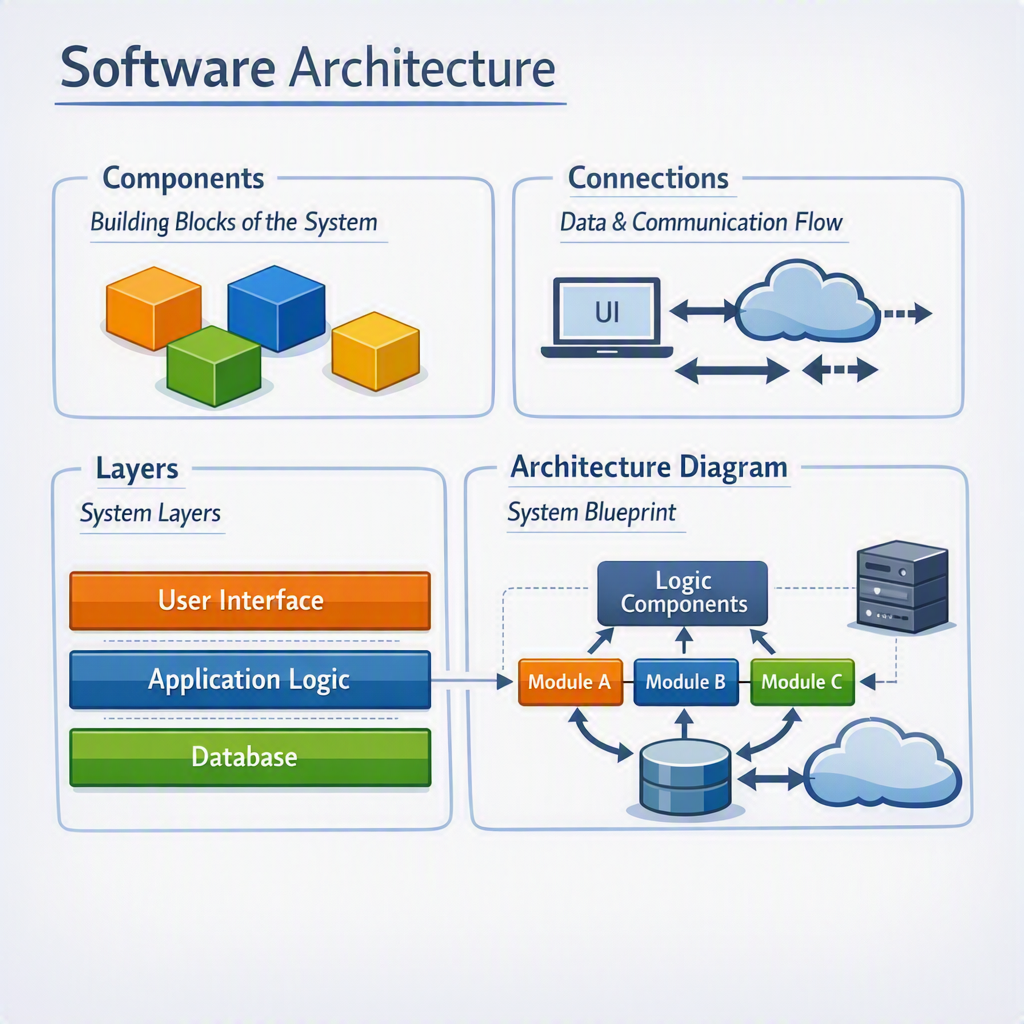
Software architecture guides the practice of software development.
What are top 10 software industry?✨️🙂
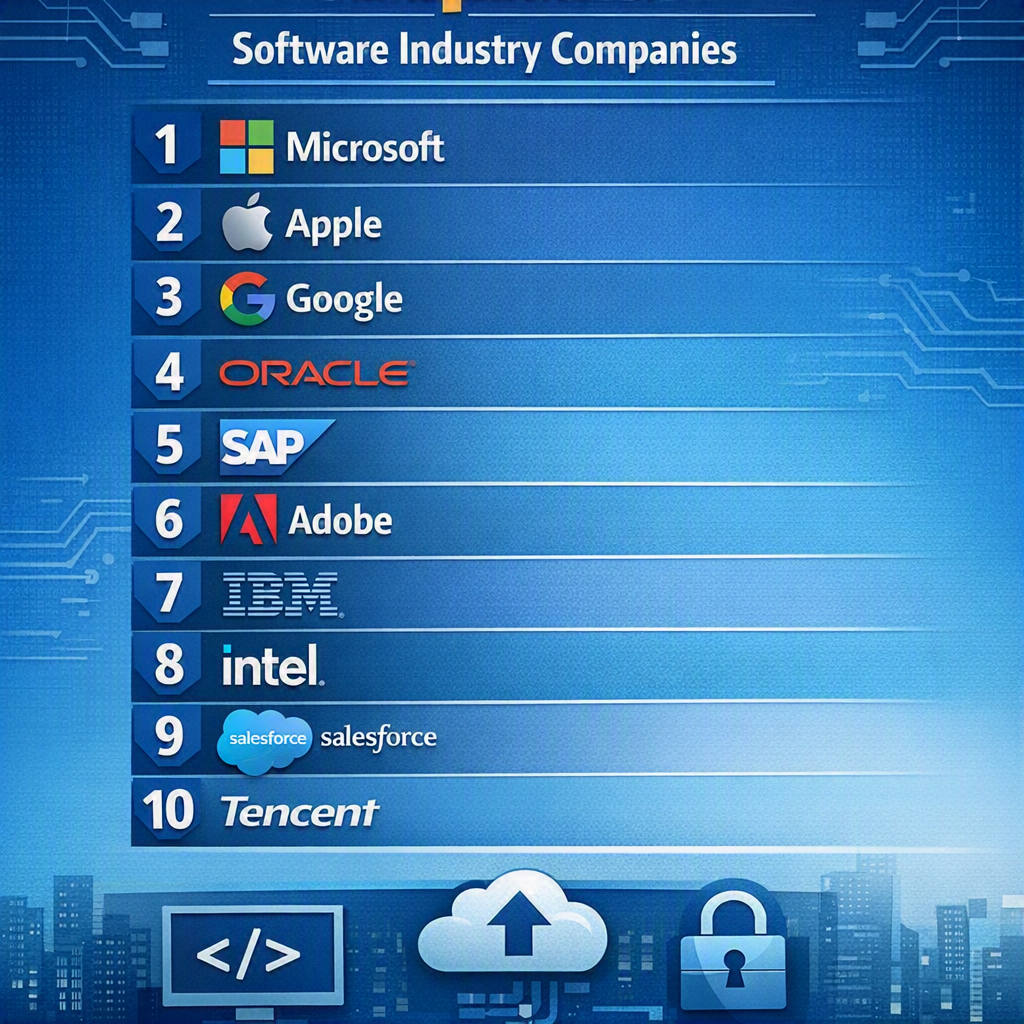
Here’s a high-impact, ready-to-publish blog post that cuts through the noise and gives your readers a clear, actionable framework for understanding the software industry in 2026.
The Software Supremacy Index: Who Really Rules Tech in 2026?Subtitle: Forget the hype. Here’s your no-BS guide to the 10 companies that own the digital world and why it matters to you.
Introduction: The Great Software PivotHere’s a truth most analysts won’t tell you: The “Top 10” software companies don’t exist.Why? Because a trillion-dollar AI chipmaker, a $4,000 smartphone maker, and a CRM for dentists all play completely different games. Ranking them by market cap is like comparing Formula 1 cars to cargo ships—they’re both vehicles, but they serve opposite purposes.In 2026, we’ve entered the Era of Specialization. To understand who truly leads, you must look at two lenses: Financial Firepower (who has the deepest pockets) and Relevance Reloaded (who you actually can’t live without).Here is the definitive, battle-tested list of the 10 software giants that matter right now—and the single question you need to ask about each.
The Financial Titans (The $200B+ Club)These are the fortress companies. They don’t just sell software; they collect digital taxes on the global economy.1. Alphabet (Google) – The Attention Empire· The Vibe: The ultimate data factory.· Why they’re #1: With a market cap flirting with $4.5 trillion, Google isn’t just search anymore. They are the AI arms dealer (DeepMind) and the cloud backup for 60% of startups.· The Question: Can they monetize AI search without destroying their $200B ad cash cow?2. Microsoft – The Enterprise Operating System· The Vibe: The steady workhorse.· Why they’re here: Satya Nadella has turned Microsoft into the “Swiss Army Knife” of business. From GitHub to Teams to Azure, if you work at a Fortune 500 company, you live inside Microsoft’s ecosystem.· The Question: Can Copilot (their AI assistant) justify its $30/month price tag to CFOs?3. Apple – The Ecosystem Guardian· The Vibe: The luxury gatekeeper.· The asterisk: They are hardware-first, but their services division (iCloud, App Store, Apple Pay) is a $100B software business on its own.· The Question: In a world moving to web-based AI, does the “App Store model” become obsolete?4. Oracle – The Silent Consolidator· The Vibe: The dusty giant that learned new tricks.· Why they’re here: Larry Ellison bet the farm on cloud infrastructure and health databases. They are the back-office king for 95% of Fortune 500 companies. They don’t make headlines; they make money.· The Question: Can they catch up to AWS and Azure in the AI chip race?5. Meta – The Social Graph to AI Graph· The Vibe: The underdog with a rocket engine.· Why they’re here: Mark Zuckerberg open-sourced Llama (their AI model) to undercut OpenAI. They are now the “cheap AI” option for developers worldwide.· The Question: Is Threads actually a threat to X, or just a distraction?6. SAP – The German Precision Machine· The Vibe: The supply chain brain.· Why they’re here: If you buy a product, SAP probably tracked its journey from raw material to your doorstep. They are the unsexy backbone of global manufacturing.· The Question: Can they modernize their interface to attract young developers, or will they remain a “legacy” legend?7. IBM – The Old Guard that Refuses to Die· The Vibe: The consultancy with a tech habit.· Why they’re here: IBM is quietly winning the enterprise AI race by selling “trustworthy” AI to banks and governments who are scared of ChatGPT.· The Question: Is Watson (their AI) finally going to deliver on its 2011 hype?—The New School Revolution (The “Irreplaceable” Innovators)These companies are smaller in market cap but bigger in daily relevance.8. Palantir – The Data Warfighter· The Vibe: The CIA’s favorite spreadsheet.· Why they’re here: Valued at nearly $350B, Palantir has successfully pivoted from government spy work to commercial logistics. If you need to connect a million data points to save $10M, you call Palantir.· The Question: Can they stay “ethical” while expanding into healthcare and policing?9. Salesforce – The Customer Obsession Engine· The Vibe: The sales team’s best friend.· Why they’re here: They aren’t the biggest, but they have the highest user satisfaction. In a recession, companies cut marketing; they rarely cut the CRM that tells them who their best customers are.· The Question: With AI agents that can “sell” autonomously, do you even need a human sales rep anymore?10. Shopify – The Merchant’s Operating System· The Vibe: The rebel alliance against Amazon.· Why they’re here: They democratized e-commerce. Nearly 10% of US retail e-commerce flows through Shopify. They are the digital landlord for 2 million independent stores.· The Question: Can they compete with Amazon’s logistics network without going bankrupt?—The “Honorable Mention” You Must Watch· AppLovin: Valued at ~$155B, this mobile ad-tech company is printing money in the gaming sector. If Gen Z is on their phone, AppLovin is in their pocket.· HubSpot & Rippling: Ranked top-5 in user satisfaction, these are the “future giants.” They are eating Salesforce’s lunch in the SMB (Small-to-Medium Business) market.
The Conclusion: The 3 Rules of the “New Top 10″If you take nothing else away, remember this:1. AI is not a feature; it’s the compiler. The old guard (Microsoft, Oracle) are winning because they integrate AI into workflows. The new guard (Palantir, Salesforce) are winning because they integrate AI into decisions.2. Satisfaction beats Size. In 2026, users have leverage. Companies like Canva and Rippling aren’t the biggest, but they have the lowest churn. That is the true metric of power.3.
The “Platform” is dead; the “Ecosystem” is king. No one uses just one software. The top 10 are the ones that connect to everything else seamlessly.
Final Thought: The best software company for your life depends entirely on whether you are building, selling, or manufacturing. But one thing is certain: If you aren’t in the top 10’s crosshairs, you aren’t playing the game.—Want me to deep-dive into the AI startup that’s growing faster than all of these? Drop a comment below!
Hello world!
Welcome to WordPress. This is your first post. Edit or delete it, then start writing!